upvote
Eating Fruit Skins

(pgadey.ca)

> Alex rightly points out that apple seeds do contain cyanide. Turns out, it’s not a huge risk for normal apple consumption.

You don't have to eat them. There's no benefit to eating them. They don't taste good. They provide a negligible amount of nutrition, if any, and harm you very mildly. The stem of an apple is edible, but for what? A gram of extra fiber after you manage to gnaw through it?

You can eat banana peels, but you probably wouldn't want to. It's a terrible texture and flavor. They decompose well, so there's no meaningful environmental benefit. Yes, they have nutrients. You can eat a second piece of fruit instead.

And this is not universally good advice. The seeds, leaves, and stem of the pawpaw is filled with toxins—enough that folks have died from it.

I don't think the author is trying to make a point, but rather to show that we do things because we were told them. But it's important to also realize that the cultural reasons are sometimes backed up with hard-earned lessons or to save us from having to learn for ourselves that watermelon rind isn't pleasant to eat without preparing it in other ways.

reply
Doing things as we were told to is sometimes called "following tradition". Traditional knowledge can be based in superstition or valid information that's out of date, but it can also be based on things that remain relevant.

e.g. Bitter cassava is a staple crop in parts of South America and Africa. Unlike apple seeds, it contains substantial quantities of cyanide. It's a great crop because you can plant it and forget it. No need for fences. Animals won't eat it. A chemist would be hard-pressed to come up with a more effective method for removing cyanide from it than some of the traditional methods of cooking it. However, problems arise when people cook and consume it in non-traditional ways.

Traditional knowledge can be both constraining and protective. It's like a fence whose purpose you don't know. Tearing it down is a gamble. You might win. You might lose. It's probably not a bad idea to try to figure out why a tradition is there before you mess around.

reply
There are a lot of examples of this in the book The Secret of Our Success (which argues that human cultures have a lot of culturally-evolved knowledge which individuals would be very unlikely to develop in a single generation, and which often provides benefits for reasons that aren't consciously understood by the actual members of the culture, while occasionally including some noise or bad advice).

Many of those are traditions or ritual behaviors that decrease the chance of poisoning, sometimes subtle chronic poisoning rather than obvious acute poisoning.

reply
> It's probably not a bad idea to try to figure out why a tradition is there before you mess around.

Interestingly, I think the rest of your comment supports exactly the opposite message. Traditional food preparation is the way it is for excellent reasons, that's true.

And what's also true is that you have absolutely no hope of determining what those reasons are. You can mess around and see if you get problems. But if you don't do that, you'll never have any idea what's behind the traditions. Investigating the question before messing around would be a gigantic waste of time and effort.

reply
As a person who always eats the whole apple, stem and all (have done so for years), I'll object to your "apple seeds do not taste good" statement - tastes differ, to me they are delicious, certainly on par with other "normally edible" seeds like sunflower seeds! Of course I wouldn't eat them in any great quantity because of the poison issue.
reply
Bloody 'eck. This sounds like a chat around the back of the bike sheds off of the '70's onwards.

Yes, apple pips do have a tiny amount of cyanide in them (but why)

This is a from a reasonable source and relates to cherries: https://www.bbc.co.uk/news/uk-england-lancashire-40738573

I think we can assume that apples and cherries are OK to eat. Apple pips are fine and why on earth would you want to crunch through a cherry stone.

reply
>I think we can assume that apples and cherries are OK to eat. Apple pips are fine and why on earth would you want to crunch through a cherry stone.

Black cherries (prunus serotina) I ate a whole bunch of during late summer. Much smaller than the Prunus avium (sweet cherry) which ripens around early June here. Allegedly the fruit does contain the cyanide producing compounds but without the enzymes. The catch is if you chew the pits (or eat the leaves/stems) it is poisonous. Poisons a lot of horses and other livestock: https://horsedvm.com/poisonous/black-cherry-trees

reply
The logical next step is to eat the tree.
reply
reply
"He was awarded a plaque, made of brass, by the publishers to commemorate his abilities. He ate his award".
reply
legend
reply
reply
How many apple seeds do you need to eat to get to that point?
reply
https://www.britannica.com/story/can-apple-seeds-kill-you

As linked in the original article - says 150 seeds to a few thousand depending on the apple variety.

reply
[flagged]
reply
By "they don't taste good" I wasn't trying to imply that they taste bad, though maybe they do to some folks. At least to me they don't taste like anything (they lack a good flavor). For me and probably many folks, the flavor isn't something that attracts me to eating the seeds.
reply
I also eat the whole apple and like to crunch the seeds.
reply
[flagged]
reply
Banana peels are delicious if cooked correctly. You can make a surprisingly tasty "facon" with them.
reply
I'm sure you could prepare almost anything to taste great. You can do whatever you think you'd enjoy. My point isn't to discourage you from doing it. If you want to eat apple stems or orange peels or horse chestnuts, knock yourself out. My point is that it's probably not smart to do so unless you know what you're doing and have a good reason to.
reply
And extremely high in potassium (more than the flesh) https://duckduckgo.com/?q=potassium+banana+peels&ia=web
reply
i wanted to try that, but aren't they like super full of poisons to kill bugs?
reply
Please tell us more! What do you mean by correctly?
reply
I too am intrigued, so I found the following:

https://itdoesnttastelikechicken.com/banana-peel-bacon/

Sounds simple enough - is there anyone who has done this? Bacon is a hard one to replicate!

reply
I haven't made banana peels specifically, but I have made this for some vegan guests before (as part of a larger dish) and while I wouldn't say it's bacon, it hits all the same notes: https://www.seriouseats.com/crispy-smoked-mushroom-bacon-bit...
reply
Maybe it's like bacon in the same way that spaghetti squash is like spaghetti? (Shape only)
reply
You can make curry with them (either just the peels, or whole unripe bananas).
reply
Most of the insecticide sprays are on the skin. You can eat the seeds, maybe don't bite them as they taste nasty. Eating the core is not the most pleasant part, and the top and bottom might be be most difficult to rinse the sprays from.
reply
deleted
reply
I mean even monkeys just dispose of the banana skin
reply
It definitely provokes some thinking of what we even mean with "edible". The author seems to use "you can eat it and it won't kill you or make you sick" as the definition.

That's alright, but then grass and pebbles are also edible.

reply
I mean it reminds me of this article where a university professor asked his students if you can put a toaster in the dishwasher. Everyone replied no, obviously not. But as the professor replied - why not? Your average toaster works perfectly fine after going through a dishwasher, once properly dried. The answers ranged from "you're not supposed to" to "it's electric"(sic).

Just because we think you shouldn't do something doesn't mean you really can't is the takeaway I guess. We don't normally eat apple cores but you could and you'd be perfectly fine.

reply
> once properly dried

That “properly” is doing most of the heavy lifting there. The reason i would be weary of running the dishwasher with a toaster inside because i would worry that liquids trapped around thin electric conductors will corrode them. In othet words toasters were not designed to be easy to “properly” dry them out. And that damage might not be appearant right away or after a single wash.

In fact i wouldn’t trust the professor’s claim that the “toaster is perfectly fine” unless the professor conducted a lot of experiments. And even then i would only trust it with the toaster models he tested the claim with.

reply
There even was a HN thread about this anecdote. I remember though that someone there made the counter argument that, yes, the toaster will be fine, but the dishwasher will be full of icky chemicals that you don't want to have on your dishes...
reply
If you eat the apple diagonally down instead of around, the cores are totally edible. Less waste!
reply
[dead]
reply
Yeah, erm.

You should only ever eat fruit skins if the fruit is organic and the skin is clean.

At this point I think its safe to say there are hundreds of scientific studies out there telling you why. This is one example[1].

I quote from their abstract:

    Notably, the distribution of pesticides in the apple peel and pulp layers is visualized through Raman imaging, confirming that the pesticides penetrate the peel layer into the pulp layer (∼30 μm depth). Thus, the risk of pesticide ingestion from fruits cannot be avoided by simple washing other than peeling.

[1] https://doi.org/10.1021/acs.nanolett.4c01513
reply
The two fungicides they tested aren’t in common use in US orchards. One is no longer approved at all. Anyway, it would be interesting to test the currently actually used fungicides.
reply
I ate Kiwis for years before someone told me most people DO NOT eat the skins. I looked at my bag of kiwis, and the even the damn monkey mascot was holding a spoon...mocking me...
reply
Also eating skins turns kiwis from a fruit you have to spend time to preprocess (halve + grab spoon) to an immediate snack.

This may sound insignificant to many but for the extremely lazy like me, this is the difference between going to waste and being consumed for many fruits.

reply
You can just break them into two roughly equal halves and use your teeth to scoop out the flesh. No need for either a knife, a spoon or any kind of preprocessing. I've been eating them that way for decades.
reply
> Also eating skins turns kiwis from a fruit you have to spend time to preprocess (halve + grab spoon) to an immediate snack.

Both of your comments sound foreign to me. In my experience, kiwis are eaten with the fingers, including the skin, but they are prepared by slicing. The form you eat is a collection of circular discs, cross sections of the original fruit.

https://www.foodrepublic.com/img/gallery/kiwi-skin-is-edible...
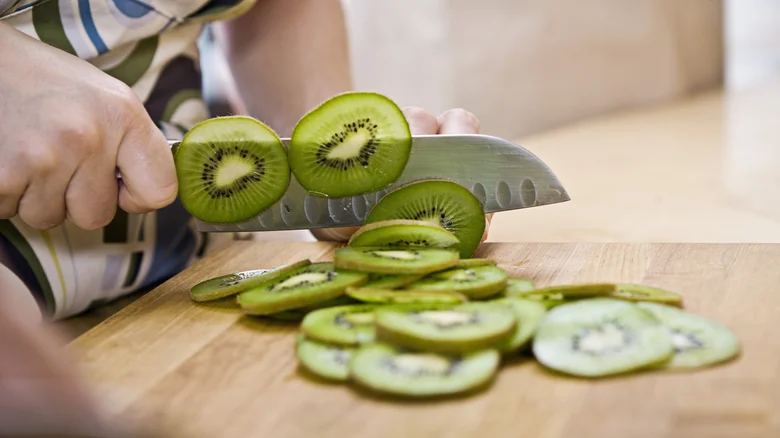
So a spoon would make no sense - it wouldn't help you even if you were inclined to use one - but there's plenty of processing time involved.

reply
I cut into fourths lengthwise and eat like orange slices. Big time saver.
reply
Half + spoon? What is this sacrilege? Peel with knife like a potato and then eat the whole thing.
reply
Why would you peel potatos? The skin is the best part!
reply
Because you're making mash, and mash with skin inside it is....not quite the same thing.
reply
When I wash kiwis I rub the hairs off, and then cut them into thick slices, leaving the skin on. Trying to skin or eat them with a spoon is just a pain, and I don’t find the skin unpleasant.

I’ve seen a lot of people also just wash/rub the hairs off and bite straight into them, though I find this can make a mess if they are too soft.

Hardy kiwis are also eaten whole, like a berry.

reply
yeah, I do this too. minimize the fuzz and the skin itself improves the overall flavor in my opinion.
reply
Kiwi fuzz irritates my throat, so I rub a lot of the fuz off, and then use a straight bladed knife to "shave" the rest off. The skin gives a tart contrast to the fruit center. I'm sure there's lots of valuable nutrients in the skin too
reply
Try a different variety. Some don't even really have hair.
reply
Don’t worry, my kids eat the skin too. I guess we forgot to tell them not to and they didn’t find it unpleasant. I tried a bite for my own edification and I did not find it pleasant.

That said, I usually eat peanuts with the shell and all. Though don’t eat too many that way, the shells are definitely not getting digested, so chew well. Also there is probably a higher chance of dirt or other stuff you don’t want to eat being on the shell, but I don’t usually eat peanuts anyway so never been a problem for me.

reply
Same for me, in about 1 in 10 or so, I’ll pop the shell and all in.
reply
It depends on the variety, some kiwi skins are tick and hairy, while others exteriors are thin and smooth.
reply
I enjoy the tickly sensation of a fuzzy kiwi but immensely dislike the crunch of croutons. People are weird.
reply
As Alex noted, apple seeds contain cyanide, or to be more accurate, cyanogenic glycosides. When the tissue of most apple seeds is damaged, an enzyme cleaves the sugar-cyanide bond, releasing hydrogen cyanide gas. You can test this yourself, by crushing some apple seeds and smelling the mashed seeds. It will smell of almonds, which is the smell of hydrogen cyanide gas.

I created a lab for intro biology around testing for HCN in various plant tissues. The interesting thing is not all apple seeds actually seem to produce HCN. Granny Smith seeds seem to always produce it (and relatively speaking a lot), while some little lunch box sized Fuji apples I bought at a farmers market don't produce any at all.

reply
Grapes are commonly peeled in Japan, and people will look at you strangely if you eat them skin on. However, Japanese grapes are huge and have a thick, astringent skin that peels off easily.

Likewise, when Japanese people go overseas and start peeling grapes, people look at them strangely. Eventually they figure out that Western grapes are small, hard to peel and the skins are thin and nearly tasteless, so they adopt our barbarian habits too.

Updated to add: Japanese grapes like Kyoho are actually hybrid cultivars of Western grapes (Vitis vinifera) and Concord grapes (Vitis labrusca), which is why they're so different.

reply
Similar hybrids are becoming more popular in the states, for example the "Thomcord" or "Cotton Candy". They're absolutely delicious and have either small seeds or none at all. Recommend to try for anyone who hasn't yet!
reply
I've had this conversation and the way I explained it is that our grapes are closer to the boba in bubble tea. It's not quite right (they don't pop quite as much) and boba isn't Japanese, but it gets the point across.
reply
Whose grapes are you likening to boba? I’m struggling with the comparison - even a loose one.

Is there a grape variety I’m entirely ignorant of?

reply
Like my parent said, the grapes in East Asia are thick-skinned, and people either peel them or suck out their flesh. The ones sold in Europe are very thin-skinned, and peeling is largely impractical. I'm relating the latter to boba.
reply
I split my time between Europe and China so I'm aware of the differences in that regard. My question was specifically regarding the comparison between European grapes and boba because I was struggling to identify any shared attributes from the varieties I have experienced. Is there a variety of grape which is more chewy in texture, perhaps?

I'm unclear why such a simple question appeared to offend at least one person.

reply
That comment makes more sense if you read it as referring to popping boba [0] rather than the "normal" chewy tapioca boba. Grapes don't pop but the feel of the skin is similar enough.

[0] https://en.wikipedia.org/wiki/Popping_boba

reply
big purple concord grapes grow wild in the US and are thick skinned and you squeeze or suck out the grape inside, skin significantly more tart than the sweet grape, pretty sure those are the tannins that you get in wine from skin contact even those those are different grape varieties.

I've visited a number of European winegrower family farms and they frequently also grow table grapes for their own consumption. The table grapes they eat are much much less sweet than vinifera grapes where the yeast consume all the sugar into alcohol and which are basically too sweet to enjoy.

reply
That's crazy, theres tons of taste in grape skin
reply
Cf. red wine
reply
I'm 45 and only recently realised the grapes in the UK are "seedless". Grapes with seeds was not a pleasant experience when I accidentally ate one whilst in Croatia.
reply
I much prefer grapes with seeds. They are much tastier and have a nicer texture in my opinion. The difference is enough that I almost consider the seedless variety to be a separate fruit altogether.
reply
that's genetic modification for you. nature doesn't make seedless fruits
reply
If by "genetic modification" you mean "random genetic mutation" formally known as stenospermocarpy.

Seedless grapes existed in the Mediterranean centuries ago. The now-popular Thompson seedless was brought from the Ottoman empire in 1872.

Similar story with bananas and the parthenocarpy mutation. Then you layer selective breeding on top of that to create complete sterility due to triploidy.

Others like the babaco papaya are just simple sterile interspecific hybrids.

So nature actually does make seedless fruit by accident quite often. It's just that you need humans to come along and clonally propagate them.

reply
deleted
reply
My dad would peel the skin of every fruit, including grapes, which is how I learned to do it.
reply
Skin on fruit is full of fiber, along with potatoes, etc. I only ever take the skin off things if it really bothers me.
reply
Are you/your dad Japanese? I feel like we're missing most of the context here.
reply
My mum peels button mushrooms, never realized it was weird and no one does this until I was an adult.
reply
Fun fact: a lot of people think artificial grape flavoring doesn't taste like grapes. And that the "Welch's concord grape jam" variety of jams is artificially flavored.

Nope, that's just what some grapes taste like. There's a Korean variety, and Concord at least. Wiki says it's this: https://en.wikipedia.org/wiki/Vitis_labrusca

reply
The grapes that grow in my back yard are Concords, and that shouldn't be surprising because Concord is a couple of towns over.

They taste just like Welch's.

reply
Yeah, Concord grapes are based on Fox grapes; when the new Welch's headquarters opened on Baker Ave they included a plantation started from cuttings from the original farm (which is just a house now but they still maintain their own grapes.) Welch's downsized and moved the HQ to Waltham last year, apparently the vines got distributed to local historic places and farmers https://concordbridge.org/index.php/2026/04/06/the-grape-esc...
reply
I live near a Korean pan-Asian convenience store, and I've been enjoy the variety of beverages and ramen available there. Oceania today exports foods with significant influence by Italian cuisine, in particular.

There are some fruit drinks which contain whole fruit, like green grapes. It's sort of on the spectrum if you imagine canned grapes, which come in a "light syrup" but the beverage is a thinned-out version of that, not tart or sugary like American grape juice.

But you pour the can out, and a couple of fresh grapes come out as well. I suppose they are peeled. I was a little disappointed when the pear juice didn't include sliced pears. But there are many more fruits to try!

reply
Yes I love those grape drinks! Very similar to thinned out canned fruit cocktail syrup/fruits.
reply
In broad strokes, the skins of things are high in nutrients, medicines, fiber, and toxins - natural, agricultral, and environmental. The degree to which each of these things is true depends very much on what specifically you are trying to eat, where it comes from, and sometimes its condition.

It is easy to forget, but plants aren't inherently safe. Produce has been made so by breeding, historical wisdom, and by laws and customs and systems. While some of these things are overcautious or corrupt, others may be keeping you safe without you realizing it. Eating things you aren't expected to eat is playing with the safeties off, to some degree.

I wouldn't think you'd get into too much trouble eating the skins of things you'd find in the grocery store, but green potatoes would certainly be an exception. I'd mostly want to wash a akin I intended to eat very well, as I'd mostly worry what might have been sprayed on that part on the assumption I wouldn't eat it.

The further you get away from expectation - stems, seeds, leaves - the further you are from built in safety measures and the closer you are to eating a random plant. Even knowing that people consider something medicine is not a free pass. Medicines come with dosages and side effects. Drugs powerful enough to help you are usually also poweful enough to hurt you, and this is often similarly true with plants.

All of that is not exactly to dissuade you from trying things, and toxic bits of things are usually obvious and not too dangerous in small quantities. Still, it's worth starting small and doing the odd search first. You never know when a particular breed of apple, grown under particular conditions, will have unusually potent seeds, and you want to have some understanding of how quickly certain toxins accumulate and clear. We do have a lot of accumulated knowledge on food safety, and it is worth consulting if you are going to step off the usual path.

On the other hand, lots of things known to be beneficial and safe are considered unpalatable due to being rough and unsweet, but you can certainly develop a taste for them. Wheat bran and potato skins are among my favorites.

reply
Yeah when I'll make mashed potatoes, I mix pieces of peeled russets (which have a smoother texture) and red potatoes with the skin on. I like the taste of red potatoes and it gives the purée a rustic texture. When I peel russets, I usually fry the skins.

On the not safe front, I recently learned that volunteer squash can be very bad for you - I guess the poisonous varieties are genetically close to the edible ones.

Oh and my grandfather foraged and ate Gyromitra esculenta mushrooms. (I've eaten them as a child, I would not eat them now.) They are very bad news. The way he processed them made them safe. But he said he soaked them in salted water to "get the bugs out" - he did not know they were toxic.

reply
When I realized you can just eat kiwi with the skin on (if it's a very hairy one, brush them off under running water) and in no time it actually tastes better (adds some lovely contrast), it became my favorite zero-ennui fruit. It almost feels like a cheat code for something so tasty and large to require so little effort!

Now, I never thought that kiwi skins are not edible of course, but I just assumed they're somehow unpleasant because everyone seems to peel or spoon them.

reply
Haha literally ate kiwi with skin on for the first time today. It’s a lot nicer, you just rinse it and eat it!
reply
You can shave the hairy ones.
reply
My favorite thing is leaving the skin and slicing them. Each slice has the perfect amount of skin and pulp, it’s crunchy, it’s heaven!
reply
I have never had a problem with kiwi skins (except when the kiwi is unripe; a natural mat with acids and possibly oxalate. NOPE).

But are you claiming you eat the whole fruit, or you throw out the tiny thorn?

reply
I usually throw out the tiny thorn.
reply
I like that you can take a bite directly through a kiwi
reply
Big grape.
reply
A gooseberry, in fact.
reply
[dead]
reply
If you eat enough kiwis with skin, tarantula abdomens start to look like something tasty.

I read that online, I trained myself to eat whole Kiwis and lo and behold: It is true!

Our brains are so wonderfully strange!

reply
reply
That was interesting other than the golden orb weaver, all the other spider species noted as edible are tarantula.

I assume because of their size relative to other species?

reply
People in the Amazon do eat tarantulas. They do roast them over an open flame first though to burn off the hairs as they can be harmful and irritating.
reply
I think this is a new pattern (which I have also seen in some other submissions), maybe a sort of "extended Chesterton's Fence", where a person dutifully maintains a fence without ever asking why it's there, then at some point realizes they have no idea if that fence is even needed - and then promptly rip it out, in the belief that it must have been unnecessary the whole time, while still not asking anyone if that's actually the case.
reply
If you're going to eat an apple this way, some notes:

- Start from the blossom end (the bottom). This makes the core more palatable for multiple reasons.

- The blossom remains themselves may have mold in very rare cases. Take a look before you start eating.

- Some apples have much, much harder core walls and are not really edible this way. Others are quite soft. So it will depend on variety.

- Don't bother eating the stems and seeds. It's pointless.

I really only do this when I don't have a place to put the apple core, e.g. on a road trip if I don't have a trash/compost bag. (Can't throw it out the window because it will attract wildlife to the roadside.)

reply
I eat the whole orange, grapefruit, lemon or lime.

I like the bitter to offset the sweetness.

reply
Umless specifically indicated as untreated, citrus peel in soaked in very nasty antifungal waxes. In the EU they are specifucally warned about not fit for consumption.
reply
My condolences to your tooth enamel.
reply
At least now I know psychopaths walk among us.
reply
Citrus peels taste good. They're used for cooking in every culture that grows citrus. Eating them raw is only bad due to farmers poisoning the food they sell.
reply
I was joking, but there is a huge difference between using citrus zest/rind in cooking or as a garnish and eating the whole thing like an apple, including the pith.
reply
I had a college who would meticulously cut that black thing at the bottom of the apple and also quite a bit of actual apple flesh, like 1cm or even more around it. When I asked him why he cut so much, he said that the black thing is remnant of apple flower and when apple tree is in the bloom it is the most sensitive so they apply most pesticides then and the concentration is highest around that black part. By cutting it away with little bit of flesh he removes most of the pesticides that are in the apple. It didn't help, few years later he died of cancer.
reply
Lots of fruit skins are very edible (kiwis etc.), but they are covered with pesticides. All conventional fruits are.

If you look at the "Dirty Dozen" vs. "Clean Fifteen" lists of fruits/veggies that come out every year, you'll notice that the cleanest fruits are almost always ones that grow with a thick skin or covering, or are covered by soil: banana, pineapple, avocado, corn, (shelled) peas, watermelon, carrot, potato, etc.

And the dirtiest ones have a thin or no skin: greens, stone fruit, blackberries, strawberries, apples, pears etc.

The clean fruits aren't really any cleaner, the study just tests the "edible" part minus the outer skin. If you eat the skin of conventional Clean Fifteen, you might as well be eating a Dirty Dozen.

reply
Looking at the pesticide scores, one should not eat any fruit/vegetable without peeling if it has any.
reply
Surprised this comment is so low, was searching for it. Many fruits that you commonly peel can even contain both waxes and pesticides to keep insects out. You aren’t even able to wash it effectively.

Things like cantaloupes, oranges, etc are famous for harboring bad bacteria and pesticides. Does not seem worth the risk to me…

I used to watch people collect dandelions and weeds in NYC parks to make into tea and consume in other ways. I’m sure there are some benefits but I’m also sure they don’t outweigh the risks from pollutants.

reply
That is why you wash your food before eating it same as you do with legumes and rice (that likely also have had pesticide on them).
reply
But peanuts and white rice, the most common ones have already been 'peeled'
reply
You need to rinse rice though, a lot of people don't realize that.
reply
In South Korea (where I used to live for a while) it's quite common to wash fruit with soapy water at home before eating them.
reply
Unfortunately a lot leaks in. Grapeskins are particularly porous for instance. So are most of the dirty dozen iirc.

Skins are healthy, but only if organic and/or clean fifteen.

reply
People throw away so much strawberry in an effort to cut the leaves off. Just eat the leaves. Next time you go to eat a strawberry, try eating the leaves too - they're very mild in flavor, and you waste no strawberry!
reply
You pince of the leaves. Where do you imagine the waste?
reply
Or you use a strawberry huller. These used to be common kitchen implements, but I've not seen one in a while.
reply
With people making an effort to cut them off instead, presumably.
reply
In at least some varieties of strawberries, the top of the berry has the least flavor and sweetness, and the bottom has the most, so I don't feel like I'm losing much.
reply
Most mass-produced strawberries people eat today are basically white on the inside and relatively flavorless to the real thing anyway, I don't think most people miss out if they eat or not the top of the berry.
reply
Only in America.
reply
Not only in America
reply
Yes, that’s where the pesticide are. Can’t get enough pesticides.
reply
Yeah you’re going to want to start by washing your produce
reply
I started chewing the leaves. There's a hint of strawberry in them.
reply
I just hold it by the leaves in my fingers and take a huge bite of the entire berry with my teeth ending right before the leaves.
reply
I just rip the leaves off, which is very easy with the variety we eat here. I never would have thought to cut them off. Are your two strawberries different?
reply
Same, sometimes this lead to me eating a bit of the leaves, sometimes I leave a bit of strawberry, but no one died yet, so I continue :)
reply
deleted
reply
White part under them tastes like nothing
reply
Yeah I don’t buy strawberries if they have a white top
reply
Not far from where I live, there are plenty of strawberry fields where I go outside to run. Over the years I found that every year, they'd throw huge amount of perfectly edible fruit in big piles at the edges of the field. Last spring I started collecting them in 5 gallon pails. The plan was to use them for Jam. Being quite lazy, I figured it'd be too much of an effort for me to cut the leaves. I wasn't sure what to expect but I love the result, the leaves added some really nice texture and offered no offending flavor that I could detect.
reply
I would find out the reason they throw the fruit away before eating them.
reply
Eating an apple the right way: https://www.youtube.com/shorts/42b8Zah8-jM
reply
I do like to save watermelon rinds and cook them into soup.

Anyone have a use for banana peels?

reply
I like turning the rind into pickles. Very good!

For banana skins, you can turn them into a vegan bacon. Many recipes online that are all pretty much the same result. I like them too.

reply
I tried following an authentic Southern pickled watermelon rind recipe, and they were so sickly sweet I couldn't stomach them.

I should try again sometime with a regular cucumber pickle recipe, just replacing cucumbers with watermelon rinds, but I don't think my family wants to humor me again.

reply
Pickled savoury watermelon is something i discovered not that long ago and it really surprised me. It's amazing. I otherwise don't care much about watermelon but pickled it gets so much flavor. I know many people who can't handle it because it "doesn't taste how it looks".
reply
Yes, British TV chef Nigella Lawson cooks with them. https://youtu.be/kOF0Id92XRY?is=YOb6iPmPaMBeHLkJ
reply
Thanks for sending me down that rabbit hole. Neat.

We throw away a butt-ton of watermelon rind in the summer. I never thought to see if they could be used for something.

reply
Now that is actually novel! To me, at least. You cook them into a regular soup as an additive? Or you make watermelon rind soup? How’s it taste?
reply
It's a variant of a Chinese wintermelon soup like https://thewoksoflife.com/winter-melon-soup-pork-ribs/ ! It's a great sponge for the soup flavors.
reply
Banana peel oleo saccharum... you can add it to drinks and cocktails for a punch of banana.
reply
Throw them in with the banana in the blender
reply
This reminds me of the Craig Brown parody of Tony Benn's diary: "eat a banana, first being careful to discard the fleshy part inside".
reply
I always eat the whole thing, especially an apple, skin seeds and all. It’s natural to me. Also kiwi with it’s skin. I only peel mango, it’s skin is not tasty…
reply
I can't name them, but some mango cultivars have very palatable skin. Even on ones where the skin is a bit bitter, it gets much better when the fruit is ripe.
reply
deleted
reply
Cherimoya skins regularly consumed cause Parkinson’s like symptoms.

Some fruit skins are okay, others are not.

And some are only okay if home grown or organic bc the skin is otherwise loaded with pesticide residues

reply
https://www.britannica.com/story/can-apple-seeds-kill-you

Also, don’t feed them to dogs especially small dogs.

Highly unlikely to be a problem but people die from water poisoning so…

reply
I eat whole cherries, I am too lazy to spit out the pits do I swallow them whole. So far it has not been any issue at all and I eat a lot of cherries.
reply
I almost always eat citrus skins after eat the citrus. With Pomelos its like second breakfast.
reply
I am reminded of the saying in my family: Anything is edible if you're willing to eat it.

My late father-in-law ate entire apples-- core and all. I've tried but I can't stomach the texture or how much more the fibrous parts of the core get stuck in my teeth. It doesn't disgust me, I just don't prefer it.

Not to miss an opportunity to talk about apples:

I started eating three apples / day for lunch last year. I hadn't realized how dirty apples are. I assumed the washing they get in processing gets them pretty clean. It does not. I wet them and clean the stem and flower areas with a paper towel. I'm shocked at how dirty the towel ends up.

I'm a sweet apple kind of guy. Envy apples are the bomb. I used to like Honeycrisp but the rumors of their being bred into shitty tastelessness are true. They're terrible. Shockingly, sometimes Red Delicious, which I'd previously relegated to the "buy as a last resort" list, are actually pretty good now. Fuji, Gala, and Cosmic Crisp are all decent specimens.

My wife likes Pink Lady but I think they're just a little too tart. She can also put away the Granny Smiths which I find to be horrifyingly sour. Ick!

Anybody have feelings about other apple varieties a person like me might be into?

reply
You might enjoy the reviews at https://adamapples.blogspot.com/
reply
I don’t know much about apple variety names, but if you love apples and plan to visit Aomori prefecture in Japan during apple season, I highly recommend stopping by a market or grocery. I used to live in northern Akita and there was a farmer from Aomori that would come by with freshly picked apples to sell at one of the supermarkets. They had many varieties and they all tasted amazingly sweet and unique. I have yet to find an apple anywhere close to those since moving back to the states. The most recent new variety that I tried that I liked was Kiku. It’s like a sweeter version of a Fuji apple with a very similar texture. Based on your preferences, I think this would a fun one to try.
reply
All mushrooms are edible, but some mushrooms are edible only once.
reply
Point taken.

I don't eat mushrooms-- can't stand the texture. I heard a podcast episode re: death cap mushrooms and it was chilling. A guy in the podcast talked about tasting a death cap then spitting it out and rinsing his mouth. He said they had a good taste.

Absolutely horrifying.

reply
This is what everyone poisoned with them say. And really often why they don't make the link between those and their illness.
reply
There are old mushroom hunters

and there are bold mushroom hunters

but there are no old bold mushroom hunters.

reply
All mushrooms are edible only once, unless you're into coprophagia
reply
Soluna is like eating crispy wine and is currently at the top of my list. Prior to finding that, Lady Alice improves on Pink Lady, and it was my rockstar favorite. Envy is my go-to year-round when I can’t find rarer varietals; I’ve eaten hundreds of them. Cosmic Crisp is a fine last resort when Honeycrisp is too bright. Consider also trying Rubinette, Arkansas Black, Zestar. My notes say Wild Twist is a former Lady Alice but I definitely rank it just below L.A.

On the flipside: Kanzi “disappointment with every bite”, Ambrosia “pie apple because the raw texture sucks”, Autumn Glory DNF, Kissabel “lost its joy and turned grassy, DNF” Sugarbee “kinda one note, chewy, technically better than Red Delicious” Sweetango “knockoff Honeycrisp”, Evercrisp “painfully crisp, annoying to eat, fades to zero, looks like it was factory-polished, DNF”, Dazzle “all the flavourlessness of a Red Delicious with a nice crisp”, Ginger Gold “ten seconds of wonder and then mushes into disgusting texture and flavorlessness”

reply
Thanks for the commentary. I'll check out some of those.
reply
> ate entire apples-- core and all

If you eat it from the North Pole to the South Pole, there is no core.

The core is only there if you eat around the equator.

Give it a try.

reply
The core basically disappears if you cut an apple in disks (or each from the bottom).
reply
I still cut out the core when I slice an apple. I don't know the anatomical terminology well, but the "plastic-ey" texture of, I believe, the endocarp is what I don't like. It reminds me a bit of the plastic-ey tooth-clogging bits of popcorn.
reply
Aren't the seeds of the apple supposed to contain cyanide? Article points this out too and risk doesn't seem worth it. I used to eat the whole apple long time ago until someone pointed that out and from my googling, it was correct. Now I try to eat all of the apple except the seeds and stem.

I like putting my apples in the fridge. Love me a cold and crisp gala apple. On very rare occasion, the gala I get are mushy. But otherwise, they are my favorite.

reply
You would need to eat the seeds of SEVERAL HUNDRED apples in one sitting, and you would need to grind them up finely beforehand to get full amygdalin absorption.

We're talking about almost a cup, or 100+ grams of apple seed here.

Your body continually neutralizes cyanide with the enzyme rhodanese, so there's also no danger of cyanide accumulation from eating a few apples a day.

reply
I don't know if my father-in-law spit out the seeds or not. I'd heard the cyanide thing as a kid and always avoided eating them.
reply
I've eaten the peel on a pineapple before. Not so bad actually.

I thought eating the skins on kiwis was normal

reply
Gotta love my durian skins. If not I'll settle for rambutans.
reply
Wait until you hear about eating the skin of a kiwi, like an apple.
reply
apple skins are so good and necessary actually and i think they add most of the taste
reply
Golden kiwis + skin = my favorite fruit-experience OAT
reply
Well certainly not for every fruit... especially after you learn that durian is an edible fruit
reply
I eat the apple skin (of most apples) but I do not eat the core.
reply
I mean, deer (and cows and goats and sheep, but not horses) are ruminants. They can eat all sorts of things humans can’t digest: grass, tree leaves, most weeds, etc).

The evolution of the rumen was one of nature’s best tricks.

reply
Grass fiber isn’t digestible by humans, but the rest is. Juice, roots, flowers, seeds
reply
You can eat whole boiled eggs too. Shell and all.
reply
deleted
reply
On a related note, a friend of mine removed both the skin and even the center core (the seeds part) of cucumbers. I think all that's left is about 30% of the cucumber.

I found that truly bizarre. Her reasoning was that it was too watery (???)

reply
To be fair there are some sorts where the seeds can be overwhelming, but that's not what you usually get in the supermarket. In cucumbers you can normally buy removing the seeds/ watery core in my opinion only makes sense when you for example make Tzatziki, as otherwise it can get rather watery.
reply
It's very common to use a peeler to peel the skin, then keep peeling until you get to the seeds and just use those peeled strips.
reply
deleted
reply
Mango skin, leaves, and sap contain compounds related to urushiol, the allergen in poison ivy.
reply
One time I decided to slice up a mango like a melon and just eat the flesh off the skin. A bit later I realized I had an awful itchy rash all around my mouth. That's when I learned about urushiol in mango skin! Would not recommend
reply
A guy I was hanging around with in India (Himalayas) asked me why I was peeling the mango. He said you should eat it with the skin. So I continued doing that. One day, at the top of one mountain, I sat down to eat my mango. This Indian guy with his girlfriend walked by and asked why the hell I was eating the mango with the skin on.
reply
Huh, that's neat, so get used to eating mango skin, and eventually you can eat poison ivy? Kind of handy, thanks!
reply
I started eating mango skin a few months ago. When it's thin and bland, it's not bad. Gives a nice crunch to the eating experience. But often it's way too thick and sometimes strongly bitter.
reply
This is quite funny timing as just a few days ago my partner, who eats kiwis almost every day, tried eating the whole kiwi. She used to scoop it out but now says she'll never go back. It's also way more convenient as there are no tools required.
reply
Well, they're all editable, only question is if you like it and if the fruit skinn itself is good. I eat most kiwis with the skin on because it's a nice tart/acidic contrast to soft sweet insides, but some kiwis have extremely thick and acidic. Most pear cores are soft and sweet, but very few apple cores, nor worth it.
reply
Stupid zoomers
reply
good post. much appreciated
reply
[dead]
reply
[dead]
reply