
God I miss being able to walk into a store to find a quality item that I need. Nowadays it's really only Microcenter where you can decide "I need this thing" and come home with that thing.
At some point, we lost the plot on online shopping. Sometimes physically going to the store to hold an item in your hand and bring it home within the hour is far more convenient than comparing 4-8 items online and waiting several days for it to arrive.
We really lost a lot when almost all shopping went online.
Did we, though? I think much of this boils down to personal preference. I grew up pre-www, so I remember having to go to a store for everything. I remember when it could be a 45 minutes drive depending on the kind of product, not knowing if they'd have what I wanted, not knowing where in the store it was. Sure, we had mail order catalogues, but that was a strictly inferior experience to online.
I've never enjoyed shopping, and have always looked at it as one of the most annoying chores of life. Now I can open up my laptop while sitting on my couch and have an almost limitless variety of products at my fingertips. Sure, it's not perfect. I can't see it before I buy it, and I can't get it right now. But to me, those are minuscule trade offs for what we've gained; I am more than happy to wait a day or two (or even a week) for most purchases if it means I don't have to go into a physical store.
Amazon sucks these days, sure, definitely. It's a flood of ads, promoted crap, and cheap, unaccountable, Chinese brands with alphabet-soup company names. But overall, the idea of ecommerce has been an amazing success, in my eyes.
I loved being able to shop and explore things in person, its a MUCH better experience than whatever the hell Amazon tries to pass off as "shopping". There used to be Fry's electronics where I lived which was amazing, you could always see the latest and greatest, aisles full of hobbies, etc. When they died, it felt like the death of retail.
Once the national chain big box stores started, Circuit City, Best Buy, etc, it became less and less of a "deal" and more of a ripoff compared to online. At Fry's I could get stuff priced pretty close to Newegg for bigger items like CPUs and motherboards. But if you went into Best Buy they want to charge you $60 for a 10ft HDMI cable, or $50 for a 25ft Cat5e cable. It was the massive 5x markup on those items, the ones that would regularly draw me into a store, that killed retail shopping for me in favor of online. If I'm not going in when I need a cable, I'm not going in when I need an appliance - they trained everyone to price compare with online stores by ripping everyone off. This worked for a single generation that had no experience with technology or knowledge of what a fair price is, but it killed every savvy generation after that.
Without ecommerce I'll be running a shitty Asus or whatever consumer laptop they sell in stores.
I'll still have to buy a new headset every six months because they only sell garbage products.
I'll still have to buy a new blender every year because they only sell the low-power ones.
I live in a big city so there is some niche stores were I can go and get actual quality products, but the big stores are all selling the same trash they were selling when I was a kid, and I don't see the point of going there when I can buy quality products on niche websites.
Also how would you even get a catalog for B&H? I'd never even heard of that place until the 2010s. Certainly no one in Texas in the mail order catalog days knew about a kosher (closed on the sabbath!) camera store located in the big apple
Back in the day, you'd buy a computer magazine and find reviews for the computers, and there'd be ads for the computers with a phone number and address. You could request a full catalogue, and get the niche thing ordered.
I think the main reason their ecommerce attempts didn't succeed is they didn't appreciate how important fast shipping was. They treated their website as another front end for mail-order with 4-6 weeks delivery, until it was too late.
https://www.cnbc.com/amp/2019/04/18/sears-sues-eddie-lampert...
Even though it's all just blatant consumerism, I genuinely think kids today lost something cool when they could no longer convince their parents to take them to the mega toy store, filled floor to ceiling with cool stuff.
Even though it was corporate magic, it was still magical to have a place like that. Now it's just all ipads.
These were items that would undoubtedly be behind the locked counters at Walmart, where it would take some time to get a worker to retrieve the items. But at least they would be directly from Walmart's supply chain, with no chance of getting fakes co-mingled in Amazon's warehouse.
Amazon is nowhere as good or special as they used to be.
There will probably come a day where the walmart online shopping is just a blue and yellow version of amazon with few benefits.
If you want same-day delivery you are limited to what is in stock at the nearest local store. And even then, sometimes they will only offer in-store pickup, it may depend on how backed up their delivery is (they use gig workers, at least where I am).
Set your search filters to "sold by walmart" to eliminate the third party stuff.
I feel like all of these threads just get derailed by people not really staying focused on the value proposition offered by each store [0].
When I'm thinking about Walmart, I'm thinking about items that Walmart themselves are selling/fulfilling. I have never found a third party listing on Walmart.com to be compelling. In my estimation they must exist because listing is essentially free for Walmart and the seller [1], people get confused (especially browsing on a tiny screen on mobile), have no idea where they should actually buy a certain type of item, have no idea what things should cost, etc. [2]
So having said that, to me Walmart is actually an outlier in being different among [online] shopping. Most of the type of sundries you'd actually buy at Walmart get delivered quickly from the store (gig work courier?). Or if they won't do that for a certain item, or you don't feel like meeting the "shipping minimum", then you can do a store pickup.
Contrast with say Target where everything gets shipped Fedex (or Ontrac now I think), and basically takes at least two days if not several because it's coming from a further warehouse. I'd say this is in the same logistics bucket as Zoro, Newegg, etc - large shippers that still wholly rely on delivery companies for fulfillment.
[0] the thesis of the original article doesn't match my experience at all, but I also keep an eye on prices for what things should cost, and the idea that you'd just hit buy on some boots because Amazon itself told you they were a good deal is utterly foreign to me. Like yes, fuck their dark patterns. But the real check here is shopping around, or more pertinently, being able to have automated software that shops around.
[1] there is very little exclusiveness to third party listings. the same exact 3P-fulfilled listings are generally on Amazon, eBay, even Zoro / Home Depot / Lowes depending on the type of product.
[2] I'm more than willing to accept someone chiming in and pointing out something compelling they have found from 3P Walmart sellers [3]. Just do it within the framework please! Or point out where my estimated framework is wrong, that's great too! Just don't analyze things as if "Walmart" consists of everything returned from a naive query on walmart.com!
[3] eg I think the return policy might be better (90 days, and you can bring to the store for free?), but prices are also generally a little higher.
Each store (or really each fulfillment method of each store) has types of items of items they're good at. That is my primary key for where I start looking.
Most items that I've found Walmart is good at, are going to be nowhere near a Whole Foods. And for food items specifically where they do manage to overlap, I would expect Whole Foods to be much more expensive for little gain. But YMMV, as food is like the one single thing where I still go to physical stores - I haven't found any online+delivery that provide enough value to justify the various fees they want.
In my experience, for most items that Walmart is going to be good at, Target is likely also going to be good at. Some of them will also be on Amazon at reasonable prices.
Does that mean commingling for "shipped and sold by Amazon" or does each third party seller get its own non comingled are ?
It used to be the case that there would be big bins containing all of a given product in the warehouse, whether they were being sold by a legitimate vendor or a counterfeiter (though I think vendors could pay extra to not commingle). When you bought a commingled product, there was no way to know whether you were getting one actually sent in by the vendor you made the purchase from. You could buy a product from a legitimate seller but get one sent in by a counterfeiter, or vice versa. Now (since they ended commingling) there are separate bins for each vendor selling through Amazon.
I don't remember them previously announcing the end of commingling.
(And note that I'm simplifying over some asterisks on various points)
As of two days ago, I am now able to get "Free overnight delivery" on many items with delivery windows from 3am-5am or 5am-8am. That's pretty awesome.
They're also testing drone delivery nearby.
I'll admit I have a Pittsburgh metric wrench set, but if I could go back in time I would've just bought the Icon set instead. I tend to avoid using them unless I have to.
A lot of their hand tools are getting better. I got the big quinn set to put together a to-go kit with as few skips as possible and they've been very nice to use.
Also one major thing I feel that is missing from all of these discussions every time "Amazon" comes up is that different types of stores have different value propositions. IMO for the bulk of their products, HF's is that you're paying a bit extra (even after sales/coupons/etc game) for more predictable quality compared to hit-or-miss GENSYM brands on Amazon/eBay/AliExpress.
I'll probably end up cancelling my membership at one point in the future because I won't have the need for tools as frequently, but I tend to go at least once every couple of months since I work on my cars and fix stuff around my old house.
In regards to the physical location, I recently purchased a sectional online. The store had a showroom at the mall, so we could test the comfort of the couch and its various add-ons. We ended up going with that store vs comparable online options because we actually understood what we were getting.
The only disappointing part of the process was that there is no incentive to purchase the couch from the physical location. I was looking to get a commission for the store while also maybe scoring a free add-on, but the employee said there was no point because they don’t get commission and they don’t give out add-ons. It’s a bummer because I want to reward the location for its help and keep it running, but it was a worse experience to do so.
But I remember back then it wasn't unusual to see a retail price sticker at $59 the shop, to find the exact same thing on Amazon for $19.90.
We figure staff walking around doing nothing need paid, prime real estate isn't cheap, even when the shop is empty.
When I was growing up you might have a nearby mall with e.g. Babbages or similar, and there were a handful of other stores that might have stuff you wanted (Radio Shack, Service Merchandise, Toys-R-Us actually had computer equipment for a little while; I've never seen a Microcenter or a Fry's), but you were still limited to whatever they had locally. If you wanted something else you ordered it from their catalog and you could pick it up later. The catalog was always bigger than the local stock.
And before all the e-tail stuff, in my hometown, there literally was no place to buy a chassis fan, RAM, thermal paste, CPU, or motherboard. Eventually newegg showed up, thank God, because I was able to upgrade my Dell box with better parts eventually.
I feel like people complaining about how e-tail is inferior must've spent their whole lives in the Bay Area, Chicago, or new York City. Must've been nice not having to spend six hours in the car just to buy a hard drive.
The problem in Sweden where I am is that it's close to impossible to find certain type of items, and Amazon has thousands available for next day delivery. Also things like German products, which are often very good, is easily accessible, while the Swedish stores all carry the exact same inventory more or less.
In fact, in my experience the latter is less likely to randomly delay a package by one day.
Both of them allow you to pay using the same online banking site that's as easy to use as Google/Apple Pay, with the random local store also allowing you to send the package to a pickup point in case you know you aren't at home. Amazon pretends to offer this option as well, but in practice the website constantly throws weird errors at you about the pickup point being full or unavailable.
In short, the shopping experience at Amazon is much less user friendly than any random online store you can find here, and I only end up buying there if I need Chinesium that's not for sale anywhere else.
Weirdly, even more well known brands like Belkin, seem to offer some of their products only through Amazon and it's impossible to buy them anywhere else, meaning that I often have to use Amazon against my will.
For comparison, the nearest UPS distribution center from me is a 40 minute drive at highway speeds. Fedex is similar. The nearest USPS post office is only 10ish minutes at mixed speeds, but they have to receive something from one of their own distribution centers first, so same day isn't happening.
It's possible to get same day shipping from exactly one local store, and that's only for items they have in stock on the shelves that I could just go pick up myself. Next day shipping isn't available from anyone but a few big box stores, again for items they have on shelves, because the population density is low enough they don't send out trucks for just the one delivery.
OTOH, there's a lot of items on Amazon that are consistently two day deliveries (especially with Prime), because enough people are buying that they have at least one, if not more, deliveries from their distribution center to our post office every single day. It can get as high as 3 or 4 semi trucks dropping off packages at our post office during the holidays.
Edit: it's worth pointing out that I'm considered in an area that is only borderline rural, with my town having a density of roughly 90 people per square mile (34 per sq km). There's counties in my state with a population density of less than 1.
If the shop was in Greece, at least Greek people could have fast shipping. But you're suggesting nobody gets fast shipping.
Fast shipping for customers near the store is common. Advertising it prominently and focusing on the local region is not. I imagine any store that sells online wants to sell to the entire country, and loudly proclaiming "we serve the NYC area" is implying "buy from someone else if you're in Chicago" and they wouldn't want that.
"I can order a toothbrush from Amazon and start a chain of human suffering several hundred miles away".
Online returns are rife with nonsense. I still need to print out a receipt and take it to my local wholefoods anyway.
With a brick-and-mortar, I need to go back to the specific store I bought from, which might be a 3 minute walk, or a 45 minute drive. They're likely to be fussy about the original receipt, or whether or not I've opened the original packaging. And in general I just don't know what their process is going to be, whereas Amazon's is consistent regardless of the product or seller.
Not sure where "rife with nonsense" comes from; Amazon will usually refund me as soon as the person at Whole Foods or UPS scans my QR code into their system.
Interesting. The normal workflow they present to me is that I initiate a return, I get a QR code that I take, with the item, to Whole Foods or UPS and they scan it on my phone and everything "just works."
In my case it is most times: "Click I want to return. Select how I want to return", go to parcel box (which I have ~150 meters from my house) and send it. It is exactly the same process when I order, but reversed (I receive 90% of my parcels at the parcel box, you know the automated one)
What’s fun about this is time is the absolute most expensive thing you can buy, and that’s been the case for all of human history. Empires have been built on the back of rich people’s willingness to throw away fortunes to not have to wait a couple days to get their desires filled. It’s a pricy way to live.
This is literally in the definition of "impulse buying" (the desire for instant gratification). I'm not sure why you need to qualify it incorrectly.
https://assets.aboutamazon.com/dims4/default/3b0f46f/2147483...
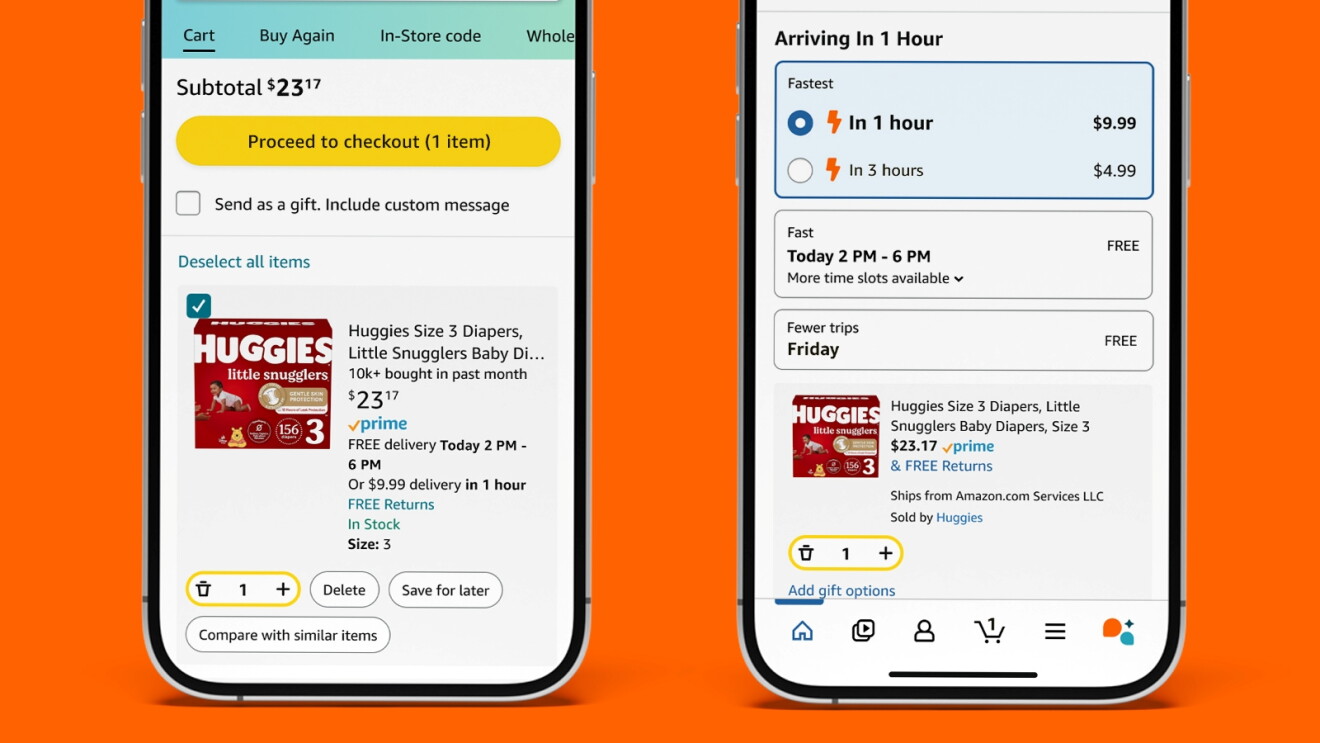
Of course, you need to be near a fulfillment center for stuff like this.
I recently bought a baseball set for one of our kids. I wasn't convinced about any of the sets on Amazon, so picked what I thought was a better alternative, an actual sports retailer which had an online shop. I had to pay for shipping, but I figured it might be worth it.
Ordered around lunchtime on a Tuesday, think they shipped it Thursday, it arrived Monday. Is it just me, or is this fairly meh service?
This is why they offer (at least in my case) free trials (worst case scenario: 3 months for 0,99€) year long.