
Having feedback when clicked, feedback when hovered. A loading state, a disabled state, a mix of everything. That's also something I found very frustrating. Like if you take the example of a button that is tied to a service on the back end, clicking this button without any visual feedback doesn't tell you if that button was clicked or not. And if it doesn't have a loading state, you wouldn't know that. something is working behind the scene when you click this button so you would click at multiple times not knowing that it's still working behind the scenes.
I am still reminded of a keynote where Steve Jobs was demoing how much faster PDF documents would display on the newer macOS. So he had engineers put a button in for him to click that would scroll through the PDF on the screen, and he accidentally clicked it more than once. Steve wondered aloud if it would scroll all the way through twice… and sure enough, it buffered the process! He had to wait for it go all the way back up and scroll through a second time!
Steve saved grace by telling the audience that, even with moving through the document a second time, altogether it was still faster than PDFs had been in the last version of the OS.
At the very least, you should consider which is appropriate for which situation, what if, in your UI, for some buttons one is the obvious choice, for others it's the other, but for some it's not so clear, and both behaviours are defensible? Now you've got an inconsistent UI.
I have no good solution for this.
The buttons in an elevator panel typically work this way. They each light up to confirm a pending request to reach a floor. They each turn off when its floor has been reached. And while a button is lit up, pressing it does nothing.
It would help if GUI elements had a property “automatically disable on click”, removing the need for the “on click handler” to disable the button (in exchange for adding the need to explicitly re-enable it).
I don’t remember seeing GUI libraries that do that, though.
That probably is because it would confuse users if buttons visually get disabled when they click them.
So, the best answer is to visually keep the button enabled, but ignore rapid further clicks. That’s debouncing.
The visual representation updating (greying out button) is a result of disabling the button, not the same thing. In virtually every GUI toolkit I've ever used there is the concept of the main UI thread, and everything that happens (input and display updates) necessarily has to go through that single thread in order to ensure correctness. (This applies to browsers, too.) That's why input goes into a queue, so you can easily do things like:
(All on the main UI thread):
  - Receive click event 1: disable button, start background process. Possibly redraw button UI *but it doesn't matter because the UI display is not the state, it's just a view*.

  - Receive click event 2: nothing happens, button is disabled

  - Background process finishes, posts update to re-enable the button

- Receive click event 3: disable button, start background process, etc.My favorite example of doing it wrong is a log in form: if the login button is clicked twice, the server would reject the login because the first click has already used up the one-time token so the user gets an error page.
But I think the biggest problem is that people either apply denouncing to all buttons in a UI (like turning it on within the framework they are using) or apply denouncing to nothing. So there really isn’t a culture for carefully considering which situations warrant which.
For users with JS disabled, your solution seems good.
If the operation is idempotent, well, clicking twice doesn't do anything. I'd still want to see the button light up to signal that the UI is alive, or the button could grey out or enter a "latched" state like a radio button if there is nothing to be done. Behind the scenes suppressing command propagation is an implementation detail and the trade off is between front-end complexity and redundant command execution overhead.
If the operation is not idempotent I can give you separate examples where different behaviors are appropriate:
1. A button used to increment a counter (e.g. quantity of GPUs to buy) should increment on every click, even if the UI response is delayed. The user can count clicks, and there is going to be a decrement button to reverse any error. You do not want the user waiting around guessing whether the software is still processing the remaining clicks. As a rule, so long as the operation is non-destructive (e.g. inc and dec buttons, all operations reversible/undoable, etc.) every user interaction can and should be actioned.
2. A button used to perform an irreversible action, i.e. a "commit", such as placing the order to purchase a GPU, should only perform that operation once. I would not call this an idempotent operation, certainly not with respect to your bank balance.
> The Nothing Phone button gives you a tap confirmation via both haptics and sound, and then ignores the tap if a previous rotation is still animating.
This is the issue. Number of performed actions has to be equal to number of times the app identified that button press was registered. Debouncing is a good practice, but if it is used then debounced taps must not produce feedback.
I was really confused at their mention of accessibility, because my mind jumped to people with hand tremors who would double press when they intended only one press.
And then, of course, there are the people that double-click every button. To handle that, disabling a submit button in the onclick is very common.
I couldn't even finish the last Apple presentations as it all feels so stiff, inhuman and run by suits, they all seem like robots scared of diverging from the holy script who will get fired if they display emotions and humanity.
Off-topic perhaps, but got reminded how delightful even the somewhat messy ad-hoc presentations from Jobs were.
Absolutely everything seems scripted including hand movements, shifting of postures, smiles..the whole works.
Now I just wait for the press release and that’s that.
Which to me makes no sense, surely you have some budget for risks if you are a 1T company? I suppose their risks are more moonshots to some degree like the Apple Car but nevertheless, I do miss the old presentations.
1. "The Nothing Phone button gives you a tap confirmation via both haptics and sound, and then ignores the tap […]"
2. There is a really good reason to tap this button 3 times in a row.
Nowadays, you use transitions instead, which are not queued. But I still very occasionally see things that use queued animations.
On physical keyboards we already have three different kinds: normal buttons, modifier keys (shift, etc) and toggle keys (caps lock).
High stakes rare actions can require special button designs. E.g. on a black magic cinema camera the button that formats the memory card needs to be held for three second while it visually counts down. This gives a small delay during which the user can decide: "Fuck this is the wrong memory card!" and cancle.
The downside is that some imaginary power user that uses the camera only to format a stack of SSDs will get burdened. You have to decide which is more common and make a decision.
But I also hate the "you had one job" meme and want to argue against its mindless usage. Most of the time, when people do the "you had one job" thing, it's false. And that's true most of the time in the case of buttons, too. In a typical user interface, a given button has some combination of these jobs:
* Communicate what action will occur should the button be pushed.
* (Sometimes) communicate the current status of some aspect of the system (e.g., often a button is used to enable/disable a mode, and the button itself visually conveys what the current mode is).
* Execute the intended action upon clicking.
* (Sometimes) communicate that the command has been received and is being executed (e.g., in the OP, the button might disable itself while animating the rotation in order to avoid the confusion the OP complains of).
the "you had one job" meme could pretty much always be followed up by "because i refused to consider the actual complexity of your job"
activate button function on touch release instead of touch down?
Your write imperative code, which issues two commands, both of which can fail independently.
There are plenty of ways to pretend to 'deal with it'.
Firstly it will just pass all tests, so most devs can stop thinking about it right away.
A dev might think you can just catch and log the exception. Doesn't fix it.
You could run the code in prod for a while, see if it goes wrong. It will, at which point the dev will try it again, and it will probably work the second time, so they can stop thinking about it.
There was a big outbox pattern discussion a couple of days ago (split thing 1 into two halves, and do them atomically, leave thing 2 as an exercise for the reader.)
I think the reason you encounter this problem in the real world is that devs just exist in some quantum superposition of "it won't happen" and "I fixed it" and "it can't be fixed".
You've just succinctly made the argument against checked exceptions FWIW (which I agree with you on). Anyone who has used Java in anger (is there any other way?) will be familiar with:
    try {
      doSoemthing();
    } catch (CheckedException e) {
      logger.error("Didn't work", e);
    }
This is largely a sotware issue. Control systems are built to handle these kinds of things. A traffic light can't accidentally show green in two directions. It's literally wired for that to be impossible because it's simply too important for it to not be possible. You constantly have to deal with faulty sensors so you have systems that will seek a consensus from 3+ sensors and, if that fails, it'll fail until you fix it.
But in software the standards just seem to be much lower even though it can be critical, even lethal eg [1]. Network interfaces should be fuzzed. Every IO operation should assume it can fail and be tested for when it does. Every IO operation should produce unexpected output. And it's simply cost-cutting and a lack of regulation that allows this sloppiness to persist. There should certainly be strict liability for any companies that allow this to happen.
[1]: https://ethicsunwrapped.utexas.edu/case-study/therac-25
I use some fairly popular (in the MSP space) backup software that thinks the network is infallible. The worst case I’ve seen is when it fails on a network request, doesn’t retry adequately, and incorrectly logs the error as data corruption.
Let's say you want to retry a network request. It's... A bit more complex than it seems, right?
Firstly, you need to know exactly what type of error you ran into. Some errors aren't really recoverable. Maybe a programming issue occurred and you are constructing an invalid URL and the HTTP client is yelling at you. No sense in retrying that 20 times. Maybe it's a network error, that seems like a good candidate to retry. Maybe, the request succeeded and we have a response, but it is a 500 error, again, seems like a good candidate.
Secondly, you need to know if it is safe to retry. If the request is essentially idempotent, like a read-only GET request, then surely it is safe, right? But, what if it isn't safe? Forget about solutions like idempotency tokens; let's assume you don't control that. Now you need to figure out how you can know if the request had side effects. If a well-known 4xx error is returned you might know, but if you get a network error or a 5xx error it's much harder. Did the request fail during a buffered response after the side effects were already applied? Maybe you can check to see if the request applied with another request. Now you have two network requests, and both need error handling.
Finally, and probably most obviously, you have to make sure you don't hammer the server when it is under load. To avoid the thundering herd problem, you'll probably want to use an exponential backoff with some jitter.
What sucks about all of this is that while there are reusable components here, the concerns effortlessly cut through different layers, making them a pain in the ass to deal with. It isn't that it is impossible for a library to handle all of these problems (I anticipate an excited evangelist may reply explaining how their favorite library does it all in one package if this post gets enough visibility) it's just that this is hard and these problems repeat in different forms, in a way that makes it difficult to fully eliminate the repetition. And this is just the most obvious basics, whereas in reality there are almost always case-specific complexities.
You can, for example, encapsulate a reasonable exponential backoff with deadline implementation and apply that as appropriate for different things, but you can't really cheat your way out of having to think about all of these things, especially if you don't control all of the network APIs you might have to interface with.
This is one part of why I don't like try/catch exceptions. They are an appropriate mechanism to use as a failure isolation boundary due to their stack unwinding capability: it would still be bad in most cases if a logic error or upstream error not being handled properly in a single network request handler were able to crash an entire network server, so being able to blanket catch everything that bubbles up an log it is good. But then using this for normal error handling, it makes doing the wrong thing perhaps just a bit too easy. I don't think you should have to self-flaggelate in order to say "just crash if this errors", but I do think that you should have to say it. Try/catch exceptions are backwards by default, just write normal looking control flow and no errors are handled and it's hard to tell if there even are any. Checked exceptions try to fix this but somehow this feels even worse; now you have a flattened list of exceptions that may occur at various different layers of depth, in some cases the same exception can occur at different layers of depth, you may literally need to read source code and map out the call stack in your head to be sure. (Hope it doesn't change later.)
The Result or Expected type concept seems like the way to go in the frame of modern programming languages. Go's error passing also works OK though it has papercuts (that a linter can help you with, at least.) To me it makes more sense to make stack unwinding error handling a more niche feature used for isolating error domains, rather than use them for all error handling.
But even that! Even that doesn't solve the problem. You still have to sit there and think about the types of errors that can occur and their consequences. At best, explicit error handling with value types just encourages you to confront it and makes it visible, even in cases where you still say "OK, pass to caller".
we are not fully enumerating and reasoning about failure cases.
I expend all my effort in avoiding 'doing two things'. It's bloody difficult, but since I've come around to thinking that recovering from 1-of-2-things-failing is probably impossible in most situations, doing it the bloody difficult way is easier.
If you flip it and instead ask "how do I write something that can't fail?" you might find some interesting ground.
The best things I know about are static type-checking, pure functions and totality. Different languages provide more or less help with these things. It's perfectly fine to do 'two things which don't fail or cause other things to fail'.
Forgive the digression, but there is an 'infectious' aspect to the above 3 things (see the function-colouring problem), e.g. you can't build pure functions which call non-pure functions. The Dependency Inversion Principle (of SOLID) gives some help in how to tackle this.
Also, the above things only work within one node (of a distributed system).
For multiple nodes, I use something like Kafka, where you write down one event, and have two systems subscribe to it, each doing one thing. Yes, there's still the obvious issue of them failing independently, but when that happens, you have an authoritative source of truth (in the form of Kafka events). This beats the craps out of developer logs.
You skip the laborious questions of "what happened in the system?" and "what should the correct state be?" Because the events are already the answer - just eyeball them.
Events also machine-readable, so if you diagnose a problem and a fix it in one case, there's a good chance you can build a detector for other cases. You don't have to wait for a support ticket to get escalated to the dev team.
You also divide the debugging space dramatically. If the Kafka log says one thing {Bob bought Minecraft for $10}, then the Ownership service is just wrong if it says Bob doesn't own Minecraft, and the Finance service is just wrong if it doesn't report the $10. Fix each independently. At no point do you need to look at Ownership and Finance together to see which one failed halfway through talking to the other, because they don't talk to each other.
Lastly, events are verifiable; they are their own audit trail. If your boss asks how much money is in the system, would you feel more confident reporting whatever the current balance is set to (i.e. the outcome of whatever code executed the last "UPDATE Balance ..." statement, or would you like to be able to sum over every transaction that you ever recorded?
Now they have at least two problems.
This is really common because of two design features that most UI frameworks share:
- The code that changes the color of the button is an internal part of the "button" component, so that people don't have to individually implement it on every button. But this means that it's kind of disconnected from the code that actually performs the action. If the "on click" handler has some last-ditch check that aborts the action, like the "don't rotate the image if it's in the middle of the rotate animation" check from the article, often there's no way for it to tell the button to cancel the color change. (And conversely sometimes the "on click" handler can fire even if the color change animation doesn't play correctly.)
- Buttons usually change color when you press down the mouse button, but only perform the action when you release the mouse button. Sometimes this is used to intentionally give you a chance to cancel the action at the very last minute by dragging your mouse off the button while it's still held down (or, on mobile, to e.g. reinterpret your interaction as scrolling instead of clicking), other times it just creates more opportunities for something to happen that prevents the action from working after the color change has already happened.
No, but what should happen in cases like that is that the on-click handler disables the button while it is unresponsive. This will communicate the fact that the button is unresponsive visually to the user and also inhibit the button-was-pressed feedback.
In most cases that is going to lead to annoying pointless flickering as most actions & animations are basically instantaneous, and with touchscreens even in the non-pointless scenarios it won't have the desired effect as the button itself will be hidden from the user by their own finger.
In principle I think you are right, but in practice buffering presses is often probably the more user-friendly option.
Well, yes, dropping user inputs is "being broken"
EDIT: sometimes UI elements with mouse-held interaction allow you to use the escape key to cancel an in-progress interaction (ESC: abort, mouse-up: commit) however the reply button on this page doesn't work that way so I have to edit this message to add this. That escape-key behavior should be universal I think.
But wait, there's more: when the elevator arrives until it leaves, the button should flash or change to a more prominent color. Why? Because imagine someone presses up and someone else presses down, and the elevator arrives going up. If the up button switches off at this point, now only the down button is lit which clearly signals the elevator is going down, which is wrong.
Let's say you tell someone to do something, and they say "ok". But when you ask them later whether they did, they say "oh no, I just said ok to indicate that I heard you, not that I was going to do something about it." That doesn't make any sense. The indicator light has the same function. Going on and then off again is a violation of basic communication protocol.
The more complex the intersection, the more controls I can watch, to get a feel for the rhythm, patterns, and triggers that influence the cue to activate my “WALK” signal.
I’m also watching the cars to see when the flows slow down or stop. I should perhaps pay more attention to the signal that pertains to me as a pedestrian or motorist...
I guess you might want to fade it from red to green (red being "this works" and green being "it'll do what I want"), but I don't mind the holding-down behaviour. The only problem is that you can never know how long you need to hold it down for unless you stop holding it.
It is probably daily that I encounter products and procedures where I can see that a given scenario is kind of a an edge case, but not an unforeseeable one. Given the scale of many things, edge cases happen pretty frequently and with ever more ridged organisations, lack of customer service, human interaction and a quest for ever more cost savings, hitting an edge case can be everything from frustrating to catastrophic for a person.
Generally I think we, as in humans, need to slow down.
Now if you just naively read out the current state of the button and do something with it elsewhere in the program looping may be off or on randomly.
It is not hard to imagine if there is some other logic (or e.g. a rate limit) on the 30 seconds and on the beep that these would see different slices in time of the button. Congrats you built a button-debounce based RNG.
Physical buttons can be surprisingly complex if you don't rely on someone else's driver. The correct solution is to debounce the button, that can be done either in hardware (too expensive, so rarely done) or in softeare, by e.g. averaging the last 50 reads and wait till the majority is either off or on.
This should be common knowledge for embedded programmers, but every noe and then you will see someone who has never heard of it.
This is a bad way to do it because it adds avoidable latency. A moving average is a low-pass filter. The switch bounce is better handled by hysteresis. Change state as soon as you see an edge, then ignore further edges until a timer expires, e.g. 5 ms, which should be enough for the bouncing to settle. A 5 ms timeout limits your repetition rate to 100 presses per second, which is beyond human capabilities.
You might want a tiny bit of hardware low-pass filtering too, for EMI resistance, but that's with microsecond-scale time constant, not milliseconds.
If you want to achieve low-latency input, "act on first edge, then ignore for the switch bounce period" is a far better approach. It also conveniently solves the "press, then release within bounce period" problem where an averaging algorithm would completely ignore the button press.
An averaging filter makes sense if you have a noisy analog input. For a button input that registers whether it is pressed or not except for a known noise around transitions specifically, ignoring the transitions immediately after the first one registered is not only faster (both in terms of latency and CPU cost) but easier to implement. It's also equally practical for switches with long bounce, where the time it would take for an average to favor a transition might be impractically long.
And even with no additional latency, 5ms is perceptible in some cases anyway. Microsoft Research has a video demonstration:
For example, smartphone app developers routinely run their apps in emulators first to make the development process more convenient, only running it on a physical device for confirmation when the work is basically done.
Many embedded developers would kill for something similar, and we're already seeing the start of it with platforms like Wokwi. Being able to do integration tests without the physical device itself is an absolute game changer.
There are 2 things here worth paying attention
* first "bounce" is user action * last "bounce" is stop of user action.
You can run action on first bounce then just ignore the button for whatver debounce period you deem satisfactory. But adding delay to start action is always wrong answer for debouncing.
Now the harder problem is the off of the button, especially if hold is also an action but "be off for at least few ms" usually handles it well and off time is not lag user feels
There are other situations but not for a button. There are inputs that might be continuously noisy where a sliding window / ring buffer rolling sample is the only way to tell the difference between states. But we are talking about binary input controls actuated by a person, not a thermometer or O2 sensor.
The standard way to debounce is to attach an timer to the button. When you press the button, an ISR runs that temporarily disable the timer from triggering again and starts the timer for a specific period (say 20ms). The processor is free to do whatever it wants for the next 20ms. When that timer expires, another routine checks to see if the button is still being held, sets the button's state accordingly, then re-enables the button Timer so it can be triggered again.
Averaging loops are much better for analog inputs where you may have noise that throws off the reading. You only care about a button being on or off, it doesn't matter if it's been mostly on for that period only that it's still on.
When you get into extremely fast digital inputs that need to be reacted to sooner than the debounce wait period, that's when you need hardware debouncing.
I know you mean "debouncing" but I love the autocorrect. Like the button is some almighty authority that Denounces noisy signals.
They are there to mask loading times and ease from one state into the other. That's why we have them.
This knowledge eventually got lost (figuratively speaking) and now we have code that needs to wait on the animation to finish.
Another amazing example of cargo culting.
Old Apple understood design is more than making things pretty. The glassy Apple is all about how it looks in a demo.
I'd expand on this: used well, they show the user than a state change is happening directly because of a particular action of theirs, and hint at how they might reverse or modify it.
In fact I'd disagree with masking. If something appeared instantly with no hint as to why, that is a distinct anti-pattern on a touch screen.
I want it to rotate an image by 90° when I tap the button that does that.
See, this is exactly my point when I say that animations are no end in themselves. They serve a supporting role to better get the actual job done.
The actual job is not "feel" it is "do". For vibes, there are movies, Art, and AI hallucinations.
Of course, "feel" can greatly enhance the "do", but only if it takes the back seat, which is exactly what I just said.
__
The age-old debate "form follows function" vs "form over function", essentially.
One of them is correct tho, because in the real non-ZIRP world, correctness is defined as "achieves a tangible goal".
Which is not to say that stuff optimizing for other goals would be "incorrect" or "worthless", but it exists in a different category from "software". More like "software-adjacent Art".
The distinction being made based on "what is the primary goal we want to achieve here"
____
Related:
Also caused by ZIRP but differently, we have that problem that software trying to invoke feelings usually does so because it wants to sell you something or has any other style of goal that might not be aligned with yours.
So that adds yet another layer.
Pure utility cannot scam people into stuff they actually didn't want to do.
> The actual job is not "feel" it is "do".
According to.. you? And subject to your expectations? If I click a button to rotate an image 90degrees on my phone's image editor, I personally expect (and want) it to have rotation animation.
So who's right? You, because you speak in absolutes?
But rotating an image is one of the rare use cases where I do want the animation. It makes me see what action happened, with which rotation angle, without having to think twice.
The motion itself indeed gets picked up intuitively by the brain.
Okay, I'm convinced that picture rotation should be animated to the exact degree that achieves this.
It's not a debate. If you are making app to do something, "form follows function " is always the right choice. If anyone on UI/UX team tells you different you should fire them, they are not interested in making good UIs. If it comes out ugly, well, you need to get good at making useful stuff also look nice
"form over function" only applies to stuff that is looked on more than used by overwhelming degree. Any other case is just someone using it as excuse for them being shit at producing useful stuff that also happens to be beautiful
I doubt the pleasure of aesthetically pleasing programs can weight up for much. Then there are the ugly and bad programs too. Those have no redemption to speak of.
The fact that it makes content move in a way that is illegal breaks my mind. You try to check "is this the end" and it all starts moving. What the hell. Why.
I kinda forgot just how much I hate this animation. Thanks for the reminder. Why, google.
> And it would be so much more predictable and pleasant if you could just tap the button three times at any pace you wanted without thinking, without paying attention, without getting your UI blocked by an animation that no longer helps you.
They cite accessibility.
The thing is, I can imagine the complete opposite side of the argument, where someone with motor impairments or parkinson's, for example, ideally liking if their over-clicks were ignored if they'd already locked-in their intention.
It's tricky to get this stuff right.
Being fast does not make you a power user. "The button works when I push it twice" is a reasonable expectation of a device by default. If that weren't the default, then most people would have a worse experience with their phone.
It could probably be done as a global device setting - e.g. ignore taps within 100ms if they're within 50px of each other or whatever.
So, for me, on the argument of about accessibility, the Nothing Phone behavior will work a lot better I think. In their mind they don't count and click 6 times to put the image in a specific position. In addition with considering that it would not make much sense to click 8 times in advance to turn back in the exact position where you are.
The mindset in their case is more: click and wait, compare if it is the position you want and do it again. The other sensitive button that will bufer would probably trigger overshooting, going too far, then too back, etc... similarly to when you have issue scrolling in a list to the right spot.
The case of the iphone would be better only for someone like a younger person, tech nerd, that want things to go fast without having to wait. Same thing for computer keyboards where I could type multiple letters in advance before the first one even show up on the screen with the lag.
If you have a UX element that I will be able to interact with before and after an interaction, then keep it visible during the transformation, process, whatever. What UX gain is there in hiding these buttons during the rotation on the iPhone? It doesn't even look better, though appearance has been the altar that recent Apple software has sacrificed actual UX gains.
Will agree with the author though that these taps need to be processed independent of animation.
We could make something similar for UX. Just a bunch of design pattern constraints that throw flags if you try to ship something with well established UX warts.
The Flat UX fad was objectively terrible on just about every metric I was taught, but people were actively pushing for such designs.
You need to denote a button is different from text. You need feedback that a UI element was interacted with, and for toggles you need for people to be able to tell what represents on vs off. The borders between different UI elements needs to be clearly defined, etc etc.
The more you can ground what you're teaching in real world terms, the easier it is to teach. And in the moments where it does deviate from real world conditions, that's where it becomes harder to learn, since now you have to remember exceptions in behaviour compared to what you already know.
Having computers imitate real world items is useful, because it provides a reference to other things rather than just being its own unique thing. This is useful even if you have never actually used it outside of a computer setting. A stereotypical telephone receiver icon almost always means 'call', even if you've never used a landline phone (much less one that's shaped like that icon usually is). Nobody has ever used a real-world hamburger menu, yet it's described in skeumorphic terms, since it's easier to explain and relate to.
Skeuomorphic UIs absolutely have a place in things like games and tutorials for the youngest of children (like 5-6 yr olds, max), but past that, I honestly think labelling, a UI with feedback after significant inputs (like sounds, button states being extremely distinct, animations, etc), and not overcrowding the UI with too many controls and jargon will all go much further than skeuomorphism.
Screw the dyslexic and colourblind, I guess.
> using descriptive naming in buttons and having self-documenting labels.
Screw the non(-native)-English speaking in this case.
And even in the case that you're a native speaker, this is really hard to do well. You should try. Most fail.
I agree you should do these things, and many of your other suggestions (within reason) if only to give your users a better chance at understanding your software, but they cannot replace a solid grounding in the real world. We should have both.
What's clearer? [Call] or [(telephone receiver emoji) Call]?
You can also use checkmark/cross icons for success/failure. And What does this have to do with dyslexia?
> What's clearer? [Call] or [(telephone receiver emoji) Call]?
We’re arguing about flat vs. skeuomorphic design, so more like:
What's clearer? [(simple phone icon) Call] or [(photorealistic drawing of a telephone receiver) Call]?
Your comment on typography.
> What's clearer? [(simple phone icon) Call] or [(photorealistic drawing of a telephone receiver) Call]?
The latter.
That wasn’t my comment, and GP was presumably referring to things like headings being larger, not some subtle differences that dyslexic people would miss.
> The latter.
Why?
Sorry about that.
> and GP was presumably referring to things like headings being larger, not some subtle differences that dyslexic people would miss.
I was imagining bold or italics, both of which are easily missed by people who are dyslectic, or using different type faces, which can trip them up. Headings can help, if the text and spacing is suitably big, but I'm not sure what situations that can help much with in typical usage. I'm having a hard time thinking of examples where I would do that beyond what's already common.
> Why?
Easier to recognise as what it's supposed to be and easier to distinguish from other icons. More distinct traits in icons help you recognise something for what it is more quickly.
It's possible to have a flat style but have buttons that look clearly like buttons, and elements that have shadows and colors.
Nobody seemed to have a problem with it. It was largely clear what was a button and what was a checkbox. In hindsight it was certainly uglier than the 95 style (maybe just because I grew up with that) but it wasn't unusable at all. As you say, it was clear what was a button, what was a checkbox. I think it was because GUIs were mostly made out of standardized elements whereas today we have everyone trying to put their unique spin on every element.
We have to go all the way back to Windows 2 in before we find flatness.
[1] https://web.archive.org/web/20220418124401/https://techland....
a) a different statement from "I prefer X"
and
b) pretty low effort, trivially to Google (or ask AI) and generally a bit on the ignorant side
A better reply would not just have said what it said but contained actual wonder about the topic. Like this, it's just indistinguishable from engagement bait.
I know the most common reason why people prefer skeuomorphic design (the visual metaphor), which is why my original reply directly addressed this complaint by saying that it’s no longer relevant. Some other complaints I’ve found online are about specific bad instances of flat design rather than flat designs in general. Therefore, I am asking about reasons that don’t fall under these two categories, which I haven’t been able to find.
A core issue is UI is a language and by reinventing things from scratch you ended up with some designs choosing A to represent something toggled on, and some designs using A to show the exact opposite. Thus a user needed to interact with that specific design to learn core functionality.
The parents question seems reasonable to my non designy mind.
No on the Internet.
Especially not on the sea-lion infested HR-world Internet, in which trolling has evolved to exploit good faith directly.
___
In fact, "being overly hostile" is exactly how you probe to see whether your suspicions are correct.
Sea lioning exploits the gap between what would be a real human thing to do and what still passes as what a real human would do.
So to get useful data, you need to modulate parameters so that people end up outside of that gap window.
Essentially you're probing for genuine Human-ness by creating a context in which the bad faith action space is no longer overlapping with the genuine human action space.
This works, because genuine humans have this amazing ability to reconcile and actually genuinely resolve misunderstandings. Something that is fundamentally impossible for bad faith actors.
(This should not be understood as "just be overly hostile" because simply being a dick doesn't provide any data at all.)
If you're a dick for a reason, you're still being a dick. (Your word not mine)
And I don't see how your approach makes discourse any better.
To me the parents question was reasonable. Skeuomorphism was designed for people that may never have seen a computer before. Do we need to still be clicking a floppy disc to save a file?
There's probably differences in how you define flat design. You could include all the issues of current implementations in that definition, or you could say that the burger menu is just bad UX and could be fixed without going back to skeuomorphism.
But you haven't really delved into that.
Dude, are you also playing that script or what?
Of course you do not engage on the level the possibly malicious party wants you to engage, because if you do that, you play their game by their rules.
Have you even tried engaging with what I just said? (inb4 "but you didn't do either!!111")
God, this fucking platform. Whatever man. Go have fun being dragged (or dragging others) into never-ending bad-faith arguments.
Although in 3.1 it was easy to tell what was interactable, despite being flat. I attribute this to the use of standardized components almost everywhere.
https://www.custompc.com/wp-content/sites/custompc/2023/06/W...
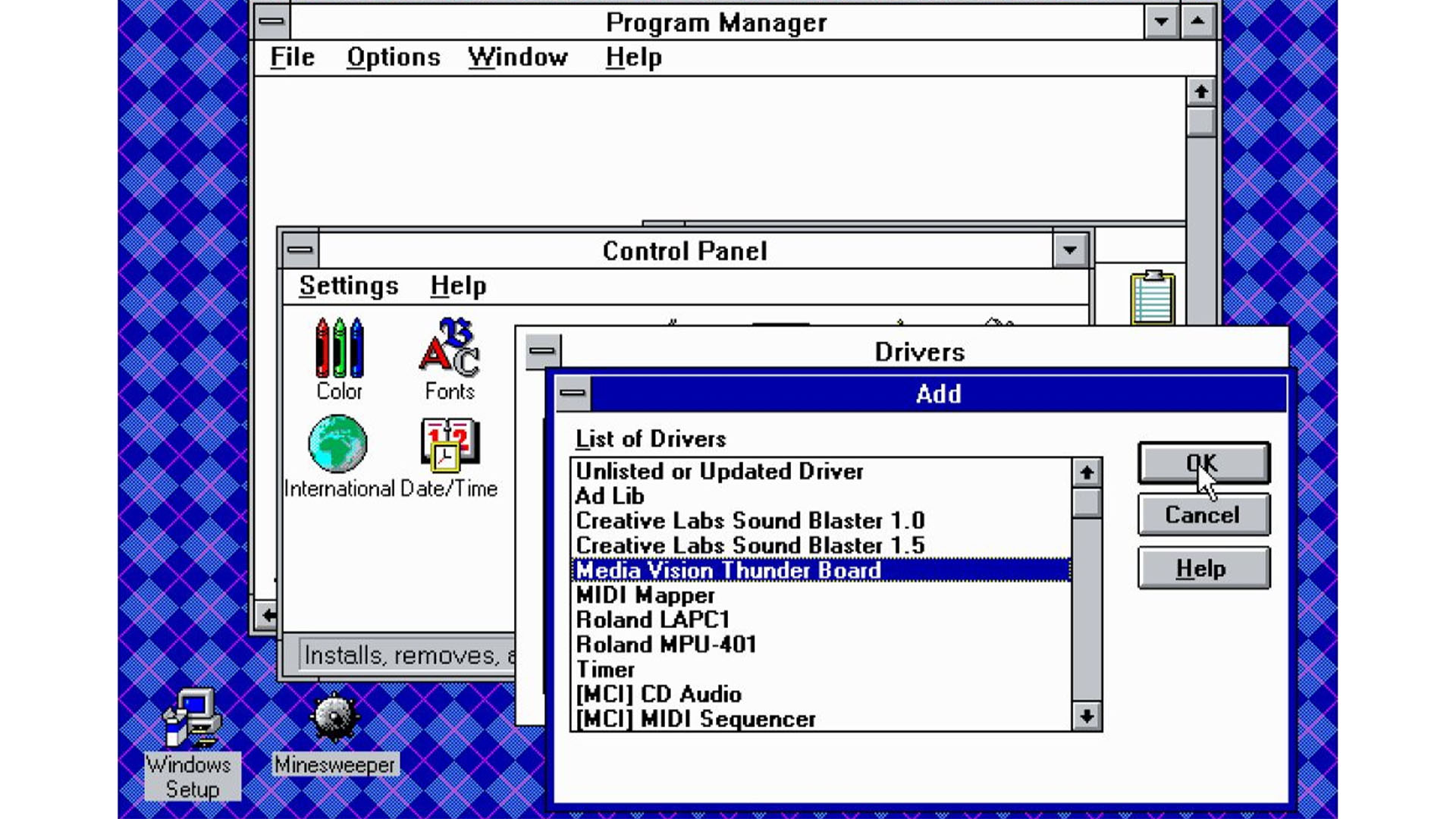
FOMO for sure is one of the driving factors.
"We cannot risk looking outdated". So weak management, probably.
But also talent availability I suppose. If there's a new trend, the pool of people you can hire include many that are in on that trend.
UI frameworks too, probably. The modern thing™ does the modern thing™ and you do want to be on the modern thing, because you fear that only that receives security fixes or whatever.
I really don't think that "keeping people entertained" is a sensible goal within the context of building software as tools and not software-adjacent Art.
Which is not to say that I would not want a great and polished experience, but that is not equivalent to "being entertained".
___
It would be nice if not everything one interacts with would try to get some sort of emotion out of me. Bring back being bored.
I don't think I know any non-tech people who like things changing about. Some tech people like that (I don't), but for the non-techy, it's just another thing they have to relearn for no good reason.
As opposed to what? Be entertained by all the bells and whistles of modern operating systems that have practically unusable user interfaces?
Whether you should build systems for that age group is an entirely different topic, but I found it a good challenge to design something that fits the user's needs.
IRL 99%+ of buttons work by just doing the thing as soon as you press them. But a button that works like that in a GUI would feel wrong.
No, it doesn't. It feels way more responsive.
My pet peeve is "stopwatch apps" which trigger on release instead of on press. When timing something where fractions of a second matter, most people won't realize that it triggers on release and tap down when they want to start / stop, adding some arbitrary delay until they actually release the button.
When tapping, I have to see, or in case of watching for some event to happen to stop the time, feel/guess when exactly the distance between screen and finger approaches zero. With a stop button triggered by release however, I can just calmly rest my finger on it and raise when the event happens, without any guesswork.
"Nobody uses real stopwatches anymore" might be somewhat true, but in athletics training they still do, and it just shows that it's not possible to adequately reproduce a thing on a touch screen and have it be as functional as the real item. A stopwatch app on a phone will always be a poor substitute for a real stopwatch.
I still do not know the pattern, but I have on occasion inadvertently ended a call by using that button prior to placing my iPhone in my pocket.
They'd even give visual feedback - the button remains looking pressed until the click handler returns when the operation is complete!
Maybe blocking the main thread isn't so bad after all?
It might be quite a hard problem to determine which buttons should be disabled during which operations. One tricky candidate is the "safe" button. Should I be able to click it when the visual feedback I'm getting does not yet match the internal state of the application (which is what will be saved)? Should I be able to start further tasks when the save is still in progress? (If so, what if the save fails? Will I be able to roll back to the state before the attempted save and try again?)
This is a good example of thinking through the user's intention and accessibility states. We need to capture clear user intent first, then decide on the UX behavior. Changes like these help all users.
One thing I learned from her is that if you want someone to stop doing something you don’t punish them, you ignore them. No response.
Now that I'm wondering. How does iphone mitigate this problem?
Other way could be to actually visually indicate action queue depth.
One more ancient trick: back when computers were slow I would always ask myself why the data is not already in the desired format.
For example: Today you might have data in a json and turn it into a row of divs. You could store the data as a file with a row of divs which would make it a pain working with it on the backend. But on the front end you wouldn't have to parse it.
The phone doesn't modify the image but it changes the image orientation.
This is much faster but all other operations would need to work with it and when eventually served in a browser all the 100 000 viewer clients would have to rotate it themselves.
I won't argue it's wrong but it shifts complexity from image rotation to image editing and viewing.
It seems strange to add "real" rotation to the ui but the phone app is the industrial standard for image editing.
If you tap for directions and then tap to change the mode of transportation as it's loading the routes then it thinks you've picked the first route because it bumps the transport mode panel up in order to show the first route in the list.
Very annoying as they could just account for the height of the first route from the start.
It's very rare that animation is not blocking further user actions. No surprise animations are tricky to program - they're very async in nature. Designing animation system that doesn't leak into the rest of application logic code is a no simple feat.
Even better: they moved it from developer options to accessibility options, which means that they treat it as a normal use case now
What is bad is that it still disables the animations for progress bars (the only place where the animation makes sense)
Idea being that for user it is less frustrating to wait for animation to end, than to see some hourglass/waiting indication.
Google, Microsoft, Amazon, Netflix, Meta. Is there even one software company that does software UX well but not on Apple's platform?
On average it is has same amount of crappy UI experience, just in different places.
Following the exact "best practice" in the article, the iPhone lock screen has this issue. Say your password is 1234 but you accidentally type 11234. What the iPhone will do is see 1123, the pause to tell you you failed, then enter 4. Now you, having muscle memory, will type 1234 (your password). But iPhone kept that 4 so it sees 4123 then pauses to tell you entered the wrong password, then adds the 4, and you type 1234 again, which again it sees 4123.
Finally, frustrated, you pause and press delete or take some other action to reset the lock screen and this time it works.
This has happened to me countless times since iPhone had a lock screen.
The better UX would be to clear the that after the error which is effectively what the Nothing Phone is doing with the photo rotation
I agree 100% with the article that for photo rotation it should do what the iPhone is doing. Conversely, it's wrong thing to do on the lock screen.
Perhaps a longer pause will prevent you from typing that 4 but that also means other people who mistype their passcode have to wait longer to retry. It's a tradeoff. I suspect there are more people who type the wrong passcode of the correct length than the incorrect length.
Record actions until interrupt.
Animation should not be considered interrupt.
An Error message should be treated as interrupt.
Sometimes I log into my big Windows machine at home with RDP from out of the house to post photos to my socials, like
and with a folder with a few hundred images in it is is awkward to use the official file chooser dialog because it is based on modern UI toolkits and practices which are wasteful and slow over the net. It is much easier to use XnView MP because it is based on an old widget set which isn’t flashy.
Similarly I find myself impressed with the old Adobe apps like Photoshop and Illustrator because, sprawling as they are, they come out of an old time when they were expected to work on machines with a fraction (1/2000 of the RAM!) of the capacity of modern machines and there is just less junk. Adobe recently took the “(legacy)” label off “Save to Web” because that ancient feature alone goes a long way to justifying the creative cloud subscription.
I don't have Mastodon so can't follow you there, but I've added your profile to my RSS reader. Looking forward to seeing more of your photos!
Also I work in XR and rely heavily on hand tracking and I'm precisely trying to use that accident so re-consider what does typing mean without a keyboard. How can one use hand tracking in XR as input without relying a virtual keyboard, which is so slow and lacks tactile feedback.
Anyway, all this to say yes, ours hands are impressively precise, fast, flexible. We take them for granted but it's definitely worth spending a bit of time training them, considering the interfaces at different level, ergonomic, physical interface, firmware, then the software with its UI.
Overuse of animations is a terrible thing that has made iOS far worse over the years. I long for the days of yore, when the loading screenshot had a chance of being accurate.
These days, when loading something like the health app I get a series of three different screens, rather than just landing at the destination it knew o wanted to start at. It is idiocy of the highest order. Why show some series of random screen transitions while starting the app? Somebody who has no clue about UX programmed that piece of crap, and then an entire team put up with this behavior. I dearsay that if this shipped under jobs there would be a director level firing to stop it.
Same BS happens with Apple Maps. If you launch the app and it remembers that an hour, day, or two weeks ago you had your phone in a particular orientation forever ago, it slowly rotates the view pane over 1000-2000ms from you ancient view pane as if you've been waiting patiently over two weeks so that Maps doesn't suddenly disrupt your view...
Animation can be helpful but at some point a half-wit VP shoved it into everything Ruth disastrous results and Apple is still recovering. Liquid Glass is a similar disaster of incompetence being promoted far beyond capability.
And if you have a tray button that needs to e.g reach over the network to a HomeAssistant instance that needs to itself reach out to some fuckass IoT vendor server, you may as well not expect any sort of feedback before you close the tray.
It sounds like Android needs a middle state indicator. When your action is in a pending state, the state indicator should not be the same as the previous state. A common pattern is to show a pending animation.
While this animation is running, what should happen if the user presses the button?
When they're off, they don't blow any air so it would make sense to me to decide that the button to turn them on is the one that controls how much air it blows. It goes from 0 to 1 to turn on, so you just learned that that button changes how much air comes out of it.
But no, most of them do the opposite. So, you turn them on with the temperature control. The action is: no air, yes air, air gets super-hot if you keep pushing the button.
I can't find any modern air dryers where they get this right.
It could be fixed with a relay or a solid state switch on the heater, or with a multipolar toggle on the airspeed. But that's several cents more expensive than making it turn on at the heater switch.
Something technical made it easier to implement.
I almost always need to rotate photos 90⁰ to the right, so I have to tap that button three times. Apart from that, if I have only one way to rotate my photo, clockwise seems more intuitive to me anyway.
     *-----*      *-----*
    |       |    |       |
    |   ●   |    |   Ω   |
    |       |    |       |
     *-----*      *-----*

      [================]
And, you don't have to worry about what to do in the case that someone hits the "rotate ball" button while it's still rotating.
Eh, it's a pretty trivial problem, comptometers have it figured out more than a hundred years ago.
The pilot lights are slightly more useful in those stupid cross-wired double switches that for some weird reason implement a sort of XOR (or sometimes XNOR because why not) gate for controlling a single light: if it's on, then the bulb is depowered and you can safely change it without turning off the entire power rail. But then one day the pilot light itself burns out...
iOS is no better. Sure everything is intuitive but it's going to get a redesign so next year you are going to have to learn everything from scratch or a feature you use often will just break.
I've tried the vendor ones by Samsung, OnePlus etc with fresh devices and this Android experience really is awful.
Personally I'm blown away by Motorola options in the budget range. For raw value alone there offerings are hard to beat.
That said, I can't seem to find any evidence of this particular thing being patented to support my case, so it's probable that I'm wrong.
Every button has two jobs. One is to accurately convey what it will do. Two is to then do it.
Several of us can neither remember what your dynamic, curvy, arrowed, action lines do, nor can we extrapolate from them. They are an exercise in frustration. The nod to situational disability is appreciated, but most would have been useless without text descriptions.
The iPhone was eight taps. The Nothing was six. (Yeah, I could have noticed it while watching, but I was situationally incapacitated; namely, I’ve just waken up.)
---
Edit: I’ve rewatched it at 0.5× and the Nothing was eight taps after all, too. Author’s point was, indeed, that all taps should register regardless of what animation state is, and Nothing doesn’t do that. Sorry for the confusion!
---
Regardless! I still find the iPhone one more pleasant to look at, because the animation doesn’t stop. But if you press quickly enough, I guess what they could do is animate until the taps stop, then:
• if the image will arrive to the desired state: finish up the current 90°;
• if it’ll still be 90° away: finish up then show one more 90°;
• if it’ll be 180° away: flip it upside down, then finish up the current 90°;
• if it’ll be 270° away: flip it upside down, finish up, and show one more 90°.
But that’s not a very practical thing to implement I suppose.
No? It makes the opposite argument.
> And it would be so much more predictable and pleasant if you could just tap the button three times at any pace you wanted without thinking, without paying attention, without getting your UI blocked by an animation that no longer helps you.
Am I misreading this?
The Nothing isn't executing all the taps, some are blocked by the animation. It is responding visually and haptically to all of the taps, but some are blocked from doing any work by the animation.
You also said the Nothing was 6 taps but I'm not seeing anywhere the article says that. I believe it was 8 taps on both.
No interface should, on a regular basis, contain buttons that, if pressed -- harm the computer and other computers near it.
And of course, this is links in modern email.
Simple totally offline ONNX models exist, whcih should make it trivial to categorize the right orientation. Acceleometer/magnetometer can feed this, but should not be the default.
Just do this and avoid the hassle of rotating at all!
Better post an overview of everything a good button should do (no it is not just one job).
Even better, post an overview of good GUI design in general.
Engineering attention is finite. Why would you spend time thinking about 8 clicks when most people will only need ~3?
Not all user-action possibilities are equally important, and if they are, then you better have infinite resources to spend on engineering.
This same issue also seems like it would prevent you from quickly double-tapping the button to turn an image upside-down, a much more common use case.
I don't know, I understand the principle, but I don't see how you can determine the value of a principle outside of a specific context.
Even for accessibility, we can't target every context in the name of being accessible. We still have to pick which contexts of inaccessibility we'll need to support with more attention.