
Well I turned off MCC and gave up.
I don't want to know what life is like having xbox hardware
There's something seriously wrong in Redmond.
At least with linux, you can search on the web and find a forum post telling you the magic incantation. With Microsoft, you will be forced to consume some second-rate engineer's unmanaged, barely workable, edge case until it might or might not work.
Office on the web is a horror show this way.
Make sure to get Java Edition. The other one is just an ad-riddden slopfest where they also ban you if you say swear words.
Which raises an interesting question, If I legally have a license for the game but they shut off the license servers, is it actually copyright infringement? (or piracy as people like to call it because copyright infringement sounds lame)
Which is why coming at this from a legal perspective a farce. Most of the world is like this, actually. You can assume that if some action brings money to large corporations then it's legal and if it takes away their actual or potential revenue then it's illegal. Go with what you feel is morally correct.
Ended up on Minecraft Education on the computer, eventually.
Not really in the cards, though I can appreciate your dedication to pirate advocacy.
I switched to Mac with the Intel change around...2006 maybe? Converted my entire family.
I personally switched to various flavors of linux around 2016-2017 because I wanted more hardware options.
Eventually, my son got into gaming and eventually we let him get an Alienware laptop maybe 2-3 years ago. Then my wife had to get one for work this year. It's like nothing has improved in 20 years.
Back in the early 1990s you'd get Microsoft Office from the store, as a box containing 10 floppy disks. And they had to put a lot of effort into testing it, because patching was impossible. And of course it was fully offline. Perpetually licensed, with paid upgrades.
The problems were instead things like "this notionally multi-user OS is just a single-user OS with a decorative login screen" and "any application can crash the entire OS" and "spreadsheets auto-run macro viruses" and things like that.
I never had problems with cyberpunk but I think I know why: I built a new PC right around its release and it was good enough to play it smoothly on 4K medium or HD ultra.
When I checked to see what 4K ultra looked like, the graphics latency caused a bunch of scripting to fall apart and the game glitched really bad.
IIRC the console release was notorious for bugs, so I assume consoles were not performant enough to run the game buttery smooth nor could they be easily upgraded.
I think they completely let it go when they laid off the testers and let users pay $$ to be testers, starting from 2010s perhaps. Maybe earlier.
On the business side, with M365, they use lock-in tactics and extremely aggressive bundle pricing. The only competitor is Google Workspace, and it's missing features you get bundled with something like an E5 license. So your choice becomes: just pay Microsoft $60/user/month and get Identity, Office, Intranet, MDM, EDR, DLP, ZTNA, the works. Or, buy Google Workspace and then also buy Slack, Okta, JamF (or Jumpcloud or similar), some ZTNA product, etc. and you are now at double or more the price of an E5 license.
On the consumer side with Windows, they secured their monopoly via internet explorer, and predatory OEM contracts to prevent machines being sold with anything else. Now Windows is just an ad-delivery network disguised as an OS. People don't leave Windows because its still, through those shady backroom deals, the default OS on every off the shelf PC, and because of existing software.
Microsoft has zero incentive to build a good product now, they already won. People use it because they have to not because they want to.
Bill gates also understood the value great programmers. The whole business revolved around this premise. this was different from other software companies at the time. Read the likes of Gabe Newell and Joel spolsky said about their time there. It was in a league of it's own.
There are a lot of great things we got from Microsoft, a zero fee platform to target, a platform that would run on what ever cobbled together pc parts you threw at it. An unbelievable attention to backwards compatibility. Compare that to what we have now in the app store and play store.
> Google Workspace, and it's missing features
Sounds like Microsoft got there by having the features.
I mean it's a good deal. As you say, when a company goes above a certain size, it does not make sense to pay for GSuite + Slack + Zoom + RMM/MDM + Zscaler
Windows is still good for gaming PCs, and it will now handle and update itself reliably. No I don't need to hear anecdotes, I work in the IT desktop space. IT janitor monkey if you will. There is no way an enterprise will convert laptops to linux or chromebook.
You see it as malicious, but well, even Google have trouble in this space. Because it is hard.
I don't think I've used a MS product in at least a decade. At least that I was aware of.
Edit: did some research and I have used LinkedIn. Other than that, nothing.
Companies over 20 staff are on Windows laptops + Office 365 E3 or E5.
Android and iOS? Sure on the phones...
What "clients" are you talking about? Edit: Re-reading I think you mean clients as in general computers, not business clients. Yes, more of the world is on phones but that is due to cost and society (ipad/iphone kids or third world on android). Real work is all done on PCs/Macs.
Schools are on chromebooks for the kids and Windows or Mac for teachers.
This used to be the case when Apple was in dire straits and MS abused their monopoly position to gain 95% of browsers market share. Grim days.
But those days are thankfully long done and there are plenty of people who are completely Microsoft-free.
The one thing people are using one way or another is Linux, because it's now in just about everything. Even those in the Apple ecosystem, with an iPhone and Mac computers, very probably have a Linux router and Linux TV at home.
The number of devices in the world running one version of Linux or another outnumber Windows devices by something like 10 to 1. Maybe more.
Microsoft is a despicable company producing turds since forever. I hate them and the crap they produce with a passion since the DOS days.
As the saying goes: the day Microsoft shall produce something that doesn't suck is the day they'll start selling vacuum cleaners.
Also MS stuff has always been slop. Hate their business practices too. But without Linux we'd be choosing between MS, Apple and Oracle Solaris or something...
Last time I remember them doing something similar was on the last days of XP / earlier Vista time. But it wasn't so bad at the time.
(Not that I would know, I don't touch Microsoft's shit with a 10-foot-pole)
P.S. My personal opinion is that Windows could be a great OS but MS keeps intentionally saddling it with more and more shit in the name of getting more from the user, instead of giving more to the user.
Some other things have been baffling over the years (but I belive they are now at least somewhat solved). For example in Windows 7 and older Windows would spend tens of seconds on "installing drivers" for a USB stick every time a new stick was inserted (or even an old stick inserted into a new port). I don't remember seeing this on Windows 10 (or 11), but I barely used those.
But yes, compared to the userspace the kernel is way less jank. (Like how Windows Updates takes minutes to run to conclude that there are updates, and dozens of minutes to install them, while pacman -Syu on Arch can be done in second if there are no updates, and maybe 2-4 minutes in the worst case of a kernel update with dkms modules being rebuilt.)
Windows NT (including Windows 2000) was considered to be a workstation OS by Microsoft. From Windows XP on, the NT-based Windows operating systems (except for the server ones) were targeted to consumers.
I don’t see that as support for the claim that Microsoft’s products were half-baked in the 80s and 90s.
If Linux had sufficient market penetration in small business, I bet you could run a successful business fixing problems with Linux products, even today.
(It may be a bit of a stretch but you could even argue Amazon is making serious money supporting big companies with their Linux problems)
They're weird to this unix-head, but generally not as buggy as in MacOS.
But I don't think it contradicts your point. This is just a rare exception to the true general rule.
I find Windows 10 and 11 really good once you tweak it a bit and remove some cruft and tweak regedit/GPO settings. Both for modern software. Not to talk about backwards compatibility, Steam games from 2009 run just fine. Windows is also the standard for online games with anti-cheat. Also, for companies, Excel is a must. Yes, still is.
The whole ecosystem of AD+GPO+ Exchange since 2000 is unparalleled, Novell had something like AD but AD won. That continues with Office 365 where it's not just an office package. It is Identity/accounts/SSO (Entra), MDM (Intune), EDR/"antivirus", Storage (OneDrive), Sharepoint (docs + storage), Teams (Slack + Zoom).
You can buy Okta, Zoom, Slack, Gsuite, an EDR, an MDM but at that point you are paying a lot more for your stack...
I understand if you are a smaller company, then Gsuite + Slack and Zoom is a good choice. But go over 100 people and it starts to not make sense.
I also hear developers liking their IDEs, both full VS and VS Code.
/IT admin
I'd say somewhat fine depending on the title, they broke a lot of backward compatibility recently
> You can buy Okta, Zoom, Slack, Gsuite, an EDR, an MDM but at that point you are paying a lot more for your stack...
I'd also say that's where they won, because it looks like an attractive option for the executive and people in power who can purchase these.
As if you're asking me, sure it's cheaper but these MS products are nowhere near as good as any of the alternatives you listed and you'd have to factor the productivity loss.
It's kind of a cheap all-in buffet, sure it's cheap but quality isn't there.
Part of the revisionist history these days is making IBM out the be hero that was crushed by Microsoft but nothing could be further from the truth. IBM was the lumbering giant that evaluated developers by lines of code produced, had 14 levels of management, and wanted to protect their hardware interests more than anything. Microsoft hated working with them because they sucked. OS/2 was so buggy that the first patch was almost as big as the entire original install.
It has been a while since I read a book on NT kernel - "Showstopper!: The Breakneck Race to Create Windows NT and the Next Generation at Microsoft"
NT kernel was "supposed" to run OS/2 apps and Windows apps. But the NT kernel is of MS making, NOT IBM.
The connection to VAX/VMS is due to MS hiring Dave Cutler, who worked there before.
NT was entirely a Microsoft project. They hired the prism team from DEC and started completely from scratch.
Mach and microkernels were hot at one point despite having many issues with performance.
You cannot find a single one that was good, or better than whatever was the alternative at the time?
Examples: Edge (bloated with ads and Copilot), Office (now a subscription, hasn't evolved, annoying integration with copilot), Skype (dead), Halo (virtually dead), Doom (studio gutted), Visual Studio Code (locked down marketplace, replaced plugins with their own, now a giant GitHub copilot ad), Flight Simulator (massive regression with 2024)
Several of the games are good, but those were mostly made by game studios they own (or later bought). Those are not really part of the core Microsoft culture.
Old versions of Office (pre-ribbon UI) were perfectly usable (if you ignore the years of Clippy, or you disabled that). But in recent years, not.
VS Code was good but it has been getting worse. Every new release is 90% AI features rather than useful things. And it is an open source project anyway, so they aren't the only contributor.
I guess Minesweeper and Solitare are still pretty good (unless they messed them up in Windows 11, which I have stopped using entirely).
But that is pretty damming isn't it? Pretty much everything on that list is bad currently. And the majority was never great.
Later they abandoned consumerware after losing the mobile space but that's a different story. Microsoft isn't really a consumer software company any more so there's no point judging it on that basis.
10 redirects to get to the portal, when creating an account/etc. if you do one thing wrong it might just disappear from a tenant or not bind properly or something and then you gotta do it all over again (happened last year)
I just don't know how this is possible, why is everything so broken?
All this is supposed to be the peak of game dev prowess. We've had like 50 years of game dev just to evolve to this. It's not just huge launchers - almost everything AAA that's made today feels like it was designed to appear flashy at first glance in some meeting for people who have no idea what they're looking at, while performance, technical features, and the most basic user experience considerations are thrown out of the window.
You already own it, so it's not even immoral.
They gutted QA in 2014, ending their software development engineer in test positions, and suggesting the developers should test their own code to get velocity.
Subsequent releases were worse than before, and things have compounded since then. Hard to say that laying off the rest of the team made a noticable difference.
Blame Satya Nadella. He fired testers and turned customers to helpless beta testers.
QA doesn't get enough love :(
I've edited my comment to correct this. Cheers!
But according to the other replies, it seems Microsoft has been purging QA for years now.
Is it? People are buying this crap, why should MS spend more money to increase quality? They will receive the same quarterly revenue but with lower profits. Shareholders will not be happy!
Or, you'll find the official Microsoft documentation, but will just be out of date, or wrong, or otherwise will not reflect the actual Microsoft product in front of you. It's baffling that people say Linux is hard when I never need to work so hard to get basic things to work as I do with a normal Microsoft product.
Engineers are not serfs, they have enough income and agency to be responsible for the fruits of their labor.
I can't even imagine the chaos they must have going on inside for them to be failing the way they are on the outside. I'm also curious what started it. They've never been a pinnacle of engineering, but things went really went downhill hard in more modern times.
> There's something seriously wrong in Redmond.
I'd say: There is something seriously wrong with the people buying this shit since over 40 years.
It's not like Microslop products weren't pure utter trash already decades ago. They got worse over time, especially lately with "AI", that's true, but nothing ever changed substantially.
It all has been looking like a deliberately ill intent for quite a while.
When you try to save a short-term buck by offshoring your workforce, you end up with long-term problems and brand damage.
And now vibe coding is the new offshoring, so we can make things worse at scale!
I think the worse thing here is all the subtle breakages and inconsistencies in Windows, as well as in the MS Office suite of products, constant redesigns of things that worked, adding layers upon layers of "make-up" on top that obscures functionality, etc etc.
Not the first gui.
Not the first web browser.
Not the first spreadsheet/word processor/slideshow.
Edit: I’ll give credit, NT is good kernel, and had some novel qualities.
AKA: Slop. Microsoft was publishing slop before LLMs were even a thing, it's no wonder they were so eager to jump on the AI bandwagon once it showed up. Their company is uniquely set up to take advantage of a slop generator.
I had bought Minecraft before Microsoft bought Mojang, and eventually I was forced to migrate my Minecraft license to a Microsoft account.
After I had successfully created the account, logged in, and transferred the license, and ONLY after I had transferred the license, I was suddenly locked out of my account until I provided a phone number.
I will never buy a Microsoft product again, and I think I've done a decent job reducing the amount of their stuff that other people have bought, as well.
Anything that touches a Microsoft account is fraught with horror and pain. Which is why the idea of requiring one in order to turn on your PC is ludicrous.
since this is a game it's probably mostly kids whose identifying information Microsoft is hunting for. I can't believe it's legal and the company was not sued yet
me I just pirate it now, never played on servers anyway.
Microsoft stole two of my accounts.
I bought Minecraft in the alpha days when all you needed was a username and password. At some point they mandated an email in the years I wasn't playing and later found out I could no longer sign in.
I bought a new "copy" and lost it because I didn't migrate to a Microsoft account. I didn't migrate because I assumed it was just a scare tactic and I wasn't playing at the time anyway. When I later wanted to play they stopped allowing me to log in.
When I look at the top selling games[1] and see Minecraft in second place with 400 million, I wonder how many of those are the same people buying it again. I'm sure nobody bought Super Mario because it would stop letting them sign in to play offline.
[1]: https://en.wikipedia.org/wiki/List_of_best-selling_video_gam...
So you either give these jackals at least 30 to 60 minutes of your life (plus money) for the luxury of using their crap services and obtaining a half-assed version of what you want, or you just go to good old Forum McTorrent and get what you actually want for free.
The digital copy is a Bazaar: You wander the booths of Prime Video, iTunes, and... Fandago!?! They assure you their copy of True Lies is the best! Ignore that other booth... you may save $2 but are you certain that video will still exist in a year?
And the whole time you know that just under the bazaar is the Underground/Black Market where all is preserved and all can be had, but you'll need to work for it.
A decent proxy for the maximum appropriate length of copyright might be when the next generation starts making those edits or disclaimers for changing culture (so the original is no longer considered appropriate for current markets), so at most ~20 years or so. One generation, and then it is history/heritage to pass on (or critique, as the case may be).
(I’m pointing out the absurdity of trying to assign ownership within a system of shared creation)
On the other hand there are video cameras that you can't use for commercial purposes because they lack the appropriate video codec license from MPEG-LA :-) (https://news.ycombinator.com/item?id=42735824)
The whole collection, mostly on Blu-Ray, was 50% off at Barnes and Noble when I was there a couple of weeks ago.
There was a huge display right at the entrance of this huge chain retailer, so in spite of the online streaming hype, there must be a non-niche audience for optical media.
I've no idea. It happens sometimes and only seems to happen with certain fils. In this case I'm sure it's a jellyfin issue, but this just comes down to having to debug while someone is waiting to watch - which is exactly the time I don't want to.
As for language/subtitles it's true if it happens from the start (which I agree, is usually true) but occasionally the downloads get weird midway through.
On streaming services shows get silently censored or edited, or episodes are just outright removed (and get re-numbered so you don't even realize what was removed), and episodes get put out in the wrong order, or they aren't released at all in the right language, and there are no subtitles, only closed captions. Neither streaming or piracy are perfect, but only one them allows you to save a show to your hard drive so you know it will be there the next time you want to watch it unlike streaming where they constantly pull shows offline
Well that's hilariously untrue. Movies getting pulled out of streaming services is why I started to buy physical DVDs again.
> Sometimes it's the wrong episode, sometimes it's the wrong language, sometimes one particular show keeps buffering even for no obvious reason. And even though it's quite rare, you never know until you're sat with your wife or friends watching it, because who checks the show in advance?
Yes, those things do happen with commercial streaming platforms; Paramount is especially bad IME, but hardly unique.
Me too, but sadly more and more shows aren't getting physical releases at all anymore.
I have 2 words for you: "soon leaving". You may have seen them on Netflix.
And in the US you have the advantage it's generally leaving to go somewhere. In many smaller countries this is not true.
I've never those words in File Explorer.
Maybe I'm old school, but the primary lesson Limewire taught me was to always check the media before you show it to someone else.
Every 'issue' that you mentioned about wrong episode, wrong language, etc. If those are the costs to ride the ride then so be it. No CEO gets paid in 'had to redownload a different version'.
From 2013
PLEASE DRINK A VERIFICATION CAN
[1] https://copypastatext.com/wp-content/uploads/2024/02/Doritos...
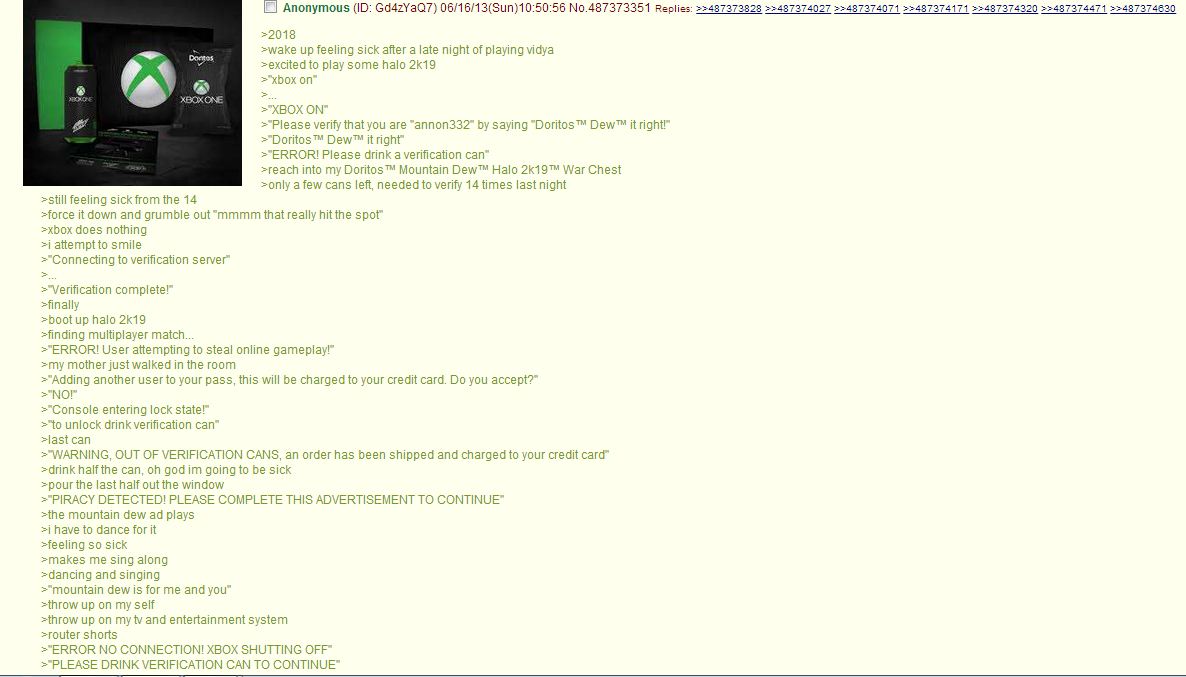
Microsoft makes a web login seem like some kind of lost knowledge like Roman aqueducts.
It continued to be so, and then Microsoft forced everyone to switch to a Microsoft account, deleting the account of anyone who didn't do so (in complete violation of Notch's original sales contract with players). If you watch the progress bar of Prism Launcher logging you in to a Microsoft account you see it logs into Microsoft, goes through a bunch of indirection, logs into Xbox (!!), bunch of indirection, then logs into Mojang. And then you get to launch the game.
It used to be a simple endpoint with username+password -> auth token. Not any more with Microsoft!
All went relatively well, until I needed to share the slides with others using Office 365: my first try of sharing the slides by clicking the Share button inside Office for macOS caused it to upload to SharePoint as read-only: not even myself (the document owner) could edit it.
I said "fine, I will just upload the .pptx file manually", and it worked well enough, until the file came back with some comments for fixes: now if I clicked the "Open on desktop" button, it kinda created a local copy that I could never sync with the remote one, but they're still clearly the same file because it did show as the same file when I went to properties on both desktop and web versions.
At that point I was getting really pissed off, so I started editing locally and copying my changes to the remote version. Office still had one more surprise: I could copy whole slides remotely, but copying part of a slide (say a rectangle form with some text) would instead convert that part to an image. Seriously, what the f*ck Microsoft?
My wife has her own account, and our accounts are bound to our controllers. When you press the xbox button you are immediately signed into your profile, and it's instant. When she launches a game with her controller, she sees her saves and vice versa for me. With Baldur's Gate 3 it even keeps all her mods separate from my mod-free setup.
Some game publishers (activision, ubisoft et al) require their own accounts, and that's usually also taken care of automatically. The xbox goes and sets up a profile on that publisher's system on first game launch.
I mean, come on. The vast majority of services that have apps running on TV implemented QR code based login workflow ages ago, and it just works. For Xbox, logging in is always a struggle.
Microsoft is a joke.
Why on earth does this it require a login in to play!? I'd prefer to emulated the OG box version, but that is one emulator I've never got working.
Well, adding a screensplit co-op now requires a log-in, which requires a phone to register via a QR code, which, after about 5 minutes of trying, completely failed. So we just turned it off and played Catan.
This is a big reason I try to keep my old consoles alive. My OG Xbox is queued up ready for a clock capacitor replace so I can fire up real Halo CE any time I want!
I had one I received as a gift. Every week or two it would boot up to its green Welcome screen and then just sit there animating itself gently, without being interactable in any way. This is how it does software updates. Apps that have problems with things like server outages tend to just sit there failing silently, eventually taking the whole machine down. Sometimes It complains that wifi is too unstable to install an update and demands a wired ethernet connection instead.
Every month or two my unit started locking up at random forcing a system reset and reinstallation. I'm not sure why, mainly it runs youtube, netflix and crunchyroll; I've never enjoyed the feel of the xbox controller for gaming. You can't get any sort of technical information out of it unless you want to pay $30 or so for a developer pack, which provides some basic OS utilities and lets you run your own unsigned apps. I briefly considered doing the latter so I could make dashboards and browse them on the sofa, but I grew to despise the xbox design ethos so much that I just bought a PS5 instead.
I also have a ps3, which has been going strong for >15 years and only ever hiccups if the power is cut suddenly and it needs to do a disk check/repair on its next boot - in which case it informs me clearly about what's happening and why. The only reason it's not my main console is that companies like Netflix and crunchyroll stopped supporting the platform. I still boot it up sometimes so I can watch things I paid for via Amazon prime without ads, because Amazon stopped updating their ps3 app some years ago but it still works.
I started out with MS-DOS back in the 80s... errr, the 20th century and was technically invested in Microsoft's way of doing things for years, as it balanced technical depth and accessibility with an approachable user interface, without the constant tinkering and driver annoyances of Linux. Nowadays you would need to pay me to use it. The only gripe I have with Sony hardware is that there isn't any way to self-sign software if you want to make your widgets or apps to run on your own machine. The closest you can get is installing Roblox and then using their free developer tools (engine + a Lua derivative).
Does anyone even provide real information? What is the point of even asking for a name?
On booting the game, you're presented with the text "Press X to join" in the second player slot. That's a lie, pressing X just makes the screen flash.
Had to search online what to do. Turns out you need a Playstation account AND Microsoft account, AND they need to be linked just to join as a split-screen player. However, no prompt or UI is implemented to explain or do any of those for a second player.
Ok, setting out to do this BS. Feeling nostalgic about Halo CE LAN parties with 0 internet connection or accounts needed. She logs in with the PS account which she had to make to play another couch co-op one time a year ago. That itself was for no reason other than to boost Sony's MAU metrics but I digress. MS account made. I assume you need to create an Xbox gamer tag too, so we do that. Back to Halo, same flashing screen issue. No prompt appears to link the PS account to the MS account. I have a hunch that MS is incompetent and didn't implement the linking process except for the primary player. I'm right. You have to force close the game, switch the primary PlayStation profile to the second player, then relaunch the game. Finally got the prompt to link accounts. Now "Press X to join" works. Truly egregious how poorly implemented and communicated this is.
At this point we're 45 min in and have lost interest.
>I don't want to know what life is like having xbox hardware
For several years, you've been forced to login with a MS account on first boot.
Fortunately, it's nothing like what you experienced at all.
but it is so hard to give them money on it
i dread buying new games as it is a game of chance what way might work this time
Xbox, the topic of discussion, is literally famous for a 'red ring' hardware failure.
Not that I am defending M$FT here. I'm just clarifying so we don't drift into calling everything a "Nintendo" like my parents did.
I have a ps4 and I undusted it a couple of weeks ago, then after a couple of os and game updates that took 2h to finish, they asked me to subscribe to playstation plus to play online and to basically use my internet.
What exactly is the point of a console at this point?
Anti-cheat. Knowing that if you get into a match with other people they won't be running software on their system that gives them an unfair advantage.
??? It's not the early 1990s anymore where you had to fiddle with autoexec.bat and assigning IRQs to get your DOS games to run. The only "downside" of PC gaming is that the hardware isn't subsidized like game consoles are, so you're upfront investment is a couple hundred bucks more. But then you don't need a subscription for multiplayer gaming, and PC games are cheaper (80 Euros for a game? come on...)
Tried two browsers to no avail. Found someone on Reddit that suggested resetting the password and finally managed to make progress. Utterly loathsome software, how the hell does a tech company exist when they can't even get their login system working properly?
1: all because I needed to change the country, now that I'm not in UK any more, as the game required age verification just to allow access to the multiplayer functionality. Thanks, Starmer.
Sail the high seas my friend.
It was pretty great up to the 360, but with the Xbox One everything went to shit. Game consoles were meant to be plug-and-play, today they are more hassle to setup than a PC with Steam (ok, I guess Playstation isn't quite as terrible yet).
Sorry though, i just reinstalled MCC yesterday to play Halo 1 myself, and lucky me my Microsoft account worked fine
Weirdly, in my limited experience it seems that 'premium' / AAA games are more likely to require an account - I suspect it's because they want to be able to save unlocks/progress for those players. Perhaps they think it will incentivize those players to buy a copy of their own.
Microsoft's gaming division was in an absolute shambles and that was before they gutted it.
Or any Rockstar game on PC since Max Payne 3, for that matter...
Or Ubisoft titles etc etc.
These days? Not so much. I’ll never be able to be sure I can play GTA VI in twenty years. It just sucks not owning anything anymore. I know why they do it, it’s a massive profit difference.[1]
On the PC end of things, it’s not as bleak. Services like GoG let you download the standalone installer, DRM free. I try to get any single player games I can from GoG, you should too.
Support the corps that give you ownership. Buy those Blu-rays of your favorite films. Either to support physical media or to ensure you will have it until data degrades.
There's more entertainment of every kind, including video games that don't lock you down, then you could consume in a lifetime anyhow. If you limit yourself to just what doesn't lock you in, yeah, you may not be playing GTA VI, but it's not like you'll lack for good games.
On the one hand, buying a subscription service for $20/month does give you instant, temporary access to a lot of things... on the other, consistently putting that money into media acquisition over the same period of time will build up quite a collection in a few years. Remember that you don't just have to buy blockbusters... you can raid garage sales, you can buy used, you can pick up surprisingly cheap collections like [1], you can hit the Salvation Army... what you find may be haphazard but you can bootstrap a collection cheaply, and may find some surprising stuff on the way.
[1]: https://www.amazon.com/dp/B006LOC01G - but look at the used prices, not the new. There's a lot of things like this on Amazon where someone thinks they can get a lot of money for it "new" where the used market reflects the more accurate market reality.
First line in the article. An Xbox owner who did the right thing by buying physical copies is still unable to play their games.
I don’t play on Xbox, but my kids do, and Overwatch worked fine yesterday (which is a Microsoft property). So I’m not sure what the outage is, but not being able to play discs is a real punch to the gut.
Disks can be locked in and digital can be completely free.
That's not the right thing. According to Stallman, that's the opposite of the right thing.
The resulting early Xbox One pivot removed features that would have been useful when systems were down and replaced them with "offline capable theater" instead. (The same pivot that also killed the Kinect and Xbox One multitasking and host of other useful media features.)
No reason to play by the rules if decency is not in the picture anymore.
How do you plan on maintaining your CD and DVD players when the new ones will be sold with a subscription plan like printers?
A day may come where it is the only option. In which case, personally, I will still advocate for not getting in the box. If they're going to hold "music" and "movies" hostage tell them to go fuck themselves. It's your money they're using to lock you in. And the day that I have nothing left that can play MP3 files is too far in the future to be sure about anyhow.
If you're really concerned that that is a likely future, you need to be joining with me now, not trying to discourage me about the hopelessness of the task. The only reason it's hopeless is your apparent willingness to pay other people to lock you in. If you don't accept that bargain, you won't be locked in.
Further helping is that these closed ecosystems tend to collapse anyhow. If you're locked in, why spend money on giving you good content? Even if they are appealing today, they won't be tomorrow.
https://blog.playstation.com/2026/07/01/physical-disc-produc...
"But the bait looks so nice!"
Yes. Yes it does.
Yes, you may have to sacrifice and not get some things you want in the moment. Our capitalistic overlords have demonstrated that they will absolutely abuse you to the maximum extent you permit. If you are willing to give everything to play GTA 6, then they will take it.
The compensation is that there is already more than you could possibly do available in spaces where they are not locking you in a box, or you can break out of the box with minimal moral quandaries and technical difficulties.
This isn't really news. Control your desires or they will control you is not new wisdom. Though the modern ability to exploit other's inability to control their desires certainly does have some new twists on it.
"Each man's master is the person who has the authority over what the man wishes or does not wish, so as to secure it, or take it away. Whoever, therefore, wants to be free, let him neither wish for anything, nor avoid anything, that is under the control of others; or else he is necessarily a slave." - The Encheridion Of Epictetus, second century AD
https://en.wikisource.org/wiki/Page%3ADiscourses_of_Epictetu...
I agree, the right action as a consumer is boycotting rent seeking products and pestering politicians. But it does feel hopeless as too few of our politicians seem to care about these sorts of seemingly minor grievances.
That's what collection is for.
Or make your own games or play ones made by indies that you can actually own.
If the death of physical media locks me into playing whatver is forcefed to me by AAA studios, I will reject that bargain and engage in the decades of backlogged media I haven't gotten to yet. If every studio stopped making music, movies, and TV today, there is still so much I haven't seen/listened to/played that it won't even move the needle.
Lastly, going against the grain here, but GTA 6 looks about as unappealing as it possibly could. I don't want to play 2026 Simulator, no matter how good it looks. Really it just looks like parody version of current politics and society and that's what games are helping me escape from.
If you buy physical media, you should rip it to FLAC and put the original disc in a safe place.
We've all heard this. But let's not forget that recently, some important representative of Microsoft went and told some important politicians, that buying is stealing.
Yes. She said that buying is stealing. Buying the game and playing multiplayer on your own server is stealing, more specifically.
So if buying is stealing, why not pirate?
Assuming you’re not redistributing, of course, which is another thing entirely.
> digital copies sourced from the high seas
However, content shifting (i.e. ripping from CD to digital) is a thing, and that's what I do with my physical media.
> As AI assisted static deobfuscation continues to improve we will see more virtual machine based obfuscators fold away. In an upcoming article we will publish details on how we fully statically devirtualized Denuvo anti(tamper/cheat). One of the most attacked pieces of software second only to anticheats.
…or you can not bother with analyzing at all and just feed correct CPUID/shared data/whatever values to Denuvo, like the hypervisor thing does.
On the Microsoft side, they've been incredibly good about first-party backwards compatibility. I bought most of my Xbox 360 games digitally, and I have been able to play them on my Xbox One, Xbox Series X, and now they are even bringing them to PC. My son and I were just playing the timeless classic NBA Jam: On Fire Edition (a 15yo game) a couple of days ago.
Emulation development will probably be significantly enhanced by the ability to use LLMs as well.
If GOG went down tomorrow, those games would be gone just the same as the Steam ones, since I gave up trying to back them up a decade ago.
On top of that, those updates can be kind of useful. None of my GOG games run on Linux, while most of my Steam games run on Linux. Also annoying: None of the GOG games run on a genuine Win9x either, as what you are getting is an updated version for modern Windows, not the original game.
Either way, I just don't think DRM-free is the proper solution for media management today or in the future. The olden days of static media are largely gone and the modern world is just way more fluid. So far none of the proposed solutions are able to capture that properly.
Your Steam games run on Linux run due to Valve's (truly excellent) work on their compatibility layer. However, that work is not exclusive to Steam. I can play my DRM-free GoG copies of big budget Windows games just fine on Linux. There's an extra step you have to invoke, but they still run superbly. Supporting DRM-free is the best we have in an increasingly hostile customer market.
I don't want to write a redo of the infamous Dropbox comment, but if you really want to go /r/datahoarders on it, you can simply have a GOG downloader running in a monthly (or whatever) cronjob.
> None of my GOG games run on Linux, while most of my Steam games run on Linux.
That's funny, I don't have that issue at all. I have whatever GOG 3rd party client running on Bazzite do the downloading & updating for me, and the only game with which I had an issue was Timberborn.
Absolutely not. Libraries and archives are able to keep digital copies, with limits imposed on how they may share them, not on what they're allowed to keep. They're not allowed, without a convoluted exemption, to break DRM. So if Steam disappears, we're all collectively dependent on our ability to break DRM to maintain our culture accessible. Games that use draconian authentication could simply disappear. With GOG, the only thing stopping us from having easy access is our ability to walk to our local library.
That's a you problem. I keep mine backed up. GOG even makes it easy to just go grab the latest patch if you downloaded the base game years ago.
>None of my GOG games run on Linux, while most of my Steam games run on Linux. Also annoying: None of the GOG games run on a genuine Win9x either, as what you are getting is an updated version for modern Windows, not the original game.
Solvable with Wine/Proton (or a Proton fork). If you want to be lazy Heroic launcher makes it easy and even logs into GoG if you don't have them backed up locally. Heroic launcher lets you pick what you want to use to run the game whether it be Proton/Wine/Etc, this even works with Game-Porting-Toolkit on MacOS.
Stop spreading misinformation. Even if you're a non-techie you can add non-Steam games to Steam's launcher (my extremely tech illiterate friend just did this) and they'll run with Proton.
It comes down to a game by game basis, and it's still extremely rare (outside of recent 2025/2026 anticheat AAA title stuff) that any game would have a Linux specific/impacting patch.
I shouldn't need an online account to use 99% of the things that I have that currently require an account.
It's much worse with Gaming. At least with TV/Movies/Music there are standards-based 'offline' formats that one could preserve the content. Games, on the other hand, may be intrinsically tied to proprietary hardware and online 'live' services for patches and content. The recent hubbub about Sony removing disk access was somewhat of a red-herring as most disk-based games you buy today have incomplete games.
This isn't a problem with physical copies because there's a lot of friction to selling stuff, and there's also something quite nice about having a physical collection of games, music, or whatever else. But with digital stuff there's no friction, and much less incentive to collect. The efficiency of the digital domain really messes with a lot of things we take for granted in the real world.
That seems to be somewhat of a myth.
Discussion here, 37 days ago: https://news.ycombinator.com/item?id=48698374
https://www.eetimes.com/The-real-casualty-in-high-def-DVD-re...
You can not only buy music on physical medium (CDs or vinyls) but you can also buy, legally, DRM-free lossless music.
And once you own that music, your right to listen to it (privately) cannot be removed from you.
And for, say, a vinyl or a CD, both in the US and in the EU, your right, for example, to sell that CD at a garage sale cannot be removed from you.
And just as I can, today, boot a Commodore 64 from the 80s, I'll still be able, in 40 years, to boot a Raspberry Pi and play my music files from it. And play my CDs if I've still got a reader.
P.S: FWIW I rip my audio CDs to lossless files, in a bit-perfect way (which is automatically cross-checked with checksums of people who made the same rips, so we all know our rips are bit-perfect).
I can still go to the store and buy some music on physical media, and (if history is any indicator) I can still play it forever until it or my playback equipment wears out.
As a practical matter: You do know that when I spin up an album at home, I simply do not care what limitations any licensing agreements may or may not apply, right? I'm going to play it anyway, and it will work when I play it -- free from outside influence.
At least there are already extensive ways to get a game cube running games off an SD card using a pi pico and some hardware that uses the expansion port.
So even once disc rot takes away the original copy you can keep going.
Always good have backups and/or modded consoles for longevity.
So my theory is that GTA 6 is somewhat larger and they really didn't want to invest into engineering a solution for multiple-disc or something when ~everyone downloads their games nowadays anyways. So in some sense, the true physical release "can't" exist.
This doesn't apply to most anything but GTA 6 is the one example I think could very realistically be unable to be stored on a disc at all, or unable to be stored on a 3-layer and the supply chain just isn't there for 4-layers in 2026.
The current Gran Turismo is around 140GB. I think it has a disc, but it'll only have like half the game on it.
Final Fantasy XIV is around 200GB now, and they're talking about dropping PS4 support because drive capacity is going to be too low during the patch cycle for the next expansion.
Also, median US internet is over 100Mb/s now, so downloading a game is faster than installing it from a BluRay reader. And then you don't have to get up and change discs to change games...
Regardless, most console owners buy their games online. Otherwise there would be more games than Funko Pops at GameStop. They also have frequent sales, unlike retailers.
Your point stands, though. Games have grown so huge that downloading them isn't a hassle for most, but disc definitely is or has maxed out. That's not to mention how long it takes to install stuff, especially on PS5!
They know people will buy it regardless of format and price, so not having to spend money to print those pesky little discs is a major net profit.
GTA VI is a cancer slowly metastasising. It will signal to all other game companies that they can charge whatever they want for their pos games and people will just swallow it all down because their favourite nobody with a YouTube channel told them to.
We were already heading for an even darker age in gaming, but mark my words, GTA VI is the torchbearer of an altogether darkerer.
Greetings to /r/datahorder bunch :)
There are many more examples like these. Very sad state of affairs.
Otherwise, there is only one option left, make it illegal to do certain things and ensure the ownership belongs to customers.
But e-books? Holy crap the drm on those things is soooooo annoying to avoid.
E-book DRM is crazy, I agree. I should have included that.
It’s slowly improving, though.
The DRM will be cracked. You will be able to play and you WILL have a better experience playing a cracked DRM free version than any official version.
You can play an emulated Mario Kart Double Dash on a Steam Machine (or any PC) today and get a better experience than playing it on a Game Cube.
Digital only games sounds bad at first but preservation of video games will be done digitally more effectively than physically. How many full rom sets of Super Nintendo games are just sitting there on millions of PCs around the world? It is trivial to preserve them: copy paste to a new machine. Done.
Disks will rot. GameCube optical lasers will fail. One day, maybe not soon, but it is it inevitable that all disk based games will become unplayable and lost one day. Maybe if we’re lucky an independent company will create an accurate FPGA based GameCube for people to play their games but emulation is just better.
Prices on the second hard market will be astronomical making physical copies innaccessible - this has already happened for arcade PCBs and it will happen for disk based games. PCBs that used to go for a few hundred now go for tens of thousands. I personally believe that this push for physical preservation is largely driven by speculators that know this. You see insane prices for things like sealed copies of Super Mario Bros already. PCB prices were driven up by speculators hoarding supply and they’ll do it for console games too.
If buying isn’t owning then piracy isn’t stealing.
Preservation needs to be about accessibility FIRST.
Physical Videogame Preservation Makes No Sense: https://youtu.be/3rM1jaFvM58
I started writing my own world of warcraft server about 20 years ago by disassembling the WoW binary. I got to the point that you could log in to the game and run around in a big empty world. I even found a couple mistakes in wow's in-game encryption in the process. Lots of teams have gotten much further than I did. There's whole communities who play wow on private servers.
If we can do that for MMOs, we can do that for just about anything. Especially with LLMs. LLMs are incredibly good at this sort of work.
Though it would be nice if more game makers ultimately provided a server. That used to be more common.
That "if buying is not owning then piracy is not stealing" sounds corny and is legally void, but hell if morally it is not justifiable at this point.
When I want to support the creator I go and "buy" the thing, but I also go and pirate anyway.
A law isn’t by default just, so when it turns from a safeguard into a manacle it is only logical, fair and correct that we rebel against it.
If buying does not imply ownership, then piracy cannot mean theft.
i went back to recomps and emulation
If I buy a game/movie/book/song, regardless of where or in what format, I should be able to:
1. Keep it forever without the risk of remote deletion.
2. Use it while offline, unless internet connectivity is strictly required for the experience.
3. Move it between my devices.
4. Backup and archive it.
5. Resell it.
6. Pass it on to my children.
Beyond that I don't really care what the container for the bytes is. If the game isn't sold on a disc I can easily burn my own.
Every publisher can offer all of this today, but they choose not to. And proprietary devices/formats means the free market isn't going to work in the consumer's favor. The only thing that can fix the problem is legislation.
*Deleting* data (and its cousin, *moving* data) is a nearly intractable problem. How can you verify that someone no longer has access to data that you gave them?
The best we have is to have some sort of ownership token that is maintained in a shared store, and build a requirement that possession of that token is required to use the data. Even this is practically nearly intractable; you have to have some sort of "trusted" hardware or software that is responsible for validating the current possession of the ownership token before using the data.
Physical media is another way of trying to solve this problem, especially if the physical media can somehow be verified and is exfiltration-proof.
[1] I say "technology" here but really I strongly suspect that this is actually impossible given reasonable theoretical assumptions around what data means.
1. Keep it forever without the risk of remote deletion.
2. Use it while offline, unless internet connectivity is strictly required for the experience.
3. Move it between my devices.
5. Resell it.
6. Pass it on to my children.
No backup and archive is the exception. I can live with that. We'll see if Sony and Microsoft follow Nintendo or not.
I am all for 1-4 and 6. But reselling digital copies is silly.
I really can't. The only argument I see is "we can't allow it because every customer is a potential thief". What will enabling resale cause? Piracy? Well piracy is happening regardless. People who want to illegally download games can do it today in one click. Instead the piracy excuse is being used to restrict legal resale so you have no option but to pay the publisher's inflated sale price.
By allowing resale of digital copies outside of platforms all you get is essentially the complete repeal of intellectual property rights for digital media.
I think as a compromise I'd be okay with some kind of license database (maybe blockchain-based, maybe not) that keeps track of who owns a legal copy of what. People reselling digital copies of copyrighted material would have to transfer ownership of that license to prove they're conducting legit business and not just minting new copies out of thin air.
One of the more galling aspects of the inevitable US-NATO[0] trade war is the fact that nobody is willing to reevaluate the legal underpinnings of US tech hegemony - namely, copyright and anticircumvention law. All the proposals for sovereign tech are really just "let's build more AI data centers". People like Cory Doctorow who have the actual way to play hardball with Trump - "let's get rid of anticircumvention and declare open season on AppleMobileFileIntegrity.kext" are sidelined as "IP thieves". Hell, even the Stop Killing Games people got brushed off by the European Commission with an excuse almost like "we can't mandate your game purchases work offline, that'd be stealing".
The reason for this is pretty straightforward: the moves done in the 90s to ensure digital purchases meant no ownership were as much a product of Europe as it was the US. Actually, the vast majority of international copyright law is actually a European invention, and the US was the last holdout on things like copyright registration and fixed (as opposed to life-plus) terms. Europe spent centuries binding the world to the most extreme version of copyright imaginable, specifically to ensure developing countries would never be able to actually economically develop.
Every country that has economically developed itself does so through a subsidy of IP theft. The Industrial Revolution was owned by England but stolen by America; and America itself wound up being stolen from by China, Japan, and South Korea. Economic development is not a game you win by playing by the rules, because the rules are designed to keep the winners on top. The entire debate over games preservation and ownership is downstream of the fact that the big American and European cultural industries are not financially viable without you renting your culture.
The reason why the fight has focused on physical vs. digital is that it's the one battle we've been somewhat victorious on. Physical ownership has generally been treated as sacred: Microsoft tried using the Xbox One launch as a way to massively restrict discs, and it created a backlash so large Xbox never actually recovered from it. Sony in contrast had to boil the frog[1], and Nintendo wound up doing so more or less by accident[2]. And when game consoles have problems loading physical discs, it's still treated by console manufacturers as a bug rather than a feature.
[0] In practice, the US vs. all of it's allies, including non-NATO ones.
[1] They were clearly intending to kill off discs with the PS5, just from the industrial design alone, but didn't actually do it until mid-cycle when everyone's actually bought their consoles and thus the impact would be minimized.
[2] It has been Nintendo policy since the 3DS to ban anyone who goes online with a duplicate cartridge ID. I don't think this was intended to poison the used market, but once cheap Switch flashcarts and means to clone cartridges became available, it absolutely did. The people using 3DS homebrew to load pirated games at least had to know what "public headers" meant in order to avoid getting banned.
No internet? Games work offline and support LAN if you have a switch and a couple of consoles.
In 2026 I can still insert any used disc I bought in my ps3 and it will generate a (offline) client-side license for me and let me play and update the game with the disk inside just as a "proof" of still owning it.
If I'm online I'll get patches, else I'll just get served the version on the disc.
(Btw, ps3 also has a print spooler and can natively rip CDs and serve them while acting as a NAS. Or, you can stream games to your psp with remote play. It was truly a "let's cram everything we can inside" era and more like a proper pc with a mediacenter interface)
That's not true. Naughty dog shutdown online servers for their ps3 games in 2019:
https://www.naughtydog.com/blog/uncharted_the_last_of_us_mul...
Rockstar games shut down gta online for ps3 in 2021:
https://www.rockstargames.com/newswire/article/51989315o2aa3...
To be fair, there are private servers for these games, thanks to reverse-engineering efforts, but those are community efforts.
I’m not sure whether this is because of the PS3 client-hosted server model, or just poor coding from COD.
Either way, I gave up eventually. It was a brief passing thought one evening; I’m sure if I really wanted to I could figure out a way to play properly. But you can’t just put the disc in and play online, at least in my experience.
We need to have this right codified into law before we lose it.
Do you know about this tool called Ghidra? It makes most programs open source. Not the ones with DRM, though.
It all depends on where you buy your games of course; GOG will let you download DRM-free installers, but if Steam goes down, your libraries goes down with it. They have made a vague promise that they would prevent that if the company ever went out of business, but who knows if they will keep that promise.
Guarantees about playability went out the window the day free, easily-obtained updates came out on PC as much as consoles.
At least on the PC side, there's a vibrant piracy community.
Starting next generation when prices are going to be obscenely high, I'm really struggling to see why anyone should invest in a console as opposed to a (mini-)PC.
GOG is different in that they ban DRM outright.
That and people simply trust steam because it has always been trustworthy (on the whole).
The only one that comes to mind is the “outrage” when they decided to release L4D2 just a year after L4D back in 2008 instead of making this a free upgrade. Times have definitely changed. looks at yearly COD with barely any changes
Some have DRM, of course.
Before I even play the game without Steam: how do I download it without Steam?
Regarding the download, it's the same issue with physical media. If I don't have the DVD, how can I acquire the game?
You wouldn't have to figure it out yourself. They didn't need a hex editor. But they did understand "download this file, go to this part of Program Files, move the downloaded file here and agree to overwrite". You'll find similar guides online. They already exist, because it's the same as if you're trying to pirate a Steam game!
People will do anything for the dancing bunnies. Both good and bad.
I know technical people can do it, but I do not believe this is a path for the non-technical user.
The proposed steps are:
- buy game on steam marketplace (no client) - download and install games (client required) - uninstall steam client and paste in fake dll file
But now I want more games… so rinse and repeat? This is a lot of work.
Or so I assume. I have Steam installed, so I wouldn't know.
Obviously if you buy it with steam you need Steam. But you only need it at the time of purchase, for the vast majority of titles
https://steamcommunity.com/discussions/forum/0/5540051992994...
How do you run an application? Depends on the application, as they all have different filenames...
I trust Valve not to screw me over, even though I know they totally could. Their own DRM is pretty weak (just put a modified DLL in the game directory and the game will launch), luckily.
Currently probably because of Valve's work on Proton, and before because Steam just worked and didn't seem to exploit players.
I use Steam but I also know I’m vulnerable to a rug pull. We all are. That’s why I’ve been shifting over to GOG and making sure to back up my library in an organized fashion. I wish I had done it sooner, but hey, today’s the best day.
As for warnings, I mean…come on man. That’s like hiding behind ToS. Let’s be realistic here: how many people here (including yourself) see a game they really want, see it has a little DRM note on the uttered store page, then decide never to buy it? Few people let that stop them from getting a game they actually want.
I don't buy games that require third party launchers ever. Been burned losing my Ubisoft account or w/e a few times. The warnings are helpful and steam doesn't have to say anything at all.
That’s the entire thing this conversation revolves around…
If my e-reader had a bad battery after years of use, I should be able to replace that battery myself without issue (personal skill allowing). I purchased it. Why wouldn't you be able to? I haven't yet found reason for this in consumer devices, except because they want you to send it in or buy a new one from the manufacturer.
Every time we see something like this, it doesn't get enough eyes or care from those who use these platforms. Sony takes your movies away, Xbox requires you be online, Amazon updating your books automatically without asking you, etc. My favorite that I repeat constantly is all of the BS that BMW has done over the years: heated seats subscription, proprietary bolt heads, ads in the infotainment. If you buy a BMW at this point, I'm sorry, but you had alternatives and I don't feel bad. The scary part is when enough people accept it that everyone else in the industry follows suit and then the outliers are the ones that respect you.
If I purchased a physical disc, I'm not even asking for the source code (which I'd love), I'm just asking that I can run the damn software I bought, but you can't even do that now. Viva open source and right to repair. Make the educated choice when purchasing software and hardware, to your benefit, where appropriate. Of course, the proprietary system is what you need/want sometimes, but I bet most of us don't most of the time.
Come on crypto bros - we need you!
The internet money thing aint gonna work. Look at the pyramid on the back of the dollar. It's esoteric. They will make you disappear and make it look like an accident. Look what happened to Ross.
This isn't even a reply anymore, sorry knollimar
After 1000 logins I get the source code.
This is too much like rent, it's not fair.
I wonder if it's legal to build a completely scam store like this. You pick a game, you click on "$7", you pay $7, you don't get anything at all, and if you try to sue them, they point out they never actually sold you anything, you just voluntarily clicked on the button to donate $7.
Now, everyone laughs about the "ridiculous" pricing of the Steam machine but once hardware prices come down they will make a second generation that will be an unlocked PC in the same form factor and probably just as powerful as the next-generation Xbox. They might even pass on some of their supply side bargaining power to the end user. Then you will have the choice between a fully locked down Windows PC that only plays Xbox games for 1,000 USD or a fully unlocked Steam machine that plays everything from the Steam, Epic, GOG store, can install regular games and even lets you do work on it, for probably around the same price. Built by a company that has the highest gamer trust of any company we know. Guess this will be a no-brainer for most folks! They have everything to pull this off as well, the brand, the trust, the gamers, the store, the platform, the money, the market power as well as experience with hardware. My take is that they wanted to pull this move already but the AI craze made that impossible so they are using the first-gen Steam machine to learn about the market, but I predict that once prices come down we'll see an announcement, they can time it to match the new console generation by Microsoft and Sony as well. The market should be in a great state by then as well, lots of folks were essentially priced out of the GPU market and NVIDIA won't even release a new generation of gaming cards anytime soon, so all those people that have the buying power but don't know where to put it would flock to a new Steam machine if it can deliver good performance for a reasonable price. And the thing is Valve will have the power to make sure studios optimize games for the Steam machine as well.
Really don't know what Microsoft is doing here, they turned one of the most profitable and beloved gaming platforms into something that seems to be in a death spiral, people are already speculating they might sell the whole thing off eventually.
HN is the propaganda arm of a billionaire enrichment company, so it's understandable that someone might be unsure whether you're allowed to say that word here.
In practice, I often end up playing those games on the Steam Deck, but I know that in 20 years (if I keep that drive alive), I'll be able to easily spin up wine and play those games just fine.
I was such a loyal fan, but the Xbox One made me go from an avid gamer to a casual gamer.
I thought I was done with gaming until I picked up a Nintendo Switch back in 2018 and I rediscovered the joy.
I gave Xbox one more chance with the Series X and that was the final nail in the coffin.
I only play on Switch 2 and Steam OS nowadays.
https://support.xbox.com/en-US/help/hardware-network/connect...
You can play digital titles, too, as long as your console is set to "Home".
I played Forza Horizon 3 for days without internet a couple of months ago.
The trouble is, you would have to know about the outage first and go offline before attempting to play.
Do you have evidence of this? I've played Xbox for 25 years and never seen this.
The entitlement only lasts a few days. If the online check fails and you’re otherwise online, it gets revoked .
Nearly all DRM systems are fail-Closed not fail-open.
I suspect it's actually because the authorities don't know what the project is, if it's only code, or they can't be sure it's an infringing derivative work (it is).
You just connect a controller right?
Nah, on ps5, you need to setup a whole ass sony account, and then login to it, and then you need a new microsoft account to link that sony account to, and then maybe, you might be able to play couch co-op.
This is an important point distinction that many people of physical media are missing or being distracted by. All this backlash could be put to better use by supporting game ownership.
You can't play the game you own if the product has to phone home. I'm not getting why people are up in arms about the physical product while DRM is in place that prevents you from playing it.
Xbox is the worst about having a dependency on the internet to play your physical media.
It's even more annoying for me because I often have phases of only playing every 2 months, so it's always true that I would need to update first.
Your kid isn't going to know what it was like to play it back then, throw them the classics and sigh in relief knowing that's he's not being tricked in to corporate exploits such as loot boxes, skins and the likes.
My eight year old nephew loves my old mega drive.
But you are mixing Sony and Microsoft here. Sure, both are bad, but many PS disks are totally playable without internet connection.
But, I was traveling for work and brought the non-"home" Switch with me along with a copy of Breath of the Wild on cartridge. I fired it up on the airplane, ready to go. And then discovered that because I had bought the DLC and the DLC license check couldn't pass, I was locked out of playing at all. It's given me pause on buying any other DLC on a Nintendo platform.
I just bought a Nintendo 64 and a Wii and it's great just being able to play my games with my kids and know that in five years nothing will change.
Your client does not have permission to get URL /comic/2026/07/03/returnal-3 from this server.
What does it say?
It's an interesting point, though not 100% accurate due to how there were early video game consoles at the same time as arcade games. Pong clones were common for home play in the early 1970s, and things like the Fairchild Channel F and Atari 2600 date from the mid to late 1970s.
What would stop me from playing it, outside of the hardware dying?
We are back to where we are in the 2000s: the gatekeepers of large tracts of culture are behaving so badly that piracy is probably going to end it's lull. It is a shame for artists, developers, and anyone else who needs to get paid that companies running genuinely very good services have chosen to behave so badly.
Now, my motto is: if I can't run it safely in an emulator and download the files from some "abandoned wares" site then I don't care. And I have zero moral problems with that.
I am pretty certain that there are different legal requirements nonetheless. The author kind of tries to mitigate the danger of big corporations forbidding physical media. Does he think that these corporations have the good of the people in mind? Or are they more interested in milking their cash cows?
Thankfully I am not the target audience anyway. I don't give my money to these greedy corporations to begin with. Them disowning people further here, by killing physical media, would just have been another stepping stone towards a movement away from these big corporations anyway. I don't have time to play games anymore anyway due to old age, but if I would I'd much rather support Indie games - with physical media.
historically, at least for me, games never worked... i spent more time fixing why they didnt work or debugging them in memory to patch them to get the game to actually run then actually playing a game. This is circa 1983-1987 too so maybe we have progressed from there, but obviously not much.
If you where to start gaming again (at least, as the current vendors intend) you'd find that the bugs you had to account for in the 80s have been (generally speaking) resolved as a byproduct of the DRM/Cloud streaming propagation we're all complaining about.
IE; consolidation of vendors, locking down the way a game propagates, restricting the lifetime of a game, made it "easier" to play games the absolute one way the vendor intends. This gives them the excuse of "Well, we designed the game to be played via perpetual license through only this platform, we can't support or claim responsibility anywhere else".
Which is to say, your comment made me think that the reason the industry is the way it is isn't because money/lawyers, but more because some product managers decades ago began pushing for consolidating/defining video game lifecycles.
Not saying that's happening here, but 99 times out of a 100 it's either a spambot or the autofuzz, not someone deriding your opinion.
Consoles, Apple, Google, etc.
Everything else is in this position of "actively at risk" where if someone isn't "keeping it up" it may just disappear, at least until it gets orphaned, in which case I suppose reverse engineering is back on the table
> so much archival work with high quality highly compressed game releases
I don’t have time or interest to figure out how to go on the Usenet and research the reputation of scene groups.
Until CPUs only run "approved" operating systems → mandatory age verification == government ID required to use any OS in a non-crippled form → browsers refusing to open "illegal" sites.
[Delete File] [Notify Authorities]
The real risk, IMO, is live service games that don't function at all without the server being online. There are games where fans have reverse-engineered and made their own server, but there are definitely ones that will slip through the cracks and be forgotten too.
1) The server doesn’t do much other than connect the players, and most of the logic is either client-side or trivial.
2) The server contains a fair bit of game content (such as drop and spawn rates, maybe even NPC dialogue) and the community has done extensive packet captures while the server was online.
3) The server binaries were leaked at some point, and everyone agrees to keep it a secret and pretend they’re doing a clean-room reimplementation from packet captures. They are, but against the leaked server, not the production server.
Having worked on a few of these projects, you’d be surprised at how many of the successful ones are actually #3.
This is problematic because we can’t rely on data breaches for game preservation.
In the end, 1 guy owns everything and we’re all batteries.
It’s a lot of work figuring out what movies support the format. And all the premium upgrades to Netflix, etc get them to stream premium formats. Then it doesn’t work and you’re spending 30 minutes debugging your TV, wondering why you’re not getting the amazing new restoration of 2001: A Space Odyssey.
I totally understand why people just buy physical media.
Games may be harder given software updates. But I’d pay a premium for a physical copy of mature games I love (like Halo Master Chief collection)
And the 4K video is compressed to lower bitrate than a 1080p Blu-Ray anyway.
My experience is that people don't care about quality. Like there was that time I found a torrent for a movie that had 3000 seeds and found that it was shot with a camcorder in the theater and the soundtrack was in Russian but it didn't matter because the sound quality was so bad I don't think I could have understood the dialog if I knew Russian. Thing is, pirates want to watch a crap copy of a movie that's in the theater and won't even wait for a DVD quality rip, never mind something better.
Not to disagree with your larger point, but physical media can also be a nightmare. Try watching a 4K Blu-ray on your computer
Here's the crux of the problem in their own sentence and they don't even realize it.
Owning and Licensing are not the same thing. If I own something, I own it outright. If I license something, I am leasing it.
It does get fuzzy with media, I will admit. But we need the same protections as physical books and game cartidges. If I buy it, it is mine to use as I please and even resell or transfer. If that's not what the transaction is, then don't call it buying or purchasing, call it leasing or licensing.
Require stores and publishers to use language that reflects the nature of the transaction.
And this isn't anything new. Mortal Kombat X came out 11 years ago and the disc had 2 characters and a basic tutorial on it. To get the rest of the game you had to download it.
The right word for a consumer product is "rent". As in I'll "rent" this game. For $2 every week until I return it.
But the case for physical disk is not (only) about playability, it's mostly about ownership and the fact that you can actually lend it to someone or resell it. It's also about retail, and it's about collectors. About people with a slow or limited connection having access with that much less to download.
Another thing is also that if I have a physical copy, I have the right to a digital copy. So a non-working disc might not always be the end. But if I have a digital copy and they take it off the table, I do not have this right and it is gone forever.