
Ubisfot is a perfect example, look at their "Watch Dogs: Legion" for example. They decided to get creative and give you random characters generated by AI.. it turned out to be a disaster.
Another one is their Far cry games, where they copy and paste the same events but slightly different, all over the map and call it a day.
I think these efforts more have to do with bean counters taking over the industry than game designers being lazy. I'm sure there are plenty of talented people working at these studios, but they are held back by MBAs.
That purposefully designed settings and properly gated procedures can make procedurally generated realities…better? More fun?
Clutch Nixon is the only thing good thing about the last few games.
I've bounced off NMS several times, despite having tried quite hard to get into it. So, my take is based on ~20 hours of early game, from 2025ish. Probably the best parallel I can draw is to Elite: Dangerous, which I played for several hundred ours before getting bored of it. What I find lacking in both games is that there's no _meaningful_ emergent gameplay that spawns off the procgen. Everything is wildy different on each planet, yet very same-y, because none of the differences really play into each other. In both, one can discover random biomes and creatures, but it's not like they are inherently interesting, they are mostly just following the same scripts.
Contrast this with something like Dwarf Fortress, which takes a slightly more in-depth approach to procgen, one where things have history, and in many ways, things "make sense". Or Rimworld, where the game tries its hardest to conjure up a narrative for you, dynamically, but still in a sandbox. So, basically, NMS is a perfectly functional sandbox game, and I have huge respect for them for keeping on working at it for so many years. However, it doesn't scratch my "hardcore simulation / mastery" itch, and so far I haven't been grabbed by any of its story generation. It just felt like a long series of fetch quests and "collect them all" games.
That's basically it. It's not a simulation. So if you want simulation, then NMS isn't your game. Maybe X4 might be better suited. Or maybe not.
Sometimes people forget that not everybody has to like every game :D
No Man's Sky is much more like Minecraft in that way, you have to make up your own goals, the game doesn't really prompt you in any way to do anything.
If you’re looking for a scripted arc, wrong game by construction.
I think the multiplayer aspect is a bit weaker than it could be, maybe improved more recently, but it is a something that Minecraft has done well
Obviously NMS's original marketing was bonkers and capitalised on saying technically true things in ways to mislead large numbers of people.
A little bit of depth to go with all that breadth?
I'm not saying there aren't deep systems in NMS. Its just that they are sparse. You can tool around all day having only the most cursory interactions with most of the game's systems. They've added so many interesting things, yet last time I played it felt there wasn't much of anything to do with them. For example, the Pokemon clone they added a few updates ago -- fun for five minutes. Super simple battles. However many months of development for something that got old after 5 minutes.
If the game doesn't appeal to you, then that's fine too. But overall the game fills an interesting and accessible niche beneath games like X4: Foundations and Elite Dangerous.
It's... fine? It kept me engaged until it didn't. Part of the "didn't" came about because I was being paper-cut to death by bugs that googling showed me had been reported for a long time, if not since the very beginning.
I kept feeling like it was a game on the verge of happening throughout, and it never quite made it. Lots of things to go do to serve.. no purpose. Nothing was that unique or memorable, and I often had very little clue where I was in relation to anything. At one stage I was overseeing a town but that seemed to do nothing for me other than make me go back and make a snap decision for no discernible reason, occasionally fight hostile creatures, and also act as a sink for resources I was gathering.
I kept thinking "Why am I even doing this" until it really sunk in "Why am I even doing this?" and quit.
It also exasperated me that even though I was using a pretty fast gaming system, on a regular basis assets would take ages to appear, including buildings. "Fly to this place on the planet, land at this archaeological dig, wait 3 minutes for the dig to bother to appear before you can do anything." (saw identical behaviour on my steamdeck too, so doesn't seem "my machine" per se?)
This was also one of many gripes I had with Starfield.
It's always a potential danger to one's enjoyment to know too much about something though. :)
Adds persistent asteroid belts, asteroid mining, and base building on asteroids
Go wild
Modded Minecraft is a very different beast, depending on the mods
It's pretty cool to see what modders have done with it over the years. I genuinely think Minecraft + Create is the best factory game.
Of course, introducing mods makes Minecraft the most compelling entry in the genre by a huge margin, but not necessarily a fair comparison since the combined human effort involved in the minecraft mod ecosystem vastly eclipses what the NMS team could do on their own.
This is also the problem with the procedurally generated planets and moons in Starfield. Yeah, there's a whole lot of them, but they're also all populated with the SAME points of interest. You can only see a cryo lab or abandoned radio station so many times before it completely loses any meaning. It's basically the antithesis of the hand crafted world of Skyrim.
It's done so badly that you get points of interest spawning with outdoor food and beverage, folding chairs, umbrellas in icy moons that have no atmosphere and -200C temperature.
The alien creatures in Starfield were at least all designed by hand, and are somehow 'assigned' to specific planets and biomes in a way that's hard coded into the game.
Eh with a planetary cluster of that scale they have little choice. And Proc Gen is also in Bethesdas history, its how they built Arena and Daggerfall IIRC.
My issue isnt that you can see the same base on every planet, my issue is largely that when you have reached a sufficiently high level, most planets will be absolutely plastered with pirate bases. The universe goes from empty to full of RNG pirates and mercenaries so damn quickly. They really needed to create more unique encounters, but less of each kind, and spread them out a lot further.
Dwarf fortress or rim world solves that by generating personalities.
Compare it to even our own solar system where even so much as a new high-res photo of the hexagon storm on Saturn comes with stunning new and specific detail, or the "heart" on Pluto, we're practically ambushed with novel configurations of atmospheric dynamics and geology. It's frustratingly rare for games to truly activate that feeling of wonder.
I think NMS is still an unbeatable deal for what it is as a game but it's a frustrating near miss flyby of what I think people want a true space exploration game to feel like.
For example there might be a wormhole that takes you to a different destination if you fly through it backwards. You're very unlikely to find that out by chance, but if you explore you'll find a thing that tells you (probably behind some other puzzle).
Great game.
I'm not saying ending was perfect, but I can't think of a better way of ending it.
The game is 2 million light years wide, but a meter deep.
There's the Kerbal Space Program approach, where space exploration is tough and you need to learn a LOT to succeed at it. The tradeoff of this is a high sense of accomplishment, where simply landing and returning from another body feels like you did something incredible.
There's also the Outer Wilds approach, where the story carries it. Moving around isn't hard at all, but you have specific goals to accomplish that move you towards a final ending. Diversity in how you accomplish those goals makes it feel fresh.
Mass Effect is similar, where you have some freedom to explore, but it's again in the pursuit of this broader story. So exploration feels like a rich side quest more than the main point of the task.
Or alternatively Scavengers Reign
Personally I want spelljammer. Baldurs Gate meets Sea of Thieves in space with 80s killer clowns
There is so much drama that can happen there and the scale is the least of it.
The creatures, vehicles, and buildings weren't generated -- they were created by other players and exchanged asynchronously, then seeded into your procedurally generated galaxy.
Spore is a Massively Single Player Online Game: no real-time multiplayer, but your galaxy fills with other people's content.
That's the opposite of the oatmeal problem. Procgen gives you infinite bowls that all taste the same. Spore gave you a finite but large set of bowls, each made by someone who cared about it. Different tradeoff, different failure mode -- but not the one this thread is about.
GDC 2005, Will Wright, The Future Of Content:
https://www.youtube.com/watch?v=N4ScRG_reIw
>[...] Also I want to apologize for the title of this talk in the description, which I know was kind of hopelessly vague.
>What usually happens every year is GDC, they call me up, and they say "we want you to do a talk" and I say okay, and then a week later they say "what's your talk about" and so then I think about it for a while and oh, get a rough idea of what I'm going to talk about, and I give them some kind of generic title in that area.
>That's what usually happens. But this year was different. This year when they asked me what I was going to talk about, I just flat out lied.
>But, so I'm not really going to talk about the future of content. I'm really more in fact going to talk about a possible future of content you know.
>It seems like the theme that I'm coming away from this conference with so far is that the next generation titles are going to be incredibly expensive, we're going to have to build mountains of content, and it's going to drive most of the smaller players out of the market.
>And I'd like to offer potentially an alternate vision of that. You know I think that there is a way to deal with that more creatively. So maybe a more accurate title for this talk would be "What I learned about content from The Sims".
That was 21 years ago. The same argument is being made again right now, with a different machine offered as the answer, and Will's alternative is still the one nobody is trying.
Will's advice for game designers and creative humans in general, from my notes on the talk:
>If you have a weird idea that's so outside of the box, don't forget it. You should go back and revisit your weird ideas later, because you can never know where they might lead to.
In February 2007 PopSci, Will explains the whole design rationale:
https://www.popsci.com/entertainment-gaming/article/2007-02/...
>We thought about it. In fact, technically, based on all the stuff we've already done for it, it wouldn't be very hard at all. We've already solved all the hard problems we would need to do a persistent online world version of Spore. The hard part is, what happens when you come to a planet and the planet's offline? Which would be the case. In fact, one of the reasons why I kind of went down this path is that nobody has really explored the hybrid model. And this really is a hybrid, it's what we call a massively single-player game, where we try to get the benefits of an online game, which is all the people building the world collectively together, without the liabilities, which is that the 14-year-old can kill you or that you've invested all this time in your planet and somebody comes along and blows it up, and therefore you had to put everybody on the same level treadmill. And I hate these level treadmill games, and I wanted the players to feel really empowered.
GDC 2005 Report: The Future of Content
https://www.gamedeveloper.com/design/gdc-2005-report-the-fut...
I posted more details on the Spore Stats discussion in 2023:
https://news.ycombinator.com/item?id=36280275
>Here are my notes and summary of the GDC 2005 talk where Will Wright first revealed Spore, which I asked Will to review and check for accuracy. It's interesting to compare the design he described in the talk with what Maxis eventually shipped. Video of the hour long talk:
https://www.youtube.com/watch?v=N4ScRG_reIw
>One of the essential problems with designing a Massively Multi Player Online Game like Spore is that players at different levels of the simulation run at different time scales.
>Maintaining time synchronization between players is also the reason The Sims Online doesn't have a "Pause" button or speed controls, or automatically pause in build and buy mode, like The Sims.
>So instead, Spore is a Massively Single Player Online Game. Users don't interact with each other in real time, but instead users can create their own content, and it exchanges that content between users asynchronously.
>That's also how The Sims Exchange lets players asynchronously upload and download their Sims save files along with web pages describing their house, sims, and photo album.
https://donhopkins.medium.com/the-future-of-content-will-wri...
>The Future of Content — Will Wright’s Spore Demo at GDC 3/11/2005
>What I learned about content from the Sims. …and why it’s driven me to procedural methods. …And what I now plan to do with them. Talk by Will Wright, Game Developers Conference, 3/11/2005.
>Based on notes taken by Don Hopkins at the talk, and other discussions and review by Will Wright. The title of the talk “The Future of Content” was purposefully vague, because Will wanted to show Spore in public for the first time, but he had to flat out lie about the title and send a fake set of slides for the EA executives to review, so they didn’t know what he was about to do. A more accurate title for the talk would be “What I Learned About Content from The Sims, and Why it’s Driven Me to Procedural Methods, and What I Now Plan to Do With Them”. [...]
>Wired asked for an illustration to print in the magazine, anything he wanted. So he made a diagram of Spore that Wired published, but he didn’t tell them what it was. The design docs for Spore have been out in Wired Magazine for a year now. (It’s in the Feb 2004 issue of Wired.)
>Will’s Secret Diagram of Spore published in February 2004 Wired:
https://donhopkins.com/home/WiredSporeDiagram.jpg
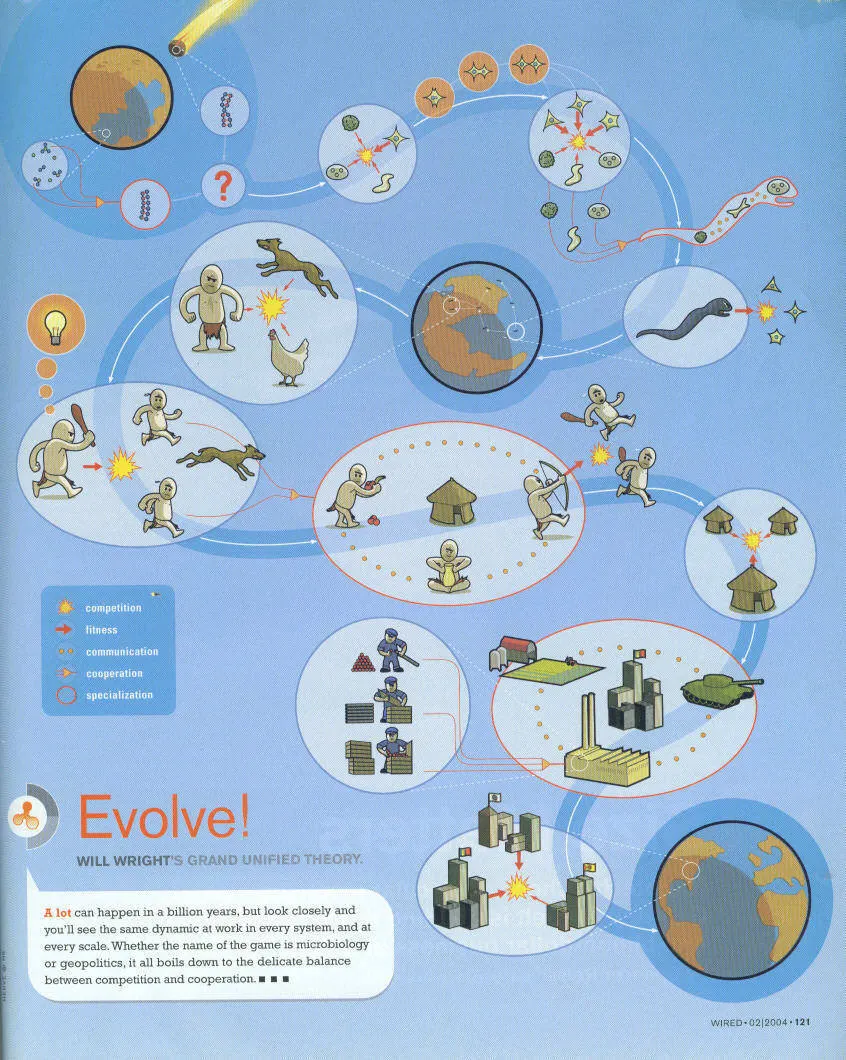
[...]
https://news.ycombinator.com/item?id=36280831
>And that is the whole point, how you win the game: become involved with the content creation community!
>The powerful but easy to use direct manipulation editor tools, the automatic content sharing system, and the online community around user created content, were together the most innovative and successful things about Spore. (As contrasted with the not as well realized gameplay and storytelling design goals.) [...]
>Chaim Gingold, A Brief History of Spore:
http://www.levitylab.com/blog/2011/02/brief-history-of-spore...
>Creativity
>Of course, these aren’t any old aliens we ask players to invest in — they’re your creation, your aliens. Once you start customizing, and design your creature, emotional investment is generated. It’s magic. Even the ugly ones are loved by their parents. Many games thrive on the interest generated by players’ creative investment. Console role playing games, for example, get this effect when players invest time in equipping and naming characters. I’ve always felt more attached to my characters as I fuss over their outfits and equipment. Creative interaction seems to always generate emotional involvement and attachment. Psychologically, it would seem that part of this stems from the sunk cost fallacy — we become attached to things we’ve invested time and energy into. Of course, it’s not just the hundreds of hours invested in a World of Warcraft character, their relationships, and possessions that generate attachment, it’s the sense that our fabrications are extensions of ourselves. As recipients of our attention and creative energy, our handiworks are reflections of who we are, tangible manifestations of our personalities. It’s no wonder we become attached to what we make, and take the success or failure of our own work and ideas very personally.
>Spore neatly solves the alien attachment problem by asking the player to design them. If a player makes a creature, and it’s appealing, they’ll be quite invested in it. Reflecting on the success of The Sims Exchange, where players shared stories, characters, houses, and objects for The Sims, Will realized that shared creativity would give Spore a broader appeal. Why not build creative exchange into the game, rather than as a website that orbits it? Player created assets are constantly being uploaded and downloaded by Spore, enough material to fill a galaxy. There’s nothing like taking home your latest finger painting, and having mom hang it on the fridge for everyone to see. Sharing not only fills up the galaxy with cool stuff, but allows the entire world to see your fridge, motivating you to continue creating.
>Of course, a lot of deep magic must work properly for something like Spore’s creature creator to function properly. It must be natural to use, easily producing satisfying results for anyone, from beginners to advanced users. And these aliens, lumps of polygons that no animator has ever seen before, must be brought to life. These are rather complicated endeavors, from a design, aesthetic, and technical point of view, but the player should never notice any of it. The game design implications are also challenging — the game must be playable and interesting, regardless of the creatures dropped into it.
But the models are fun, sure. And other people can find your models, and you can find theirs.
So if we recognize that the "gameplay" part of Spore never worked... we're left with Second Life, a much, much older thing. It hasn't been much of a success.
No Man's Sky suffers from planets being "deserts", they have different attributes but it's still a fairly lifeless empty world.
Ironically this is realistic but also not terribly fun as a player.
The worst thing I can say about it is that it tries to be everything for everyone, and is relentlessly friendly - all the new mechanics are very forgiving, very optional and (from what I've seen) rather easy. But there is sort of an in game story explanation for why it sometimes feels more like Stardew valley than a space exploration game.
That and the trailer was very different than the released game.
They apologized IIRC and then continued to work on it for like a decade - adding multiplayer and many large changes to the game
   > you must ask yourself a single tough question:
   > How much do you value technological wonder over everyday, solid, smart game design?
It probably won't be as good as an artful human designer hand-crafting a world, but it can be better than something overly random and blandly uniform in distribution.
As an example in No Man's Sky the player immediately starts with a jetpack. It makes it so the terrain is approached the same way every time: you just jetpack over it. Very rarely something is tall enough to require you to walk around.
Legend of Zelda: Breath of the Wild is a positive counter example. You have stamina so you're constantly thinking about the height of cliff faces, you can glide so you're thinking about height points and straight lines through the world, cliff faces cannot be climbed in rain so you think about the weather, slopes can be slid down on a shield, etc. There are a bunch of systems that may you think about the topology of the terrain, so even just varying the height map becomes interesting.
Similarly in No Man's Sky there are different resources but they work the same way on each planet and the player interacts with them pretty much the same way everywhere.
When I say elements should be "understandable" what I mean is that a trap, which Dwarf Fortress falls into, is to add a vast simulation which the player feels they can never really grasp. Simulations should not be a black box because then they begin to feel like a random number generator.
The aim shouldn't be to make an "infinite" game but to make a very interesting system for the player to slowly understand and master. The developer shouldn't just add stuff, but they should think about the long journey (and eventual mastery) a player might take as they spend significant time with the systems.
Weird question: do you have any tips on how one might apply these principles to a semi-stochastic synth plugin for musicians?
(I have several ideas, but I'd be curious to hear yours, independently.)
If you don’t already have a fun game, then pro gen won’t make it any more fun than it already is. It turns a fun 1-hour game into a much longer fun game.
If every single Minecraft player loaded into only a single Minecraft world, it would still be as fun as it is. Would No Man’s Sky really be that much different if it just shipped with a handful of pre-defined planets? It might have less replay value but the gameplay wouldn’t be any different.
Good proc gen changes things in your game such that the player is given interesting reasons to make different choices each time they play.
First procgen game I ever played was Starflight 2. (Pre-Internet era, so I couldn't get hold of Starflight 1. SF 2 spoils you, hard, on the major spoiler in SF 1, so if you're playing them from GOG or other sources then you should definitely play 1 before 2).
My ten-year-old mind was boggled. Hundreds of star systems, each one with several planets (usually), and you could land on each one? And explore the whole planet (in a very limited top-down 2D view, because this was the 1980's), harvesting minerals, and the map was quite a bit larger than what would fit on one screen? And it all fit onto one 720K floppy disk?!??!?
Now, of course, I know how they did it. But there was an actual game there. There were half-a-dozen alien races you could interact with (talk or shoot, as required), and there was an actual story. With a twist at the end that 40-year-old me would see coming, but 10-year-old me was shocked and amazed by. (And the twist in SF 2 wasn't even as good as the one in SF 1). And you progressed that story by following the gameplay loop:
    - Fly around looking for planets with valuable minerals
    - Land, scoop up what you can carry, fly home to sell them
    - Gradually increase your ship's capabilities
    - Collect plot-important artifacts, fly home to get them researched
    - Research tells you "go talk to these aliens".
    - Do a fetch quest so they like you, then talk to them.
    - They tell you where to go to kick off the next plot point.
    - Find out where the Big Bad's home base is
    - Find out where the MacGuffin is that lets you access that location
    - Take MacGuffin to right place, fight Big Bad, save the day.
And they timed it well: the core harvest-resources-and-upgrade-the-ship loop didn't have time to get boring before you were off to collect plot coupons. And there weren't too many plot coupons before it was time to find the MacGuffin, use it to beat the Big Bad, and save the day.
Star Control 2 did it really, really well, with better graphics since it was released a few years later. BTW, if you haven't played SC 2, search for "The Ur-Quan Masters" to download and play a totally free, legitimate, open-source version of the game, with full original assets since the copyright reverted back to the original creators who released it into the public domain for the UQM project to port to modern machines. I wish that had happened to all the old classics, but Star Control 2 is truly a good game. Definitely seek out The Ur-Quan Masters.
But before you do that, I would strongly recommend to play Starflight 1 and Starflight 2, to get a feel for the origins of the procgen-with-good-story genre that Star Control 2 did so very well.
P.S. Edited the "core gameplay loop" paragraph to better make it clear there were two or three loops, and you progressed forward through them, rarely having to go backwards.
1) is the really hard part, I think: it's a challenge to come up with enough meaningful variations that also work from a gameplay point of view.
I think the opposite. The more dimensions you have, the more "invalid space" there should be. Otherwise you end up with giant dinosaurs with tiny feet and fairy wings. You end up with a yellow kitchen with a barrel full of arrows next to a blue dungeon with a giant dresser. You end up with nothing making sense, and everything feeling random in the same way. Trying to spot the differences between 100100111101011110110001001011101 and 1101101110111010000100111001011101 is exactly the "bowl of oatmeal" problem. The vast majority of possible combinations of values should be invalid and impossible, otherwise the choices actually don't matter.
This I think is a core challenge with procedural generation. You can have procgen countries with procgen cities with procgen citizens, but if none of those citizens have an aunt in another city - who you can actually visit, in a new world from the same seed, and learn that she has a nephew in the first city - then it feels empty, fake.
Hierarchial procgen is easy. But you need cross-interactions like that to make it feel alive, and that's hard.
These are games painting with a 16 color palette while the technology exists for any shade in RGB. The more variations, the less likely things will be coherent (let alone brilliant)
Spelunky uses handcrafted chunks that are connected together like a puzzle. Each generation feels interesting because each chunk is interesting and they are just strung together into a unique maze.
Terraria does a similar thing, where all the things that matter are hand-crafted. Bosses, items, layer details, progression. The map and cave system is generated but the caves tend to string together hand-crafted experiences and hand-crafted monsters. Many areas are generated, but in a unique style for variety. And there was still a fixed progression in the background (ore and boss progression). I think its in a big contrast to a similar game like Starbound, where all the weapons and creatures and maps were procgen at first, and it felt very '10000 bowls of oatmeal'. Terraria vs Starbound is the most like-for-like comparison I've seen for "procgen done right vs wrong"
The actual geography doesn't vary that wildly most of the time ( if you've seen one lightly forested river valley, you've seen them all), but players generate a relatively low number of worlds, and in each world probably only see a handful of sites, where dwarf-scale world gen actually matters. Unlike NMS, though, the details of world gen matter to gameplay a lot. Trade caravans and invading armies can't traverse mountain ranges and ocean, so a mountainous peninsula can be extremely isolated. At the site level, you'll probably want to design your fortress to take advantage of local geography to help fortify your fortress and provide resources, so terrain and features like rivers, volcanoes, etc. placement matters a lot.
In contrast, No Man's Sky world gen feels pretty tangent to the actual gameplay. The game does a good enough job incentivizing you to explore lots of planets, but in terms of the survival/base-building aspects, there's a pretty short list of resources that matter to deciding where to setup, and geography hardly matters in terms of how you build.
1. Any imaginary world needs to be internally consistent to be interesting. Procgen does not void this rule; randomization needs to be gated to that internal consistency.
2. A world can be composed of multiple environments, and each environment can a different definition of internal consistency. Dungeon Crawl Stone Soup does this very openly and to fairly good effect, but pretty much any decent procgen game will inevitably end up with the same choice, because it's what enables you to play with various procgen systems/rules while still having a coherent overall game.
3. Generalizing 2, procgen systems generally do not start from nothing; You embed reasonably well-defined bases (races, weapon forms, etc) and then apply randomization on top of those bases to form the final element. Meaningful fundamental variation in those bases leads to guaranteed meaningful variation in the end result.
4. Games are fundamentally interactive systems. Generating a thousand variations without actually changing interaction is equivalent to generating exactly one variation. A blue orc vs a red orc is a not real variant, unless you make it so by attaching effects / statuses / capabilities. The color distinction is then a signal into the more abstracted changes that have occurred. This is where NMS falls over -- the images have changed, but the interaction has not.
5. A corollary to point 4, changing numbers without changing interaction is equivalent to doing nothing. If a meaningful damage threshold is functionally every 10 points of damage, then generating numbers 0-9, 11-19, etc is equivalent to generating just the numbers 0 and 10. This is where borderlands falls over -- a million variations in guns, but the vast majority of those variations are just numeric differences that don't change anything in practice.
6. If the procgen applies to equipment/builds, you pretty much need permadeath as a driver for exploring a procgen game and its systems, because you need players to explore for a local optima. Exploring the space for a global optima in a procgen game inevitably devolves into a gambling simulator, because players optimize out the fun, and the optimal play is to the kill unit XYZ repeatedly for the 0.5% drop. Games like Terraria fall into this trap (though Terraria resolves it mostly by making unit XYZ be trivially summon-able bosses)
7. Procgen can never guarantee interesting results; You inevitably need a system of vaults/artifacts -- hardcoded quality items -- to guarantee periodic interesting locations/items. Ideally more notable than average generation, but less than strictly optimal so as to not overpower the other systems -- an issue I've had with games like Diablo 3, where finding an item-set was vastly more powerful than anything else that I acquired for the next 5+ hours, eliminating the entire looting system (and even character skill system, since it forced my build too)
8. Decent Procgen is inevitably rule-based, with possibly multiple chained-rules each doing their own rolls, to ensure coherency. Ideally the rule-chain is roughly discoverable from the end results (by virtue of following internally consistent and apparent rules) -- an end-result that cannot be explained is indistinguishable from pure-random, and pure-random in incoherent. See any Tabletop RPG generation tables.
9. Hell, just start any procgen design from tabletop RPG tables.
10. The number of variations that can be produced is meaningless. This is only for marketing.
11. A procedural system that generates exactly once is fairly pointless. Permadeath.
12. A procedural system is inherently unfair, because you cannot guarantee difficulty, proper placement, unit composition, etc without removing the procedural systems outright. Embrace the unfairness, and design around it. Permadeath.
13. A procedural system is inherently unfair; you need to give some guaranteed items with guaranteed results to navigate an uncertain world (e.g. escape tools).
14. It's always good to enable some control by the player over the procedural generation. Choice of environments, chances at additional loot, etc. You want the player to engage with procgen rules, because they're interesting (and if they're not, what are you doing?), and the easiest way is to give them tools to manipulate it to their advantage. Also permadeath.
After generating the level structure, emplace an entrance and exit such that they are maximally apart. And emplace a strong monster in one of the rooms around the exit. And emplace a health potion in one room before the strong monster. And emplace treasure in the exit room.
That sort of stuff and be specialized and coded towards your particular games structures fairly easily.
Scale is much harder though. In something like NMS it’d be intensive doing such a constraint solver on the whole galaxy. Might work in chunks or regions though.
Obviously people have high consistent wins in StS1/2 so it’s not like they’re guaranteed unwinnable, but for the average human (mostly just boils down to “path to do act1 elites until after you probably have a counter to all of them)
Your options are:
1. All scenarios are easy enough that you can get away with just about anything sensible
2. You don’t have any counter mechanics, which is basically the same as 1, and is difficult to do anything interesting with
3. You announce up-front what you’re going to deal with, so the onus is now on the player to find a solution in the meantime
4. You give the player a NOPE utility
In a roguelike, I think 4 is the better design, but 3 is also reasonable. 1 & 2 just makes things less interesting.
The fanboy started saying how they could have endless different levels in Destiny 2... which is absurdly off-base since the entire game is just running through the same 9 sandboxes and 12 raids over and over and over again
He then went on to talk about AI creating an album as perfect as OK Computer on-demand, which was gently putdown by Kirk (who is an exceptional musician but also chill enough to suffer fools)
In my own procedural explorations, the solution to the 10,000 bowls of oatmeal problem is to manually curate them and give the user only the exceptionally good ones. It's a tedious lot of work.
Why doesn't this apply to Minecraft? People love Minecraft even though it's equally purposeless and arguably bland and empty.
In No Man's Sky I got dropped in some world that felt empty with tutorial on how to collect some stuff and how to get to the ship.
The first impressions weren't the same between these 2 games.