
I know that personally I find New York’s prewar buildings more beautiful than your average soulless luxury tower. But I enjoyed living in a soulless luxury tower because it had good lighting, not terrible elevators and decent fixtures.
Obviously no one likes having a small or no elevator, or poor insulation, but that's related to technological progress, not aesthetic trends. If we kept building in the traditional styles, we would obviously have incorporated this anyway.
In fact, at least in my (small) city, fully renovated old buildings (where the scale of facades, windows, etc. is old, but the floor slabs, insulation, elevator, etc. are brand new) are where the most expensive flats per m2 are. Considerably more than in new buildings.
> In fact, at least in my (small) city, fully renovated old buildings ... are where the most expensive flats per m2 are. Considerably more than in new buildings.
Isn't that because of location? These places tend to be right next to the rail/bus station in the middle of the city.
A specific example. The very same building developer completed these two buildings and offered the flats for sale more or less simultaneously, in the second half of last year IIRC.
Building 1. Renovated early 20th century building (originally built in 1923). Google Maps coordinates (the renovation is not yet visible in Google Maps): https://www.google.com/maps/@43.3621801,-8.4070271,11a,75y,2... Photos of the renovated building: https://ammapromocion.com/plaza-de-vigo/ Flats have 117 useful sqm and the middle flats were being offered at between 1.1M-1.2M €, and sold fast (you can still buy the 1st floor flat for 950K. But it's a 1st floor with a bar directly below, which reduces its value rather sharply. This is Spain, bars are noisy and open until late).
Building 2. Newly built. Google Maps coordinates (again, finished building not visible yet in Google Maps): https://www.google.com/maps/@43.3599669,-8.4061383,23a,75y,2... Photos of the finished building: https://ammapromocion.com/promocion-juan-florez/ Flats are different sizes, but some are only slightly smaller than in the other building - around 110 useful sqm. They were being offered for around 700K. They also sold fast.
The distance between both buildings according to Google Maps is 290 m, a 4-minute walk, so they are basically in the same neighborhood. You can argue that the new one is in a worse location because it has more traffic and the street is uglier, and it's true (although the other is in an area with many bars, so I think not everyone would prefer its location). Anyway, that kind of difference could be worth at most 50K in this market, being generous - and most likely more than fully offset by fact that the newly built flats include garage while the renovated ones don't have it! Anyhow, it definitely doesn't explain a 400K+ price difference.
It's just one concrete example, but I've seen many (I was recently looking for flats... finally I settled from one from the 1940s, building not renovated :)). Of course I don't know the trends outside my city, but at least here, fully renovated old buildings are the apex of the housing market.
But very quickly it became clear why that was the right decision: building codes. People legislate building codes, but of course they're unwilling to DO anything. So old buildings, built against old building codes, don't have to change, and that means they effectively get to ignore building codes. If I rebuilt the place I would have had to move the house (as in physically move it, just 4 meters, but it's a house, 4 meters might as well be 400 kilometers, you have to rebuild it). I would have to give up at least 40% of the surface area (the "ground surface") AND one of the floors. Net result: the new house would have been about half the living surface of the old one.em.
So obviously the renovated house is worth a lot more than a new house: for starters it's double the size!
It's even self defeating: the isolation of the old house is better. Yes, people legislate modern isolation materials but if the house MUST be a lot smaller there must be a lot more contact area with the cold air, because it wouldn't be built against the neighbor's house anymore and a LOT less thermal mass (thermal mass = free heating, more or less) so you're starting from a very bad starting position.
With modern materials and structural design you can absolutely have both.
Until form is no longer synonymous with function, design will eschew ornamentation.
Taste is subjective, but is there really a more beautiful building in the world than the Heydar Aliyev Center?
I don't know about you, but I'd certainly put the Taj Mahal ahead of that, as well as any number of gothic Cathedrals.
I prefer Sydney Opera's outside shape.
The wiki pictures of the inside of the Heydar Aliyev Center also look odd to horrible to me.
Architectural taste doesn't align with the taste of everyone else. Why should that be the case? Why shouldn't architects design buildings people enjoy?
In many fields (architecture, art, cooking all come to mind) there seems to be an outright resistance to doing things that people actually enjoy. My hypothesis is that practitioners in those fields have spent so much time studying them, they have become bored of the "normal" stuff which people actually enjoy. In an effort to satisfy themselves, they optimize for novelty, either not knowing or not caring that doing so is making their work something which can only really be appreciated by people as desperate for novelty and steeped in the field as they are.
With food at least it isn't so bad, because there are a ton of not pretentious restaurants you can go to enjoy. Nobody can force you to go to the pretentious restaurants run by chefs bored of normal food. But with architecture, a building is something everyone in that city is forced to experience, whether they like it or not. It would be nice if architects were therefore more mindful that they should try to appeal to a broad range of tastes, not just architecture nerds who are bored of what came before.
No one will care if you build 1000th replica of a nice building. It's just not interesting to anyone and actually becomes boring very fast. People may live in it but no one will come from afar to visit it because of its beauty. It will become another one in a row of the same.
If you build a striking, exceptional building, it can become a big success (like Gehry's in Bilbao which is a success story for the whole city), so people who commission buildings sometimes select for that.
And also there is a sizable group of people who actually enjoy interesting buildings, like people who enjoy haute couture or haute cuisine etc., so it's not like there is no market for that.
From a energy conservation point of view I get it, but something in my also tells me that pressure testing houses is a bit off. I don't think I'm meant to live in an airtight box with an HVAC system.
A challenge with some old construction is that it was (at the time) cheap construction. Which means that after a century there can be lots of structural issues, mold, leaky roofs, problems with foundations, etc. But you should compare that to modern cheap construction, which isn't all that great either and doesn't age well.
A lot of West Berlin post war construction is particularly grim and ugly because it was obviously built on the cheap with little or no attention to how things looked. Surviving, pre-war construction is a lot nicer. Especially if somebody invests in fixing that up. You can see the contrast throughout the city because heavy bombing left a lot of gaps that were later filled in with some typically very bland and sometimes very ugly and now very dated construction. It seems some architects had some weird notions of modern. Especially some seventies and eighties architecture is a combination of cheap and very ugly. Cheap concrete does not age well. And painting it some weird shade of yellow or purple doesn't make it better. More recent construction is a lot less offensive, thankfully. The DDR mostly didn't bother with filling in the gaps and as a result, a lot of recent construction has been addressing that using more premium materials and architects that actually know what they are doing.
For the most part, it's about optimizing construction cost. Everything else is secondary. The reason you don't see ornate stonework is mostly that skilled labor is a lot more expensive today than it was a century ago. Even if you want to spend 50% more to make an architectural statement, you still do it with prefabricated steel and glass.
Entertainment is a non-productive activity. But people need entertainment.
People like to live comfortably. But people also like beauty.
It's that simple. People do care about the looks of buildings. Aesthetics matters.
They also do this with cars, clothes, wives, phones, and their own faces.
There might be some survivorship bias there.
Not according to this article, which looks into it.
The problem with modern architecture, in my opinion, is its preference for "dramatic effect": long contours, flat surfaces, high contrast. This is visually exhausting. It looks nice in a catalog and from a large distance, but it's uncomfortable to be close to. This doesn't follow from the use of more glass. It's a historical coincidence that the float glass process made windows cheaper around the same time that architects started experimenting with smoothness.
And it's is a false dichotomy, both can be done.
> I enjoyed living in a soulless luxury tower because it had good lighting, not terrible elevators and decent fixtures.
Now imagine if it had looked good as well! It could have really lit up the area of the city it was in.
I have seen the opposite as well. Building an efficiently laid out, beautiful building doesn't take that much more raw material, it just requires more thought. Big US cities used to also have copypaste mass housing even a century ago, built with a strong eye towards cost efficiency, but designers also kept aesthetics and livability in mind.
And since they were basically identical to each other, they had to figure this out only once, and they could build the same t
The 'cheap and nasty' design school usually succeeds at the latter, not so much the former.
And this supposed efficiency of modern architecture often doesn't really show up. The Empire State Building was famously built in a year. Nowadays the most utilitarian housing project takes longer.
It is designed to be this way for investors more than consumers. Investors want these units to be as fungible as possible so they can better compare local market dynamics. Commodity trading has a lot of advantages for the investor after all. The consumers have no choice really but to be in this market if they want to be sheltered at all. It isn't like you really can exercise free market selection for something necessary like shelter. You have to take what has been made available and you cannot do without.
There is therefore no incentive to make a smart building that is favoring the tenant since this doesn't grow the potential pool of tenants in the area, that pool remains the same size as it was. It is unlike a lot of other markets where having a better product might actually grow the customer base of the product segment overall.
I think you hit the nail on the head. Lot of the finance machine works on standardization, like the are some building techniques, like spray-on insulation that work perfectly fine, but banks wont approve a loan on a building like that because its hard to inspect and repair.
This ironically makes these crappy buildings built to investor standards expensive, since banks will give cheap loans for it, on account of having low maintenance costs.
Of course all this exists only on paper.
My other question that I've never found a good answer to, is with mechanization, how is it that "cheap" modern buildings are so expensive. Or were old, traditional buildings super expensive? What is the cost of a unit of beauty per year, then and now...?
Old buildings were often expensive to their inhabitants because people were very poor. The cheap ones were largely torn down, because they fell apart because... they were cheap. Also, people largely lived in comparative squalor to today. Only about 50% of homes in America had an indoor flush toilet in 1926, and most of those were the urban north east. In 1926, the average home was <1k sqft (avg >2k in 2026). The modern idea of insulating a home wasn't around 100 years ago - houses were small, and cold, and you had to shit in a hut in the yard or in a bucket you threw out the window after.
Like cars, we've upgraded our standards of comfort and safety a lot. HVAC, electricity + internet networking, running water and bathrooms and water heaters, insulation, double paned windows, more and bigger appliances, safer standards for things like like staircase dimensions, increased fire/earthquake/hurricane/etc resistance, etc - there are a lot of things that just didn't get included in old homes.
Old houses were literally boxes made of wood, and now they're complex and mechanically rich in many subtle dimensions. Houses also have gotten bigger, so even as the price-per-sqft grows, so does the total size of the home.
Homes still aren’t really mechanized. I’ve seen attempts but they haven’t worked well yet. Labor and materials are so expensive!
And most new homes are built by one of a few big groups. Oligopoly issues again.
I'd say yes. Reading fairy tales and historical records, we see just how huge were the prices. A pair of boots could be worth a year's income of a peasant.
We have not made any progress, and perhaps we don’t need to, when it comes to architecture since World War I. There have been a few projects like La Sagrada Família, but those are exceptionally rare.
Suburban homes. What a disaster and embarrassment to the human race.
If you like neoclassicism and hate brutalism, then I would say you are very strange too. To me, brutalism hits the same things neoclassicism does but much more organically and better.
This is true, but usually fewer people die in the construction of those utilitarian housing projects
In China buildings are built faster.
I'm thinking of something like a violin. You can't pick up a violin and judge the perfection of the fitting between the wood surfaces that are glued together. If that work isn't perfect, the instrument will eventually fly apart. But you can look at the "scroll" and "bees sting" which are unforgiving of tiny errors. These kinds of features persist to this day due to traditionalism, but have disappeared from most industrial products.
Today, I don't expect an ornamented house to be of any better quality than a plain house.
The Dana-Thomas House, designed and executed by Frank-Lloyd Wright, spared no expense in an age when skilled craftsmen were affordable.
Are there seeds of the Guggenheim in New York between these two buildings?
https://www.ourchanginglives.com/springfields-dana-thomas-ho...
https://www.tripadvisor.com/Attraction_Review-g60763-d108687...
It’s like people visit the remains of the forum in Rome and picture the colours being as they are today instead of the ridiculously bright/strong colours they would have been when erected/used.
No one else on my street has followed my lead though.
I think some of it is because people are obsessed with treating housing as an investment, and so anything outside the norm is a financial risk.
Standing out doesn't really help if it isn't more desirable than the boring normal.
What I personally dislike is the recent trend of all black siding and trim. I have no idea why people are doing this on new construction near me, other than perhaps cooling is cheaper than heating in our climate. It's certainly (IMHO) hideous though.
It’s easy to sell grey, white, and black cars. So it’s what you buy.
This assumes no purchase is longterm. Which is its own indictment.
I should add: I love that you broke this idea. Can you (safely for the internet) share any photos?
Which modernism?
1930s modernism was about new materials to allow luxury for the modern man (electricity! large windows! electric oven! washing machines! fridges! indoor toilets!)
1960/70s modernism was about creating new communities, adapting land to fit the modern car based world. No more pokey little shops with only a few items, requiring a trudge along a wobbly high street. NO! drive your car, go to a futuristic supermarket only once a week.
I don't think we see a modernism now, not as a movement. I will now divert to UK building, because in the US its different. Part of the reason why thats the case in the UK is that councils used to build houses, facilities and infrastructure with their own money. This meant they had their own architects. This lead to town plans that were coherent, if not always successful. See Birmingham, milton keynes, roehamton.
Housing wise, council houses were built, or should have been built to a standard. They were, especially in cities much bigger, brighter and luxurious compared to what preceded them. Were they pretty? no, modern is never pretty, because its not what you grew up with. When I was a kid everyone _hated_ victorian terrace houses, because thats what poor people have. They were more pokey compared to executive estate housing, and in some places didn't have a drive for your four door saloon.
Now, those estates are meh and terrace houses are very expensive, despite being cold, draughty, dingey little shitboxes with odd toilet arrangements. (unless you've slapped in a loft conversion and extended over the kitchen/outdoor toilet)
> Dieter Rams as some aesthetic pinnacle rather than soulless mass production.
The problem is, Rams was about bringing the complex new object into the house in a was that was reliable and simple. If we were all about Rams' vision, then we'd have got rid of radiators, had decent windows, insulated the place, had lots of cupboards and cleanly separated living spaces. Not an everything room and a bedroom with inbuilt mould farm (shower + shitter)
Yes the modern apartment is inspired by loft living and dieter rams, but that requires 100sqm/1000sqft and high ceilings. none of which most places have. So you get a kitchen diner because it allows developers to shave off one room from the floorplan and increase density by 1/3rd without extra mateiral costs.
But thats not modernism, thats poor fucking standards, and the lack of competition in the uk in the form new council houses. (a 3 bedroom council house will be at least 90sqm with seperate kitchen, living room)
This is a really interesting argument and very much not the story I've heard. Can you cite any sources for any of your statements at all?
– Cheaper: than what? Is it that premodern architects had the same technology and materials available but chose not to use them <because they had a higher aesth-ethical integrity>?
– What is a 'side effect' in architecture in a way that's unique from the necessary compromising that the needs of occupants, material constraints, longevity, cost, time, labor, aesthetics, and etc. which essentially is architecture?
> given {cheap material, not the good stuff / I don't feel like it / measuring sucks / I just want to cram people that will ruin your neighborhood everywhere}, the average roll of the dice yields simpler geometry with less ornamentation.
But simpler geometry is structurally stronger and allows more spacious airflow / less heat trapping. The cost of materials is not inert, the demand for them affects the cost obviously. Energy efficiency is beneficial to all. Open floor plans are less prohibitive on use cases. Large window sectioning allows for more light/efficiency and also keeps the street level perspective from seeming insular.
The logic doesn't follow for me that capital was plainly more benevolent, then around some time or another they began the project of "educating" people into accepting their cheap and accidental aesthetic standard.
What survives the past are its most accomplished projects, and thus maybe per capita it appears of higher quality than modern. And more importantly re: the submitted article, it has informed centuries of signing what "home", safe, hospitable, threatening, and etc. mean. So the whole measurement of who prefers what says something but I don't think it speaks to natural perception.
And if you are against things generally in the sphere of "Bauhaus" interior design then I would say you are engaging in a cargo cult of using modern materials in unnatural ways to copy older designs without eye to how the modern material has its own natural form and manner of usage. I would say, for example if one only has hand tools and solid wood then it is reasonable to follow Colonial design school, but if one has glass, stainless steel and plywood, it is wasteful to force them into a Colonial shape rather than their natural forms. Either style respects the substances and tooling it uses.
You are free to pay four digit prices for every piece of furniture if you truly oppose designs that are aligned toward mass production.
One consequence of this was the decimation of skilled craftsmen. Millions of them were sent off to become machine-gun fodder, to never return to their respective trades.
Along with them was their craft. The next generation of apprentices never had the mentors they needed, hence that was that, the end of what you might call traditional architecture.
There was another minor disagreement that began at various times depending on one's nationality. In the UK this meant 1939, and with it a second 'double tap' on the skilled craftsmen that the building trade used to rely on.
Many of the survivors did get to work on war memorials, and every village has one, carved in stone, and often kept in immaculate condition to this day.
In my local station there are two memorials, and I struggle to hold it in as I walk past. Needless to say, we lost a lot of good railway workers too. Sad.
There wasn't a lot of money after each of these minor disagreements and heavily blitzed cities still bear the scars. There can be a wonderful parade of shops with flats above, with wonderful craftsmenship, which is truly wonderful considering they didn't have motorised vehicles as we know them, or cherry pickers, or any machine that is big and yellow (JCB in the UK).
Nowadays there can be a huge 1870s building, with four storeys, all with big rooms and high ceilings, next to some 'rubbish' that was built in the post-disagreement years.
Some places were physically removed from the map. A 500 bomber raid on the special crane used to hoist big guns onto the ships of the Royal Navy happened one night. They completely missed the crane to destroy the entirety of Clydebank, a district of Glasgow. People are sore about that to this day.
The crane still stands, albeit idle, since shipbuilding went to Asia in the post-disagreement years. That crane, once the largest and most capable in the world, has a soul. It speaks of sorrow to me.
So yes, you are correct, but there is more to the story than just a Modernist story of cheap mass production. The limit was not resources as you can see the quarries that were abandoned after the first minor disagreement, and there is enough stone in any given mountain to make millions of homes. The limit was the loss of men as well as the loss of European colonies, on which the wealth of European cities came from.
Moving swiftly on, I am no Ferrari fan under normal circumstances, however, Lewis Hamilton currently drives for their Formula One team and he is a hero of mine. Hence I am willing to defend the loathed Luce!
The Luce does have Mr Ive's design input and I don't think anyone is critical of the interior. It is well understood that serious tax avoidance vehicles need to stay away from having big screens on the dashboard since they are not going to age well (and F1 cars don't have such things). Having four seats rather than just the two makes sense to me, since the car needs to have some length to it for high speed stability and there is no need for a massive red V12 engine in the middle of the car.
The Luce brings much from the world of F1, including high performance cooling systems that cost 100x the price of the radiators in your car. People like older cars because they can tune them, the Luce is the first EV that is what you might call tune-able, with the owner able to set the car up for a given track or just the road, with them also able to do what they want with it.
The aerodynamic package is ahead of its time, and, as such, it will draw criticism. We have been here before, notably in the UK with the Ford Sierra. This was a 'jelly mould' shaped version of the three-box saloon that had gone before, the Cortina. Initially the press hated on the Sierra and people did have genuine misgivings. However, it did not take long before the Sierra rose to the top of the sales charts to set the trend for the 'jelly mould' look, these being the 'peak car' maintainable vehicles that people wish they had today.
Fortunately I will never be a customer for Ferrari, however, if I was a tax-dodging benevolent dictator with the wealth to put together a motor museum, I would not hesitate to buy a Luxe for the collection, to go alongside an OG Tesla Model S, with the faux grille, and a Xiaomi SU7. I would like to add a Ford Cortina and a Ford Sierra too, however, millions were made and millions rusted away, leaving none for my fantasy museum, particularly in the desired Saluki Bronze colour.
And now it's used for bungee jumping.
The US equivalent is the Hunter's Point crane.[1] This was built to do a very specific job - lifting battleship turrets. It's not used any more.
But the flip side isn't anti-modernism, it's mass-market kitsch, which is at least as ugly.
Minimalism isn't bad on its own, and the best minimal design really is beautiful.
But the abstraction and containment went too far, and the result is often functional (on a good day) and joyless even if it's a prestige product. And claimed efficiency is often purely decorative. (Which is ironic.)
The worst is block sprawl and suburban slop - endless subdued and constrained repetitions of the same thing, with very minor variations.
If bespoke robotic manufacturing becomes a thing it will start being possible to build and make exotic, individual, decorative things at scale. Most of the results will be terrible, but some will stand out as examples of new aesthetics.
It's far more common than it should be.
> The worst is block sprawl and suburban slop - endless subdued and constrained repetitions of the same thing, with very minor variations.
The economic of bathtub curves incentivises designs nobody hates, even if at the cost of nobody loving them.
I mean look at the ecology of our world. What do you see out there when you look outside? Solely some lumbering generalist beast doing not good and not too bad taking up all the energy that comes off our sun?
Absolutely not. The opposite happens. The generalist tends to die out, outcompeted by the litany of specialists who better occupy the specific niches the generalist attempts to fill.
Left to its own devices, the market ought to look like this: hyperspecialized at all scales and levels such that every demand is maximally occupied by the most efficient manner to serve that demand. One might ask instead what artificial constraints are allowing a generalist to emerge and not be swallowed up by the sum weight of the countless specialists who are more optimal at every possible thing?
I read someone's argument that the ugliness results in market failure. Because the ugly results in not only local opposition to building renewable it results in everyone in the area being opposed. And they then use the political process to block new construction.
What really bad is after a 100 years of this the construction industry no longer knows how to design attractive buildings. Starts with architecture where 2/3 of the architects are aesthetically blind. And the remaining 1/3 had it beaten out of the in school. Ends with manufactures that have long since stopped manufacturing pleasing materials for construction.
So it had dual pressure, from economics because it was cheaper/efficient and from the cultural reform side.
Stalin pushed classical and actually within the soviet union Stalinst buildings were considered the best. These are called Stalinka.
Khrushchev embarked on a massive post-war building campaign in an effort to improve living conditions within the USSR by providing millions of new housing units.
These were modernist mid-rise and high-rise buildings and were designed for mass production and efficiency above everything else. These were regarded as considerably lower quality buildings than the Stalinka and were called Khrushchyovka. The Krushchyovka were the classic "commie blocks."
I love modern architecture (and art); I find many older forms to be garish, focused on pointless decoration and on wealth display, rather than on the beauty of function and form. The imagination of [some] modern architecture, starting from those fundamentals, is stunning.
You don't like it, which is just as valid, but trying to turn your preference into a universal truth for humanity is not valid. Can't it be just your preference?
Why is it so important? I think the real subtext for most such comments is culture war: A reactionary take on modernism and postmodernism, trying to make them outre, outside norms, attached to political liberalism which is often the real target.
Innovation is usually greeted by reactionary responses; what's odd is that, in our world of modern double-speak, reactionary has become seen as cutting edge instead of a lack of imagination and progress, of retreat and regression. Let's go back to what we were doing 100+ years ago!
Instead it just feels like some knowledge was lost to time and we lost the plot along the way, because there is a refusal or inability to just do what used to be done all the time in the past. Yes building codes are different, but stuff like trim or brick work or generally curb appeal shouldn't affect that. No one is asking for no sprinkler system or no hvac, just a better looking building from the outside. Many of those old buildings do get gutted and end up modern inside but maintain the old facade. People want more of that facade I think without it being a diminishing resource.
It very much does, unfortunately. In the US, the places with the highest housing shortages are mired with endless red tape, discretionary reviews, parking requirements etc. that substantially increase costs. This leaves little room for anything else, including aesthetics.
Developers have gotten very good at navigating this, but it has also led to them sticking to basic "good enough" designs like the five-over-ones we see when new apartments are built.
I think the cause may be that most real estate developers are not students of architecture and also are looking to minimize costs and time. Even if the developer wants to build something beautiful, cash flow (burn rate) is a big problem: You borrow millions or more, and have no revenue for the entire time it takes to build the building. Getting credit is hard enough. Do you go more in debt, and possibly for longer, for the nice trim? Does the banker also care about architecture and see that as a good investment?
Also, the trim then and trim now probably were designed with the same thing in mind: Whatever is least expensive with current technology. For example, an architect once explained to me that interior trim, for example where the wall meets the ceiling, has a purpose - it covers flaws in the join. Modern techniques and materials allowed us to eliminate it.
Most importantly, speaking of innovation and technology generally, IMHE what you say is an almost universal experience: Often it's not the new thing that is the problem, it's that the old seems carelessly discarded. All its benefits and nuance; all the skill and expertise; all the deep understanding and appreciation that comes from generations and lifetimes spent developing and using it, that enriched our lives; all lost. Think of poetry, which used to be far more popular - now people barely read it much less have any deep understanding of it. People who would have been poets are now doing something else; who could even mentor you if you wanted to be a poet?
It's not "fascism" to wince and shrug at the taped banana. It's just common sense. But if you insist that everyone who does so is secretly motivated by some kind of bigotry, you end up pushing them towards the right wingers anyway.
Ugly is in the right of the beholder when it comes to individuals, but societies also have collective preferences.
Agreed, though your comment does much more than wince and shrug:
> too ridiculous to be seriously defended
Humans are very social animals and we follow social norms, like a herd moving together. Look how similar everyone's clothing is: Nobody is on 5th Avenue in a loin cloth or Elizabethan outfits (unless intentionally violating norms). Why do we all chose to wear the same things? We follow norms.
How do we signal and punish things outside norms, or shape norms to exclude something? Ridicule. Sophisticated public communicators consciously use it - you can see it in the way some conservative publications depict trans people. Their intent, through ridicule, is to push them outside norms - a foundation of facism, normalizing persecution and even brutality and murder. Facists also did/do that to art - it's the same thinking (though not everyone who ridicules art is a fascist - the fascists take advantage of that bit of human nature.)
In your comment you aren't just wincing and shrugging, but literally ridiculing (to be clear, I'm not calling you a fascist in any sense)
> It's just common sense.
Which means, common norms. There's nothing special about them; it's just a social phenomenon. Every innovator, including in tech, faces the usual response:
  - First they laugh at you (ridicule you)
  - Then they say it's not in the orthodoxy (if ridicule fails,
    you go from being ridiculous to being a threat to norms)
  - Then they say they knew it all along (you're now within norms)
> societies also have collective preferences
They don't. People try to make preferences look more universal to justify their own beliefs or simplify thinking, but it's always far more diverse. Look at how the Democratic party attempts to lump simple demographic groups (e.g., black men) into one stereotype of political thinking - and ~25% voted for Trump in 2024.
Societies do have norms, which are very changeable. Look how the far right has changed norms around the world in just a short time. It's not by accident - I've seen guides on how to normalize antisemitism, for example. The leading fascists in history, the Nazi party, had very consciously designed propaganda to do the same.
If someone wants to be an innovator (and have a truly free mind, IMHO), they need to step back and see norms, their dynamics, and what's beyond them, and learn to see what's outside without the filters, to treasure it as potential future innovation. To look at things on their merits, not at whether they are inside or outside.
At the debut of the first play by Harold Pinter, The Homecoming, much of the audience booed and left at intermission. Pinter, the great innovator, booed the audience. (Or so the story goes.)
What if it's almost everyone's preference? Except for the high priests of architecture who have their own agenda. Then we end up living in a world full of buildings they design for themselves that most of us dislike.
> Why is it so important?
Because the rest of us have to live with it at street level, every day.
> A reactionary take on modernism and postmodernism, trying to make them outre, outside norms, attached to political liberalism which is often the real target.
But they are the norm and have been for some time. It's time to challenge that norm.
If we go back to (for example) Le Corbusier, we see this sort of thing thrown around in discussions all the time - you just don't accept innovation, you're hung up on traditionalism, get with the way of the future. Only it's not the future, it's one part of the past, and for all there was noble intent behind some of this stuff, we've had adequate time to judge the outcomes as lacking.
1. I think the onus is on you to prove that it's not a minority, in the face of people overwhelmingly favouring older, more ornamented designs.
2. Beauty does not have to feel 'fake' and ugliness can be very authentic indeed, especially when it comes to concrete. I'd take a faux-neogothic revival over another period of brutalism without even blinking.
I used to live near-ish to this eyesore - https://en.wikipedia.org/wiki/Wyndham_Court#/media/File:East...

It's a hideous blot on the landscape, the wind blows through mercilessly and constantly, it feels desolate and dystopian to be around. It smells of piss and depression. It's notorious for drug dealing. But someone managed to get it listed and protected anyway so now the town's stuck with it permanently.
> I do not understand this movement to rob concrete, steel and plywood of it's natural voice and force it to conform to design styles made for different substances and tech.
Perhaps we don't have to force it to be 'traditional' but it's clear that the 'natural voice' afforded by these materials and the current set of design languages in architecture result in ugly buildings that the large majority of people just do not like.
We don't have to look at the overwhelming preference for traditional buildings and take away from that "We must go back to exactly that", but we should at least take away "People don't like what's being made now, we can do better"
And if there is no way for concrete, steel and plywood to express more beauty then perhaps we could think about using other things that might. Either way, ploughing on with creating spaces and edifices that the majority think are ugly and worse than what came before, either because of a professional disdain for what humans actually like to be around, or some high-minded ideas about material expression seems ... well, pretty pig-headed.
Its not about high mindedness. Tell me suppose you took steel started making cuboids out of it and sanding it rough then stacking it with cement. Does that in any way do justice to steel or is it a complete waste and misuse of the substance? What these people are trying to imagine as their ideal are not as extreme as forcing steel to behave like brick but it is on the same spectrum. Neoclassical buildings are another good example. They are completely fake. I would bet they mix wildly different centuries apart greek and roman designs. And we know they are steel and concrete structures internally just facaded over with marble, not structural load bearing all-marble like the original greek stuff. Brutalism is just a more honest form of those massive neoclassical buildgings, the scale and power of it minus the fake marble nonsense. But I am not even saying you have to be brutalist, it's just one example of an honest medium.
If I only have hand tools and solid wood, I would make Colonial furniture for example. If I have stainless steel tubing and plywood I would make bent tube legs and plywood rests.
Plywood is an amazing substance why do people hate it? It uses wood to make large panels that lack the directional weakness of wood and to quite an extent the movement issues of wood are also avoided. Concrete is pourable rock. Steel is a flexible and easy to cut and join structural substance. You may disagree with certain design ideas that use these substances snd cwn say we could try different designs but I think its ridiculous to cargo cult brick and mortar or marble for instance (which are perfectly fine materials for their tooling and design) and wholly reject modern substances.
Brick cuboids don't grown on trees or are found in nature either. I would say the funniest one is people calling structures like hypar shaped halls as unnatural. That's as natural as it gets, nature itself leaves the hypar the only shape that is optimal to be supported atop a grid of columns, not the flat roof. These curves are more natural that flat and square walls. At least people should be wrested of the naturalist argument if they use it against designs like this.
That's how they sold it, but it's not true. By the end of the 19th century, all the building ornamentation that you can still see in European capitals, had been stadardized and was mass-produced, while the construction techniques using brick and mortar had been further refined, yielding building designs that were cheap to construct and easy to maintain.
Modernist buildings were, at the same time, more expensive to build and less durable because of the reinforced concrete which has a much shorter lifespan than stone or brick plus mortar. The only advantage they had was that of increased height, but that was only an issue due to the restrictive zoning in Anglo countries. Without NIMBYism that pushed towards sky-scrapers, NYC could well have ended up like Paris: replacing 1-3 stories buildings with 8-10 stories, but allowing mixed commercial/residential space everywhere.
“Yes, God damn it, the Parthenon!”
The ruler struck the glass over the picture.
“Look,” said Roark. “The famous flutings on the famous columns—what are they there for? To hide the joints in wood—when columns were made of wood, only these aren’t, they’re marble. The triglyphs, what are they? Wood. Wooden beams, the way they had to be laid when people began to build wooden shacks. Your Greeks took marble and they made copies of their wooden structures out of it, because others had done it that way. Then your masters of the Renaissance came along and made copies in plaster of copies in marble of copies in wood. Now here we are, making copies in steel and concrete of copies in plaster of copies in marble of copies in wood. Why?”
The Meteorology Building (bldg 54) at MIT was built that way, with all of the above problems. Much embarrassment. Later, much computational fluid dynamics and, in 2019, a rebuild of the plaza level with more walls.
Now, not every modern building has to look like a glass and steel colorless brick.
For example, I really like the look of Oodi [0], Helsinki's new library: it reminds me of wood covered with snow, and the interior is exactly what you would expect from a modern building (built in 2018).
The article reads like the author picked a conclusion and made things fit his opinion.
In my experience, the biggest issue is natural light - it's hard to beat glass walls when you need a structural skin with some windows where possible.
Because I spend 80% of my time indoors, and 20% working in the garden, so frankly don't even care what the building looks like.
Maybe only care that the property looks neat when it's time to sell.
As it stands, these studies are just cherry-picked navel gazing with extra steps. You can't design a study like this well. There are hundreds of thousands of buildings, and tens of thousands of variations of subjective preference. And all of those go out of the window as soon as practical concerns (like affordability) arise.
Nonetheless, I think it is a failure of architecture that modern design is ugly. It shouldn't be impossible to make good looking, practical, cost-effective buildings with all the options of materials and engineering that is available.
So let's start as the baseline of these 77 to 23 blowout victories by traditional architecture.
Now gradually substitute other modern designs until you can get more of a 50/50 agreement at least, and hopefully 60/40 in favor of modernism.
You could be right. Some of these might be cherry picked bad modern designs. From the article one of them looked like it should have the wicked witch of the West telling her pretties to fly out from their caves to go attack Dorothy. Another one looks like a massive collection of missile launch tubes.
Some designs I almost have to laugh at, when almost similarly disjointed mcmansion hell type monstrosities are snootily dismissed.
You can totally have a traditional style building with a modern interior without a hint of brutalism or concrete.
But this is a reasonable point to raise. Although both would serve their purpose a concrete viaduct is much cheaper to build than a masonry one, to the point that it may be difficult to justify the latter no matter how strong the public preference is for it.
https://substackcdn.com/image/fetch/$s_!5kYm!,f_auto,q_auto:...
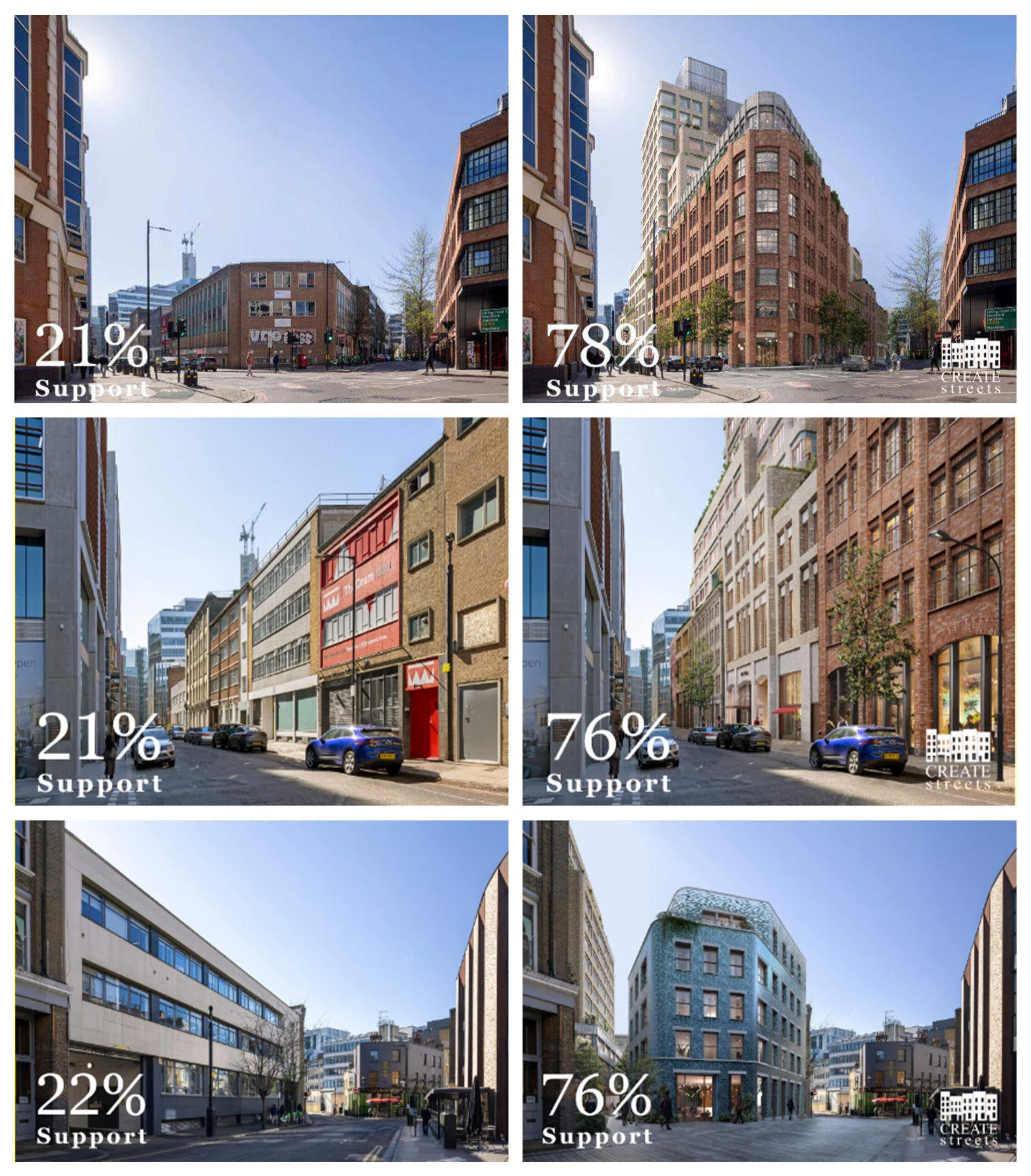
Which side is modern and which is traditional? The examples on the right are clearly more modern than the examples on the left to my eye: the left looks like it's from the '70s while the right is unmistakably 21st century. But the examples on the left are run-down, plain, and feature advertisements and bricked-up windows and steel shutters and security doors, while the examples on the right are brand new and shiny and walkable. There's graffiti in the first example and in the last one they replaced the asphalt with pavers!
Hard to take the conclusions seriously when the authors have their thumbs on the scale.
What changed is labour costs in western countries relative to the cost of materials and other physical things
Or on the flip side, go with cheap "traditonal design" like https://mcmansionhell.com/post/809937203073581056/mctuscan-h... and no, sorry, that's ugly as sin.
I think it's true that construction in general has become cheaper over time, so comparing older buildings to newer ones often results in comparing more expensive design to cheaper design. But that's different than aesthetic. To properly compare aesthetic they should normalize for cost at least, if not also execution.
I suppose they did have the expert vs non-expert study, but the only example they showed from it had a hideous buildings in both types so I'm not sure what that's supposed to really accomplish.
This is only partially true.
Traditional building used to be cheaper than it is now, yes, but things like ornate decorations and facades were still expensive additional work. It's worth considering the survivorship bias here - the traditional buildings people know and love are the ones that were well built and cared for.
This again, is partially true. A lot of ornamental decorative elements in public facades were, essentially, mass produced using molds --- very few were hand-made in the way they are done now.
They would degrade over time, however they could also be repaired or replaced relatively easily.
Your point about survivorship bias is also somewhat more nuanced. The buildings that have survived were often, as you said, made with more expensive materials, and they lasted longer; but there was also a change in tastes over time, in particular against ornament and decorative elements, and a change in the idea that certain buildings should be maintained. In the past, people were just way more accepting of tearing down or replacing buildings. Conservation as a general approach was not as common, nor were people as inclined to see certain buildings in particular as uniquely worthy of conservation. It is those buildings which were deemed "appropriate" for conservation and "historically significant" which have largely shaped our understanding of "traditional" architecture, a somewhat snapshot idea of architecture on the cusp of modernism,
I'm more curious about residential though - see huge interesting in MCM over the last decades. I am biased but I think there is a great deal of interest in warm, modernist spaces with ideas like natural materials and lots of natural lighting, especially when compared to the beige boxes of American home building.
My family lives in a MCM house built around 1960. We bought it in a "hot" market where you couldn't be particular about anything. We chose a house based on location and the interior.
Cultures have visual languages just the same as they have written and spoken (and signed) languages. The crucifix symbol has an understood meaning in most European cultures, because of how foundational Christianity is to their cultures. Is it really so surprising that people prefer buildings in a visual language they already understand?
There's also this paragraph at the very end:
>If this is true, a greater puzzle comes into view. Almost every architectural school in the world exclusively teaches broadly modernist styles, and probably more than 99 percent of architects practice exclusively in them. In Britain, there has been hardly a single public commission in a traditional style since the 1950s, and only a trickle of commercial and institutional ones. Except in the market for private housing, traditional styles have been virtually extinct for seven decades. Although in some cases this can be explained by anti-traditional planning rules, the broad trend is still evident in jurisdictions whose development control systems are stylistically neutral.
In a world where we've seen nothing but modernist designs for 70 years, is it really that surprising that people might prefer novel designs? Especially novel designs in a style they are repeatedly told is better, or references a more refined time?
1. There’s a traditional visual language that people instinctively prefer.
2. Modern architectural sensibilities have superseded traditional visual language through repetition.
I’m reading this to mean something like “people like their own traditional foods but since they've been drowning in pizza for the last 70 years, they’ve forgotten about their traditional foods.”
How can a basal, instinctive preference just disappear? Can the sex drive disappear with enough brainwashing?
The article even seems aware of this possibility when it mentions that architecture students prefer modernism (with the semi-covert implication that their education is poisoning their aesthetic sensibilities). I claim its at most partially because they've been taught to prefer modern designs, but mainly because they've been taught to think about visual languages consciously, so they are able to recognize what a given architect is trying to do, in a way that a layperson might not. That's certainly why Thomas Kinkade gets as much hate as he does (that and the dodgy business practices...).
I'm also not claiming that people have been starved of traditional architecture entirely, just that nobody is building things in the traditional style now. They're not tearing them down either, the White House East Wing not withstanding. This is a novelty bias, nothing more. If you only ever see neoclassical architecture in buildings that are designated as "fancy" or "special" or "august", and all these modern, ordinary buildings do not, you're going to assume that the style itself, and not simply the age and intent at construction are what contributes to that.
I mean, 39 out of 50 US state capitol buildings have domes, as does the nation's capitol building. I think anybody in the US can be forgiven for thinking that dome = legitimate seat of authority. Certainly, that was the hypothesis behind the design decision.
Speaking only for myself, I found Washington DC, which is all neo-classical all the time, just really boring. All the buildings look the same, and I couldn't escape the sense that I was in museum that hadn't been updated in a long time. Chicago's Fields Museum has the same quality.
The funny one is the buildings that have better landscaping. A few of the buildings in the post only look attractive as a consequence of the green courtyard in front. If you cover up that part of the photo, they just don’t look as stunning compared to the other. Perhaps that’s an argument for traditional courtyards (fair enough), but it doesn’t imply the need for traditional building construction.
I wish more people were building brand new, modern neoclassical buildings that are truly beautiful in a Haussmannian way, yet as practical as modern skyscrapers.. something like 1 Mayfair in London or 150 East 78th Street in New York.
https://www.dezeen.com/2026/02/17/chinese-projects-completed...
Not that I like all of them, but the point stands.
And most new single family housing is similarly generic.
Or maybe do nothing, it's not like the public opinion really matters in the technocratic settings.
Akin's Law 38: "Capabilities drive requirements, regardless of what the systems engineering textbooks say."
But, I think one missing piece between architects and the general public is how architecture students are taught to design (and thus, see) buildings first through the lens of massing [0]. When you compose a building primarily by shaping the different masses, you lose sight of the ornamentation and complex decoration that sets old buildings apart. Then, you add air conditioning and modern building systems and the need for high ceilings and windows with airflow also disappears.
What you are left with is a sealed box. Essentially, architecture has ceded too much design space to engineering in the name of cost optimization and there isn't much 'art' left in it. But look around - that's true across our society.
It gives them some clever thing to know that normal people don't know anything about. If King Charles is right about architecture (he is), then what new experimental architecture can you research? You can't, because we've basically already discovered what people like.
On a serious note, I've seen conspiracy theories about how such ugly modernist architecture is being used to break our spirits, to make us numb to ugliness and to promote an acceptance of mediocrity. While I originally dismissed it, I've become old enough to see many beautiful buildings replaced with caricatures of them. I'm starting to wonder if there weren't a kernel of truth to these ramblings.
I think the biggest problem with them is that the minute you stop maintaining things like gardens in contrast to the concrete and let it get dirty and scarred, it looks apocalyptic and stressful very quickly. Whereas even quite dilapidated neo-classical-ish buildings look innately reasonably pleasing.
There's a trend in some Eastern European countries to paint older brutalist concrete buildings as a cost-effective measure to reduce concrete spalling and do thermo-modernization. It's actually pretty amazing how much nicer some of these buildings look even with just a uniform white paint job (others involve more color).
Architects seem to be largely opposed, seeing it as an erasure of the material honesty that brutalism was supposed to represent, but IMHO it suggests that a lot of the core issue with these designs wasn't the shape or creativity of the buildings themselves but just the way the concrete look quickly aged.
Well, let's try crank the knob yet another notch then.
> Maybe the majority is actually correct
What a horrible thing to say. The liberal democracy, may it be known to you, is about protecting and empowering the minorities of various kind, and the aesthetical minority exists, and its tastes matter.
> traditional architecture is just plain better
It's unsustainable [citation not needed].
& buildings shape lives.
the only way to reverse the modernist trend is to have laws that incentivize classical buildings otherwise we gonna keep getting ugly buildings.
Good architects match modernism with livability. A couple months back I visited the Barbican Centre in London and it never ceases to amaze me how thoughtful is every little design item.
As such the vast majority of the Barbican's disparate cohort of brutalist concrete buildings in the UK were not built for humans, they were built for middling architects who were never going to have to suffer living in them. They need to be razed to the ground and thankfully many/most are going that way.
Stark, grey-brown, crumbling, water-stained monstrosities that just add to the feeling of misery in a country which is already stark, grey-brown, crumbling and water stained in so many other ways.
Modern buildings often are their own idiosyncratic isolate in the middle of the city.
When looking at movies, cities tend to have a uniform feel and look (like the elvish Rivendell), and I think people enjoy that.
Like Mont-Saint-Michel in France, or the Chuxi Tulou village in Fujian, China.
That in itself could be traced back to the professionalization of building manufacturing - the small-scale building and design that happened before this industrialisation of construction did away with all the little vernacular architectural decisions that would have been part of a building's design. Far more of the labour-force was involved in building construction, and less was done with pre-fabricated materials (probably just bricks and mortar), and certainly not as much was done on a mass-scale with the same homogenous approach^2, and with much less concern for the labour costs associated with those little details that add "character" to an older building^3.
I'm starting to find small examples of lower-scale construction projects in my home city (Sydney) that seem to return some interesting elements to newer building construction, like variation in materials such as perforated shading or different colours or textures of prefab cladding, using brick for feature walls in other pre-fabricated concrete buildigs, more external hanging gardens, etc). This is better, and I'm happy to see it, because while the older federation terraces in Sydney are nice to look at, they're hopelessly underdesigned for the climate (too hot in summer, too cold in winter, too dark in a country that is blessed with natural light, and often with damp and mould problems that shouldn't exist on a building post 1900).
^1 popular in the sense that its widespread amongst the general population, not the way modernism is popular with architects, both for its cost and the way its become part of the popular taste of architects as a profession
^2 the treasured old neighbourhoods in cities that are preserved and made "heritage" are the results of hundreds of individual decisions by dozens of individual builders and tradespeople, which although similar, contain enough difference to convey a sense of character. Compare that with a small team of planners working for a single construction company remaking a block or entire suburb.
^3 I could be wrong, but I would have thought labour costs were a much lower component of building construction then, or at least there was far more labour hours that go into a building's construction, allowing more time for the little details that give an older building its little characteristics like lacing, fancy brickwork or unusual reliefs.
Abstract modernism with random shapes and obsessively minimalist design is only the worst case scenario where all the hate is justified. It's what happens when architects design for each other and not the rest of us.
You can design two buildings for people to live in, make them identical in layout and build quality but one of them has slightly more classical style of architecture and people will invariably prefer it, all else being equal.
If aesthetic sense is distributed according a bell curve, the majority of the population will have "average" taste. If you say good taste is one standard deviation above the median, then the majority will have worse taste.
And then there is the issue of construction. Many older designs use materials and methods that are either out of date or expensive to replicate with currently popular building materials. Simply going back to older designs is not a practical option for most buildings. There has to be some balance of old ideas with newer methods.
I live in a hundred-year old house (old for the region I’m in), with rabbit warren hallways. I wouldn’t want it any other way. That might just be my taste in interiors, but (as with the article about exteriors) I suspect it is more common than all the modernist functional people would prefer.
But most people will prioritise cost (both capex and opex) and comfort over aesthetics.
Then again, I wonder whether the modern innovation of using steel under tension could enable us to make the "wings" (buttresses) smaller.
I feel similar positive about new buildings in my native Netherlands, which seem to be getting less flat and with smaller, more reasonably sized windows (if you know, you know!)
The examples where arch students gave higher scores, like with that god awful-looking house, I don't have an answer to. Maybe they had terrible taste. Just because you are a student of architecture it does not mean you have good taste or how to build beautiful things that evoke a specific emotion.
They are comparing "same buildings" with AI but I would imagine they are not controlling cost.
Imagine gargoyles and metal dragons on drainpipes and all the ornamentation now and how much that would cost.
People prefer ancient dry stone walls over fences but they cost orders of magnitude differently.
I wonder if with robots and what not if we will see a resurgence in detail and ornamentation and other kinds of expensive but nice constructions.
Robots are not going to bring any of this back because robots will just create a new set of optimizations and constraints needed to make robotic construction cheaper and easier. If modern cars (which are the result of similar optimization) are anything to go by, this will result in output that's easy to build but hard to maintain or modify - so largely a continuation of existing trends.
Take a look at "3d printed" houses for an imperfect example of this kind of optimization for automation in action. Better robotics will bring about a more balanced version of this trade-off (walls will probably be possible to modify, unlike 3d printed ones) but the incentives remain the same.
Edit:
Trivial example: One of the easiest way to autonomously insulate a house will probably be with spray foam insulation - you can get a robot arm to hold the sprayer and move it in a specific, continuous motion pretty readily even today. But spray foam insulation is hard to modify after the fact. Removing it is time-intensive compared to removing insulation "batting" and applying it again requires specialized tools, PPE, and perhaps licensing.
Modernist builds aren't really cheaper.
Maybe the average modernist building really is that bad and the issue is that "traditional" buildings are more forgiving for an average architect.
I might be missing something but isn't this all a bit of a no-brainer?
In the old days, buildings were made to impress, to project wealth, to show the generosity of wealthy benefactors to their town or city. Take a look around somewhere like historic Bruges, which benefited from the wealth of local merchants. Incredibly impressive. Not remotely cost effective.
Today, buildings are typically functional, or at least financial considerations are top of mind. And cheaper tends to be uglier. Why would someone invest in an elaborate and expensive design when they could simply throw up a slab of brutalist concrete and punch some windows into it? It's all the same to the workers inside.
And of course for older folks, older buildings are closer to what they grew up with. Even if only a bit. Seems a natural effect for older people to enjoy older architecture.
The olden times were no stranger to slapdash, poor quality construction, but most of it has been demolished either due to having low perceived value or due to not lasting as long and people not doing the necessary lifecycle replacements.
All the terribly kept tenements that housed 10 families on two floors were also "traditional," but you can't even find them now. Even in places where there are some left, the ones still standing were probably the best of the bunch AND have been extensively repaired since.
I find the Habitat67 brutalist apartment complex in Montreal to be tasteful and livable?
Google "survivorship bias".
Look at 1950s New York - almost every building is beautiful, and every building is more beautiful than modern ones: https://stuffnobodycaresabout.com/2020/01/31/new-york-city-i...
That's not survivorship bias, that's going from near-uniformly beautiful to uniformly-ugly.
https://stuffnobodycaresabout.com/wp-content/uploads/2020/01...

Personally I'd prefer to spend my time in and around a building like this than any of those:
https://labs.utdallas.edu/mems/files/2021/08/nserloutside.jp...
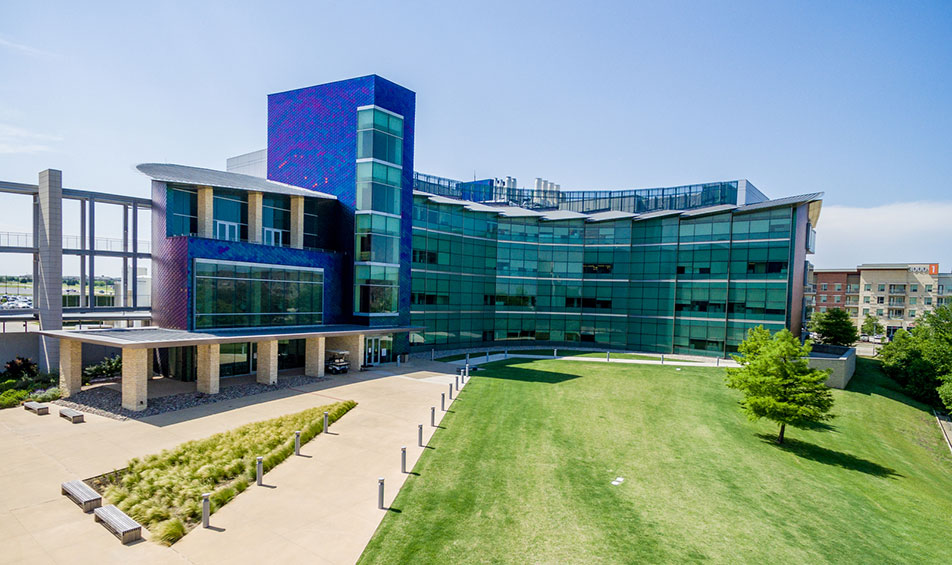
To me a building like this looks a lot more interesting. Lots of mixtures in materials, textures, and colors. And as mentioned before, this building lets in a lot of natural lighting. It lets you see outside instead of just constantly feeling like you're trapped in a jail cell.
Its not even like I really hate old architecture, I just think a lot of these examples given suck. I like this, for example (although it is getting close to overstylized for my taste):
https://www.adventuresofacarryon.com/wordpress/wp-content/up...

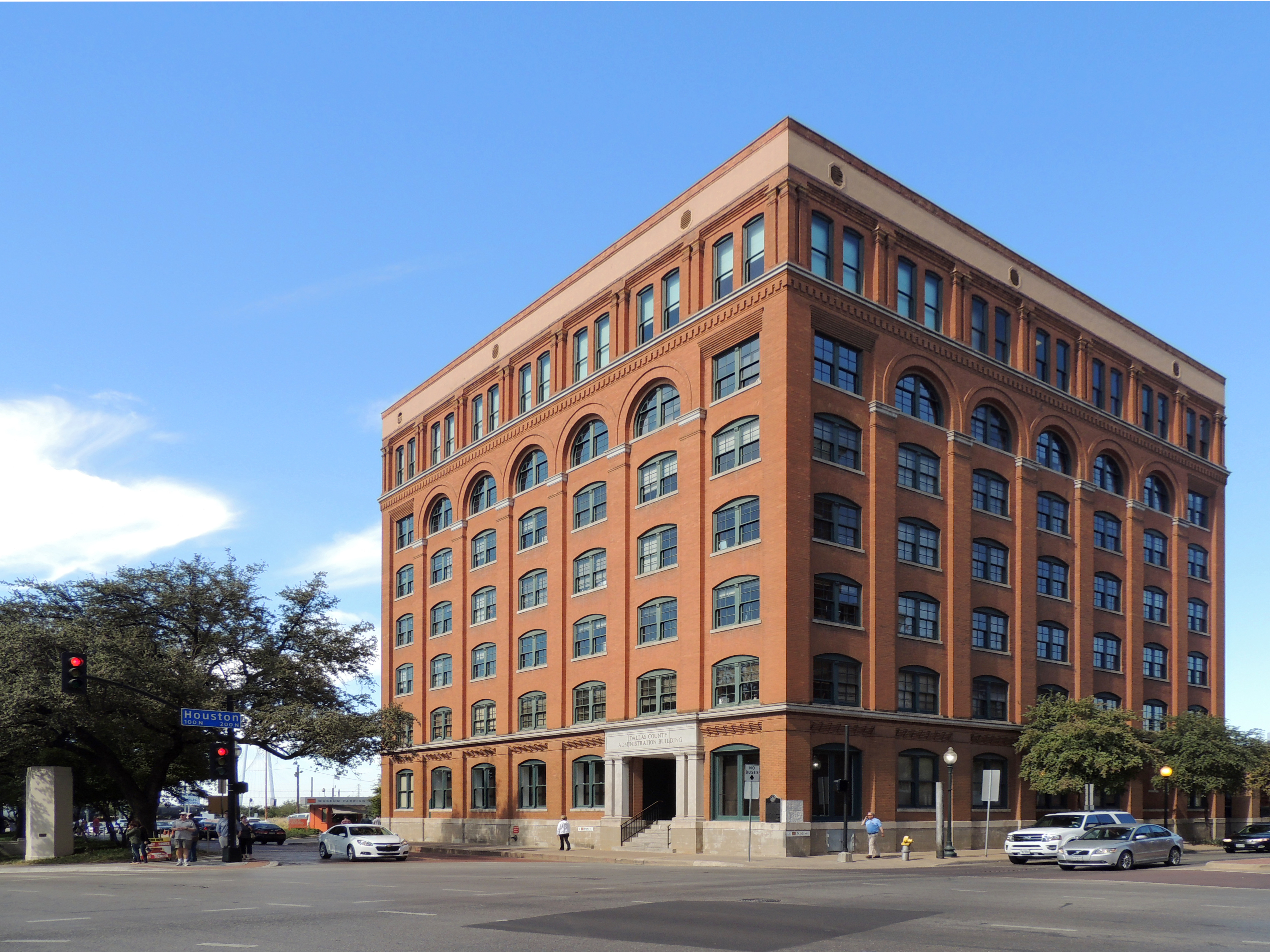
Buildings like this as well, although definitely not as much natural light. Notice its actually nice, clean, and maintained compared to the other examples given. Still kind of old and boring though in the end.
https://upload.wikimedia.org/wikipedia/commons/1/14/Dallas_C...
If you're defending modern architecture, you have NO place complaining about originality, when 99% of it is steel & glass basic geometric shapes.
I can definitely complain about a lack of originality for works which lack originality.
Modern designs can often lack originality, I agree. Classical designs can lack originality as well. A lack of originality can make things boring. Don't let your personal choices get in the way of objectively analyzing things. Its not good to put yourself in a camp and act like everything in group A is good without question, everything in camp B is bad without question.
You can't honestly say the modern building I linked above lacks originality. How many other buildings have anodized scales on the outside which change colors based on the lighting? Are you really saying you'd prefer to actually be in and use one of the buildings in that postcard image I pointed out?
Buildings like this have way more originality than all those brick buildings in the postcard I linked, other than the one featured center in that postcard. Or yet another white stone government building with roman columns in front and endless small windows. And I don't even consider it that original.
https://img.imageboss.me/concrete-assets/width/3072/format:a...
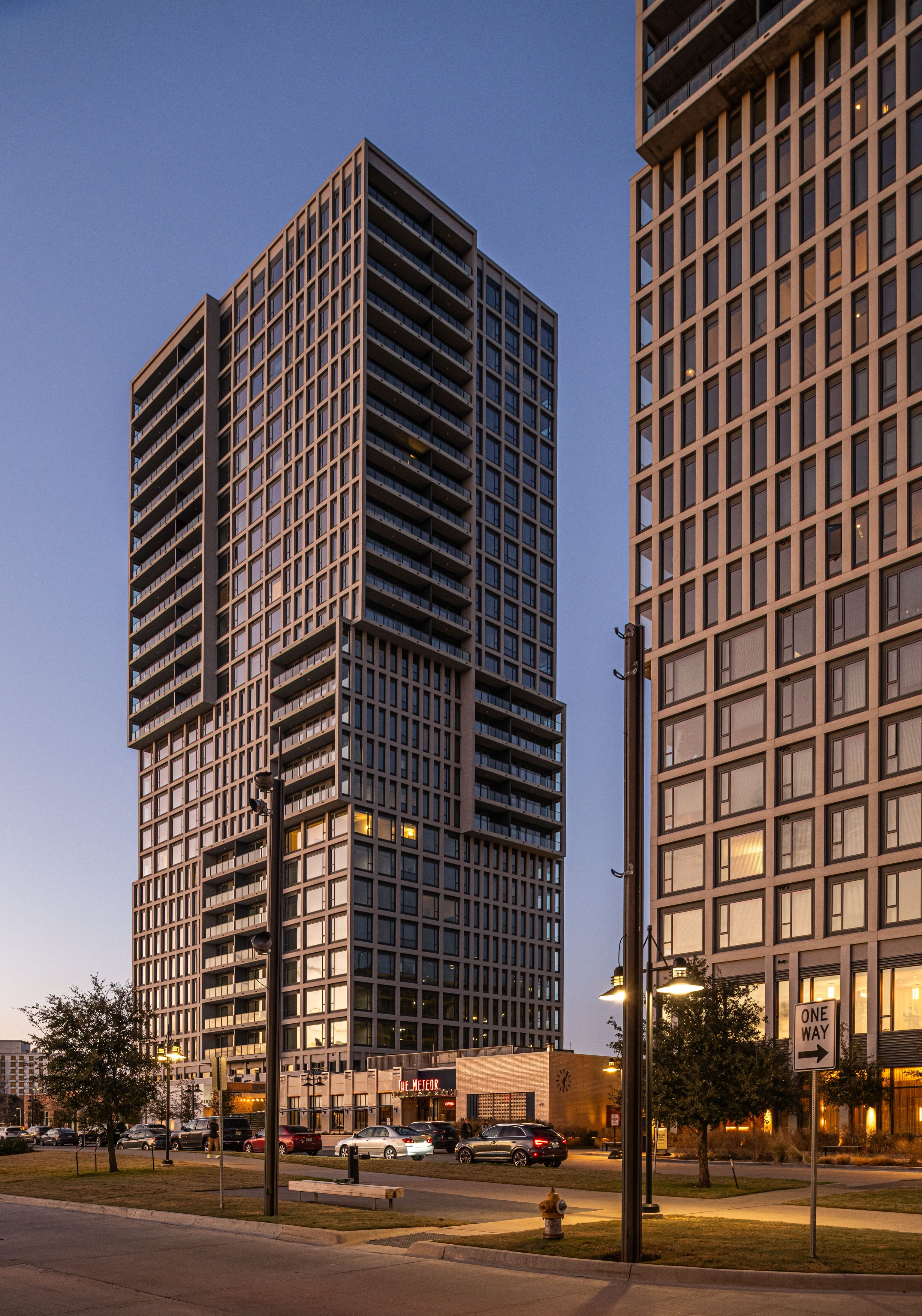
I'm not saying all modern designs are good. I'm also not saying all older designs are bad. I'm not even saying those classical revival government buildings are inherently bad, they're consistent and unoriginal for a reason. I am saying I am a human being and like to have some sunlight and see trees and the horizon from time to time, and that's more important to me for a building than some little intricate stonework that I can't even really make out because its three stories up and the whole exterior facade is covered with black gunk because its too expensive and fragile to actually maintain.
But why do the students of architecture prefer brutalism? I don't believe they factor the financials in when they choose which picture they like better.
it refers to "béton brut" - french for 'raw concrete'. in this case, brutalism could be more readily understood as 'rawism'. it also emerged during (and is a descendant of) the modernist architectural period, which is well known for those boring, non-descript office towers.
there's nothing wrong with the simplicity of raw concrete. but just like other architecture, it can be done well and it can be done poorly. it can be done for utility, and it can be done for extravagance.
I think many people think of non-descript office towers when they think of brutalism, rather than all of the interesting things that can be done with a single material (shapes, textures, designs, etc. it's a very versatile + strong medium!).
Now, as a contrast, another masterpiece from the city where I grew up: https://www.scribd.com/document/955270807/g10-Cultural-Cente...
Because they study architecture. The article is profoundly anti-intellectual. This discourse, that colleges indoctrinate people and, thus, cause them to disagree with some form of "truth" that the uneducated masses know.
If the architecture they're studying is divorced from the preferences and needs of the uneducated masses then who cares? They may as well be studying their own butts.
Preferences, perhaps, but needs, I'm sure not. On this, I much prefer being divorced from preferences, than designing soul-less buildings designed solely to cater to preferences, without leveraging the knowledge gained through years of study.
Classic butt-guy response.
It's probably some combination of the subculture effect (i.e., subcultures tend to develop their own in-group aesthetics) and as a functional shibboleth (i.e., being able to "appreciate" things average people don't has an in-group signalling function).
One great example from the city where I grew up: https://hicarquitectura.com/2024/09/lina-bo-bardi-sesc-pompe...
As for the building you showed me. I think it looks awful. It actually looks worse than the architecture in movie Equilibrium.
https://www.re-thinkingthefuture.com/rtf-architectural-revie...
Take a look at any old poverty-stricken farming village. It'll be strikingly beautiful compared to anything modern.
This is the Anamosa state prison: https://en.wikipedia.org/wiki/Anamosa_State_Penitentiary#/me...

This is Anamosa middle school: https://www.anamosa.k12.ia.us/wp-content/uploads/2017/08/IMG...

> Not remotely cost effective.
This is the main building of the Ontario college of art and design: https://en.wikipedia.org/wiki/OCAD_University#/media/File:OC...
.jpg)
Why are we still humoring the "cost effective" explanation, when, whenever the people in charge of design are given free reign, they make non-cost-effective, ugly buildings, ugly in the exact same way all the other "cost effective" buildings are ugly? Whenever they are asked which they prefer visually, ignoring cost, they pick the ugly buildings. Meanwhile anything old, from farms to literal prisons, is beautiful. And all those old buildings you claim didn't care about cost effectiveness, were built in a time when the GDP per capita was 4.6x lower than today [1]. If you believe GDP measures wealth, if you believe there was economic progress and we are materially better off than in the aftermath of WWII, we should have ~4x more "wealth to project". And yet this is what we get.
The explanation that fits the data is that they're building exactly what they want to build, and they're building ugly on purpose.
That prison building is overly stylized to my taste. And given how complex the exterior is and seeing it's state it's obvious it's hard to maintain. Unless you like all the gunk growing all over the building all the time.
Is the old building "fancy"? Sure. So is that fragile china that's kept in the fancy vitrine but rarely actually used because it's such a pain to maintain and actually use.
There is a clear preference for other people to build in traditional styles, but as soon as you have to care about more than what the facade looks like from the outside people choose the uglier functional option.
Like what? A shadowy cabal of liberal elites pulling the strings from the shadows? Stripe (who own Works In Progress) founder Patrick Collision donated to the Trump campaign in 2024. Tiresomely obvious what this "piece" is trying to do. Find a new gimmick imho.
Unfortunately my European brothers and sisters prefer to live in open air museums. However slowly but surely skyscrapers have been creeping up into the Netherlands- you just can't beat the efficiency.
Humans weren't meant to be packed like ants. Wrong species.
as an aside, for the longest time i have thought modernity was fully understood by the 60s (ellul, debord, macluhan, ...). but maybe there the focus was too narrowly political, sociological. it has been revealing to see this ethos (and it is an ethos, make no mistake) recently linked to autism. high modernists are uniform, monomaniacal people. like machines. and the world they fashion, is therefore one that is uniform, principled. how the unsociable autist colleague cannot distinguish between is and ought, so will modern architecture barrel down deductively to its unpleasant conclusion.
modernisn is the commodification of all spheres of existence, it is an unprecedented evolution, how to break out of this, how to get of this train with only a single endpoint.
I'm not a hater on modernism -- I like stripped down literature and architecture (though I wish concrete buildings were cleaned more regularly). But there does seem to be some truth in this idea that "the elite critics" have dominated these fields, resulting in the production of art (and buildings) that are broadly unpopular. I think the overriding goal of these critics is avoiding kitsch, which they see in classical forms.
Be kind. Don't be snarky. Converse curiously; don't cross-examine. Edit out swipes.
Comments should get more thoughtful and substantive, not less, as a topic gets more divisive.
Please don't fulminate. Please don't sneer, including at the rest of the community.
Eschew flamebait. Avoid generic tangents. Omit internet tropes.
Please don't post shallow dismissals, especially of other people's work. A good critical comment teaches us something.
Please don't use Hacker News for political or ideological battle. It tramples curiosity.
It reads uncomfortably close to an anti-intellectual discourse so popular in the far-right.
a) Genuinely widely preferred, with many articles on this, ranging from aesthetic preferences through to scientific studies of how eyes move and what causes fatigue. There is genuine value to architecture before modern architecture -- and...
b) A stalking horse for right-wing thinking.
It's really interesting how this happens and it mirrors other right-wing techniques. A common way to get people into right-wing thinking is to find something that is genuinely unpopular or that people have concerns about, yet which has constrained discourse. Examples: lower incomes. You then talk about the good old days, and reframe it: lower incomes becomes, 'people taking your income, agh those immigrants'. Architecture becomes, '1940 and before were better, oh and everyone was white then'. You get the idea.
Another popular one on social media is the Greek and classical world, especially its comparative lack in modern education compared to, say, 1900. That's an easy intro to colonialism and racism, disguised in the neutral or even interesting format of ancient history.
Once you recognise this, you see it everywhere.
But don't let this fool you re older architecture having genuine value. We just have to avoid saying people have no taste, or referring to their preferences as 'pabulum'. That is condescending, makes normal people feel unheard, and then when someone does hear them on the innocuous subject of architecture, they pay attention to what else that person says.
The pattern is 1. take something that's true then 2. use it to imply the Truth. Step 3. is if anyone doubts 2, challenge them to disprove 1. Even if you don't deny that 1 is true and just challenging that 2 doesn't follow from 1, the waters have already been muddied in the eyes of many onlookers.
It's silly that this works but there's so much over-communication now that simplicity is very effective. People often repeat the fallacies verbatim too.
And that is why all the pollsters were caught flat-footed by Trump in 2016. The people who did feel unheard learned to not respond.
When politics exclude a group, or a group feels excluded, it's easy to lure the group into supporting anti-politics, which is a nice way to say "fascism".
This is kind of where we are now, with the far-right preying on the most vulnerable people that feel ignored by politicians.
So? Many people (not all) are right-wing because they want to preserve beauty. Being a right-wing is not a rare thing, it's the second most popular belief system in the West.
>Another popular one on social media is the Greek and classical world, especially its comparative lack in modern education compared to, say, 1900. That's an easy intro to colonialism and racism
Racism is much less of a thing in Europe, compared to the USA, yet fascination with Antiquity is just the same or even higher.
The author writes an article observing that people find more beauty in traditional architecture and you immediately slander him as a racist white guy who wants to go back to 1950s segregation? You think you're the reasonable one in this conversation?
There isn't just "some" racism and segregation, either. Check the text messages sent by cops in the Karen Reid case. What are the odds that the most racist cops in the state worked that case?
Go touch grass, it's healthy. (And get off bluesky)
> Go touch grass, it's healthy. (And get off bluesky)
You seem to have been triggered by the OP pointing out that a lot of this traditionalist architecture movement is - yes - racist old white dudes who want everything to be like it was when they were kids. Nostalgia is a powerful force, but it's worth remembering that the times filled with traditionalist architecture also had entire lower classes that slept in Flop Houses [0] and Shantytowns [1].
Ultimately traditionalist architecture may look nicer, but it's not surprising that buildings which cost more to build also look nicer.
If someone simply pointing the driving force behind this upsets you so much that you start posting replies like this, I would advise spending less time on X. Go outside, take a break from your "culture war". It's healthy.
No, it's not racist, no matter how much you try to make it so. It's exhausting and tired and makes people like Trump win. Racism is bad, good looking buildings are ... good.
Absolutely ridiculous, please listen to yourselves and please, please, think long and hard about how median American's would respond to this nonsense. (If you know any)