
Some outcomes can be annoying, but the net result is still positive, for the consumers and their data privacy at least.
I'd classify mandatory encryption backdoors as an industry crisis rather than an annoyance.
[though you are not wrong that encryption backdoors are a backwards step on individuals rights to privacy]
As long as you manage to navigate all the dark patterns and not accidentally give your "informed consent".
So your argument is abusive practices are required for the creation of influential companies, serious technology, and high paying salaries?
But like I said, nice place to visit for the time being.
Yes, because it’s a place where culture matters and where trying to change everything as fast as possible for unknown reason and handing out unlimited power to corps to e.g. level half the country to build DCs is not seen as a good outcome. The specific mindset you complain about is what makes those place nice.
For example because I literally can’t sleep well above 20°C.
I don't know if this is a genetic thing, but as a scandinavian who wears shorts down to like 12C, I am unable to function in >30C humid weather. Anything more labour intensive than drinking sangria on ice is not getting done. This year we had up to 37C in Denmark. If you're able to tolerate heat well, I'm happy for you, but my sleep was ruined for months this summer. Not to mention the people who literally died.
I'm investigating my options for at least cooling down the bedroom at night, because I'm not going through this nonsense again. Plastic straws are banned now and we're sorting garbage in 42 different bins, so I'm thinking that about evens it out, environmentally.
The Amish hang wet bed sheets in front of the window (with a tob under it to recycle the water) not sure how well this works in the Netherlands with 95-99% humidity, it certainly wont raise humidity but evaporation might be shit.
Not every bathroom is fit for it but if there is no AC and things become unbearable I put the shower head upside down so that the ceiling and walls get wet and it rains everywhere. Then I daisy chain fans to "tunnel" the air into the bathroom. The temperature drops like a rock.
Like the US of A?
Also various stars have introduced more bottle cap regulations. One such state is a hotbed for inflated software developer salaries.
You know, the thing that actually makes a country/society
Putting the needs of business over the needs of the people those businesses are actually supposed to serve is how you end up with America
Better than a government that fears the word gay
> and how low i set my ac temp leads to an incredibly hostile business environment and stagnant culture.
You are quite a cherrypicker, aren’t you?
How about the regulation to have USB-C as a standard or replaceable batteries.
Or one of my favorites, the ban of ingredients that cause cancer.
BTW ever heard of Frauenhofer IIS or ASML?
Sure, but plenty of companies want to operate within the EU. While I feel any legislation will only affect their operations within the EU, having the infrastructure to operate under privacy laws there means it'll be easier if/when other jurisdictions follow suit
With no Flock cameras!
Privacy has been dead for some time now. The fact is most business people never figure out how they are exploited. The modern intelligence campaigns just made it economical to hit almost everyone regardless of scale... often under some silly pretense like terrorists wanting our underpants. =3
Which has nothing to do with the stalking of the adtech industry, unless you are suggesting that the EU might sell access to the keys to the likes of OpenAI [though you are not wrong that encryption backdoors are a backwards step on individuals rights to privacy]
Things could be worse. It could be like most of the US where there are both no (or at least far fewer) protections against invasive behaviour of private companies and the government actively trying to backdoor private comms.
It has a lot to do with the practices of the adtech industry. If privacy is protected and upheld vis-a-vis the government (or meta-government in case of the EU), it may be upheld vis-a-vis private corporations and other governments. But if the government likes to be able to spy on its citizens, it will not foster mechanisms, practices and a culture of private communications.
But - I agree that it could be much worse.
Just set up your user agent to work as you wish, isn't that simpler than have unelected, technologic dumb bureaucrats writing laws that are complex and don't solve the issue?
All the EU bureaucrats can do is regulate, that's why it's so difficult to do business in the EU and that's why there is so little innovation over here. If Microsoft and Apple were started in the EU they would've been shut down within a week because you can't operate from a garage.
I guess that every once in a while this might have a positive outcome for consumers, a broken clock is right twice a day.
And, regarding the original topic, we wouldn't have many of these privacy issues if the US had not strategically failed to regulate its obnoxious tech monopolies
why not use your own words? If you are gonna ai generate this blog, just post the prompts instead.
Most people do not, in fact, want to read raw prompts.
> This blog is where I write about what I find.
Why not simply include a disclaimer that it was AI model output not his own writing? Because humans don’t like AI writing and the article wouldn’t be featured on as many tech news sites. Hence the sin of omission, the choice to mislead.
> Most people do not, in fact, want to read raw prompts.
I wonder if this is really true, and if it will remain true for long. Have you observed someone read another person’s raw prompt? Or observed someone submit both their prompts and their LLM output for review?
Personally I’d be curious about the prompts for a lot of top HN articles which are LLM-generated. It would say a lot more about the human operator’s intent and thinking process compared to the LLM output.
A coworker who spoke English as a second language once screen shared their Claude session during a code review, and it was interesting that their prompts were all in their native language. The guy wasn’t writing an article, and I didn’t understand the prompt anyway, but I still found it interesting as a glimpse into how he uses LLMs.
For this particular article, if the prompt was initially a series of bullet points that wouldn’t be so bad. If there were multiple prompts spent editing and rearranging the article that would be an unusual work by pre-LLM standards. However I’d suggest that instead of dismissing the idea, we could embrace “raw prompts” as a kind of new medium, to cross the divide between pro-LLM and anti-LLM readers.
Why would anyone want that?
Note to folks who have this same thought (seems like many given other comments). Why are you on this site if you aren't here for human-created content? If you want AI generated blogs/posts there are plenty of sites like linkedin, twitter, chatgpt, and claude that will give you meaningless content with a press of a button.
At least criticise the article on merit and not some 'let me google that for you' high horse. If it's slop it's slop, but let the votes speak for that.
This sentence is way too much detail and it's literally the first thing you read. I can pick apart most of the sentences in the article. Another one:
> Across 932 decoded sync tokens, 736 carried subject_type: account_user and 196 carried anonymous
This sentence is pointless. What matters to proving that "It works when you are logged out" is to show that the identifier is stable. Why does the reader care about the actual counts.
AI has a tendency to do this which makes AI generated text a lot harder to read. The raw prompts likely don't have the specific websites and cookie names because that's not relevant to the reader or writer for that matter - it's a footnote at best.
> let the votes speak for that.
The comment you are replying to got a fair number of votes too… Having somebody run a Pangram check saves n people the trouble of doing the same.
> The mechanism is standard adtech. What has no precedent is running it on an AI chat product.
As someone who has been well aware of this mechanism for quite some time, I still feel icky anytime I re-read the details of it.
What a time to be alive.
See e.g., https://www.science.org/content/article/ai-chatbots-are-beco...
"It is difficult to get a man to understand something when his salary depends upon his not understanding it." - Upton Sinclair
I couldn't help but notice how each successive headline reporting our glorious victories seemed to draw closer to Tokyo.
Well. I can't help but notice how each successive headline reporting how this "scam"/stochastic parrot/"scare quotes intelligence" seems to be solving more and more things that were but a few years ago widely regarded as being indicators of high intelligence.
Being highly convinving is one of the things on that list.
A programming contest has a problem where given N < 10000, do something hard like come up with the number of primes less than N
You can come up with all sorts of algorithms that do intelligent things. But the most effective solution is to use metaprogramming to make a massive switch statement that contains all the answers
That seems like a really bizarre way to describe a tool that solved an open Millennium Prize Problem. They are, empirically and repeatedly, ahead of the status quo.
So if your argument depends on them being behind the status quo, reality has already disproven it multiple times over.
Definitions are "formal statements of the meaning or significance of a word, phrase, idiom, etc" (https://www.dictionary.com/browse/definition)
> They are necessarily behind the status quo.
The existing state or condition would be what is written in the dictionary, not whatever personal definitions you've constructed.
> "You can't call this newfangled contraption a computer, because a computer is a person!"
Seems like a straw man. A computer is not a mammal, no matter how much you twist a set of definitions.
I’m not the person you replied to, but I believe they’re referring to the occupation of “computer”:
https://en.wikipedia.org/wiki/Computer_(occupation)
So yes, at one time all computers were mammals.
The people who write dictionaries generally take a descriptivist approach, that’s why slang terms enter the dictionary after they start to become popular.
The state of the art of human knowledge would be another step ahead of the common use of any language.
Don't misunderstand: I'm happy saying AI models "think" or "have learned a thing", and for in-context learning I'd call them smart even by this definition…
…but also, any living creature that needed as many examples as machine learning currently needs, would starve to death before figuring out how to eat.
While training, machine learning processes (not just LLMs, also applies to e.g. self driving cars), are really really stupid and only make up for this by being really really stupid really really fast.
To what I wrote upthread: the "victories" of humanity over machine keep getting closer, but we have yet to wake up one day in great confusion as we find an entire city is no longer in communication with anyone, nor finding ourselves in a state of utter disbelief when the reports come in that the city stopped communicating because it is entirely gone.
If humans learned like ML systems learn, (biblical) Methuselah would still have been failing the Sally-Anne test on his supposed deathbed at 969 years old, like some of the smaller early LLMs did.
> It also doesn't really matter when "we are trained differently" has no direct bearing on the end result.
The question was to ask for a definition such that AI could still count as "not smart" compared to humans. This fits.
It's also why they're spiky intelligences, which I'm happily using right now to write code for me, but also do not trust in the slightest to identify the weeds in my garden. These submarines sure do swim fast*, but they're also very much disqualified for the Olympics.
There's a lot of innate knowledge but all neuroscience demonstrates how incredibly flexible the brain is. Brains constantly learn and rewire.
Here's a few things that I think show how crazy it is AND stress those points
  - people that have had corpus callosotomy (brain cut in half) *may* be indistinguishable from a normal person. Depends on how young you were when you underwent the procedure
    - true for most brain injuries
    - can even include the frontal cortex
  - you can learn to ecolocate
  - people with Aphantasia are indistinguishable from others
  - people without an internal monologue are indistinguishable from those with one
  - people can learn to use prosthetics
    - even without disabilities
    - or look into MRI scans with tool use
We are constantly learning. You aren't just born with your knowledge and it stays static. We are extremely proficient at metalearning (learning how to learn, few shot learning, zero shot learning [0,1]). Our brains are constantly rewiring, able to heal from traumatic damage.
I could go on and on. Does information pass down through genetics? Of course! But that's far from the whole story.
I'm tired of people trying to make AI sentient by making humans robotic. Stop trying to trivialize everything and be okay not knowing the answer to everything. You're human, you're designed to learn and explore, not sit and argue from an armchair
[0] and I mean these in the original sense. Not in the sense that you train on a billion examples of labeled animals and then congratulate yourself on your ImageNet-1k held out test performance. That's not zero shot, that's just a test set
[1] I can literally make up words and you'll understand them. Or use words in novel ways. That's literally how slang works and how new words come to be. Don't be a walibanut ya glufus. Read some SciFi
Most of the effort of evolution was making cells work at all, and even then it's a bit weird, e.g. no plant or animal produces vitamin B12 and we all get this from some bacteria and archaea.
And evolution is kinda hard to time right: bacteria can reproduce in minutes, humans in decades, but only mutations that survive reproduction can be passed on. This makes it even starker as a difference: bacteria had order of 1e13 generations to become multicellular, while human DNA had about 40,000 generations to cope with fire, 220 generations for evolution to do anything with the invention of the wheel, and one generation to cope with the invention of Minecraft.
The analogy here would be: DNA is to our brains like a VN replicator bootstrapping a computer all the way up to a bare-metal-no-OS untrained model, and perhaps a few crude "hard coded" modules like a smiling-face-detector. It's a lot, but it's also missing a lot. If biology used the models and training processes that are state of the art in ML, it would take around a millennia to talk like a child and still fail the Sally-Anne test, and million years or so to pass a degree.
I'm still going to deny the premise of your argument, becasue I think we should define intelligence in terms of capabilities. If a system can discover a cure for cancer or solve P vs. NP, it doesn't matter how many FLOPs it took to train.
A 1 gigabyte LLM isn't going to impress anyone with what it can do.
About 99% (depends who you ask) of our DNA is shared with our nearest primates. Like us, they can learn to use touch screens, but also like us they won't find touch screens in their natural environment. Dogs can be taught to drive cars (just about), but again, not natural environment.
> I'm still going to deny the premise of your argument, becasue I think we should define intelligence in terms of capabilities. If a system can discover a cure for cancer or solve P vs. NP, it doesn't matter how many FLOPs it took to train.
We can define it in either way. I think both are valid, because plenty of people mean each of these two things when discussing AI in particular. As I referenced in the other branch, these submarines sure can swim fast.
But at the same time, they have a lot of gaps. This is because some experience needs the real world: just as nine women can't make a baby in one month, a transistor running a million times faster than a synapse can't make a month-long cancer experiment happen in 2.6 seconds.
This dependency on data, and that state of the art ML is bad in specifically this way, is why Tesla's self-driving cars, despite having had around a trillion miles of real-world experience today, still come with steering wheels (even at least some of the Cybercabs, despite the big thing of this model supposedly being not needing them, though with Musk and his promises you should only count the Cybercabs when they actually ship and not just press releases).
Imagine an alien that matches your abilities across every domain, but has a 10 billion year training period, something many orders of magnitude more expensive than an LLM. I simply don't believe that alien is less intelligent than you.
We also don't expect humans to be competent in every domain. Most humans suck at most things. We will usually call someone intelligent if they excel at solving problems in one or two narrow domains.
> 10 billion year training period, something many orders of magnitude more expensive than an LLM.
I'm saying both definitions are valid definitions, they both point to important and different things: skill now, vs. how hard it is to get new skills. Some would describe it as "crystallised intelligence vs fluid intelligence".
I think it's important that any arguments are over the thing in dispute, not the label for that thing. Don't mistake the map for the territory.
Anyone who says "AI is stupid" by the first definition, what it can do, I think is making an error: they are already wildly super-human in at least some areas, if not generally.
Anyone who says "AI is stupid" by the second definition, how many examples they need, I agree with: there is a lot they are not currently able to learn even though it is easy for us, because the data they would need to do the learning on does not exist at the scale they need.
Also note: examples, not years. An alien intelligence whose synapses trigger 10 times faster or slower than mine (or ten million times faster or slower than mine), but who gets as much as I do out of each book or conversation, is my equal by the second definition.
OK, they can play chess, but that's not real AI - can they write poems? OK, they can write poems, but that's not real AI - can they compose music? OK, they can compose music, but that's not real AI - can they translate languages? OK, they can translate text, but can they do maths? OK, they can do maths, but can they solve a Millenium Prize? <-- we are here
I try to keep an open mind about propaganda fooling me today; the people who were fooled in the past often were not fools themselves.
A million YouTubers grinding The Algorithm while secretly sponsored by various world governments, isn't much different to a thousand well-placed gossipers secretly sponsored by various world governments.
> the people who were fooled in the past often were not fools themselves.
Being fooled doesn't make you a fool. But being unwilling to change your mind does. Being unable to admit you don't know or don't have enough information to make a strong opinion makes you a fool too.
Propaganda wants to take shortcuts, to simplify things. To trivialize. "It's so easy, you just..." because the fool is the person who already knows, the person who has nothing to learn, the person who thinks they're better than everybody else.
I’m reminded that almost no one beyond a select few knew high up in the military and around the emperor knew how badly the Japanese were defeated at Midway.
Paternalistic. Arrogant. Shameful. And deeply engrained in the Japanese cultural zeitgeist (of the early-mid 20th century).
Edit: I guess it’s commonly attributed to a German citizen, but their cultures mirrored each other. Fascism falling under the weight of its own propaganda.
Why is it so black and white?
Your kind is what makes the internet shit, not AI
It blows my mind that people don’t care about the world they are building with this stuff. It’s a real tragedy of the commons. People see these collaborators from different wars and regimes and think “I’d stand up against the bad guy”… well I’ve got news for you if you build spyware, you are not the person you think you are.
https://gowers.wordpress.com/2026/09/17/why-i-didnt-sign-the...
"Nothing is worse to the demise of a society, than people who want to convince you that the cat is out of the bag and will not go back in, while the cat is being violently shook out of the bag at the same time."
There's nothing in the bag.
The cat will never get out of the bag.
It wouldn't be a problem if the cat was out of the bag.
We cannot possibly keep the cat in the bag.
Putting the cat back in the bag is not worth trying.
This is where the lawyers find the loophole to get the cat out of the bag.
Seems more like a real tragedy of private enterprise.
We used to assume that the surveillance world would be built by government (1984). But it turned out to be equally likely to be built by the free market.
Facebook didn't invent "talking to friends" or "showing adverts", but made itself "the place" hard enough most of the advertisers and most of the people intermediate through it.
OpenAI didn't invent "asking questions and recieving answers", not even "from an agent who knows which sites to search on your behalf"; but it is competent enough that I might have it read 50 times as many pages in a day as I myself would have read, and the sites' owners don't get real eyeballs looking at ads during this. (In my case, adblock even if I did it manually; but apply this massive increase in page hits to everyone who has their LLM research stuff).
There should be general standards for what individual apps and websites should be allowed to do. There should be an expectation that the purpose of an app is what it does, i.e. a social connection app shouldn’t be an ad platform that suffers users insofar as they provide useful data to sell to advertisers.
Blaming a corporation takes away all the agency the workforce has.
When I ask people about things like this, I hear a lot of "If I don't build it, someone else will"
My goal isn't just to refuse to build this stuff, it is actively to resist the people who are.
I don't have much influence though
Firefox, Brave and Safari do. Chrome and Edge do not.
> Google Chrome doesn't block third-party cookies by default, only in Incognito mode, or when users explicitly set it to block third-party cookies via chrome://settings.
Looks like the settings let you block all third-party cookies and add exceptions for specific sites, which seems a bit awkward but could be made to work.
Alternatively, you could run OpenAI in its own profile, or look into what extensions might do.
The fear over blocking third party cookies breaking stuff is severely overstated. I have it disabled by default and I don't think I've ever seen any website breakages. The most is office365 nagging me to click on links so it can authenticate across domains.
https://www.cbsnews.com/news/google-third-party-cookies-chro...
This disgusts me more than any of their recent news. There needs to be a lot more pressure on them to phase this out.
Maybe this article will be the small snowball that gets that started...
And the focus on cookies only is also intentionally misleading. Tracking is not just cookies. Chrome will track you in Incognito mode.
People have very different "expectations" of privacy when they're having a conversation with an AI VS when they're browsing something like Facebook
Not to mention Facebook is free whereas you pay for a GPT subscription
Recalling the now-old adage: Facebook is only free if your time and privacy are worthless.
There was never any expectation of privacy if you knew Zuck's history. Facemash almost got him expelled for violating individual privacy.
It's not a coincidence that federally backdoored spyware like Windows is the most popular operating system in the world. I too remember the shocked headlines of the Snowden revelations, and ten-plus years later I work shoulder to shoulder with people that couldn't possibly care less. There is no expectation of privacy, HN too quickly extrapolates it's own virtue signalling to normal people that enjoy using spyware like TikTok, Facebook and Windows.
I think you can easily imagine a future where the subscription model token subsidy ramps down and is replaced by ads, but it’s important to use precise language about the current state of the world.
The fact that others do the same doesn’t make any of the cases excusable.
Safari and Firefox should isolate the cookie by default.
It is not a requirement and no one wants to see ads.
That's what firefox's total cookie protection (enabled by default) does.
Doesn't mean you won't be tracked by about 15 other means.
> Something like it is basically a requirement if you want to see digital ads.
So to summarize, yes, it should be illegal.
Remember they once predicted it would be 50% of their income.
This is the only way they get there.
Nobody is going to pay for ChatGPT. They'll just use the ad-infested version, like they do everything else online. Well some people will pay, but not enough to justify the insane amounts of money being poured into it by investors.
It's still an advertisement, and the underlying marketplace is similar (pay for access to change behavior).
The best uses of AI will be surveillance, propaganda, cyberterrorism, and automated military tech.
See, e.g., https://www.nytimes.com/2026/09/18/technology/iran-china-aut...
I think it is more insidious than that. AI shapes how people think not just what they think.
Since this has been standard ad tech for awhile, browsers have reacted to this to implement cookie partitioning for exactly these privacy reasons.
https://apps.apple.com/us/app/ublock-origin-lite/id674534269...
Don’t beat yourself up, uBlock Origin on iOS is only four months old.
according to Bloomberry: https://bloomberry.com/data/chatgpt-ads/
1. Never register with OpenAI/ChatGPT, and
2. Strongly block ads, e.g. using uBlock Origin + EFF Privacy Badger. Yes, those don't work on Chrome, Edge and other Chromium-based browsers.
Also, even then - ChatGPT may be tracking your behavior indirectly through Microsoft's various services and platforms. But we should do our best to undermine mass surveillance and support individual privacy.
``` ||openai.com^$cookie=__obi ```
Does this look right? AdGuard style.
Doesn’t Gemini or whatever Meta’s agent is do this too?
https://support.mozilla.org/en-US/kb/introducing-total-cooki...
[1] https://storage.ghost.io/c/b8/53/b853e3d4-3186-409d-9c7f-7da...
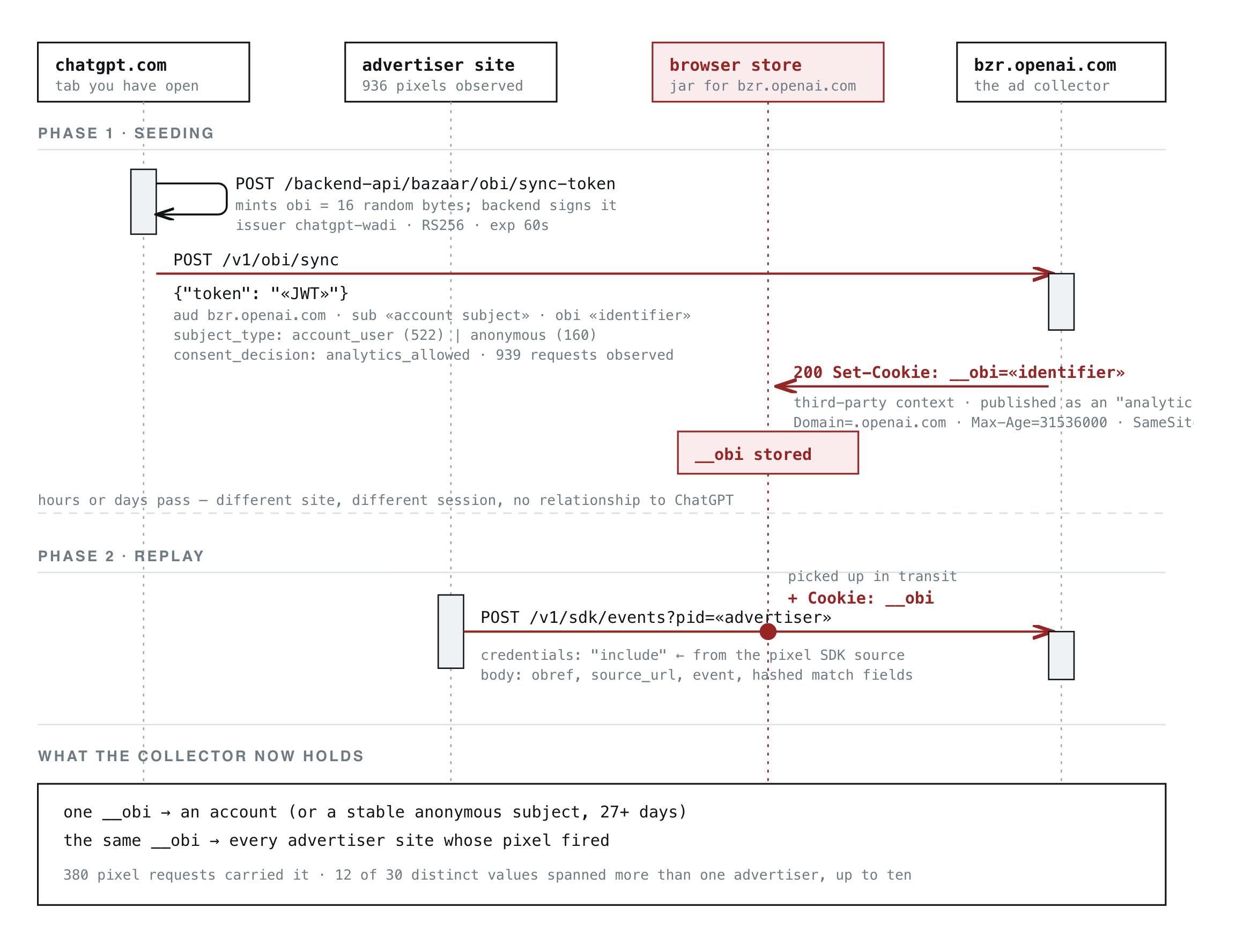
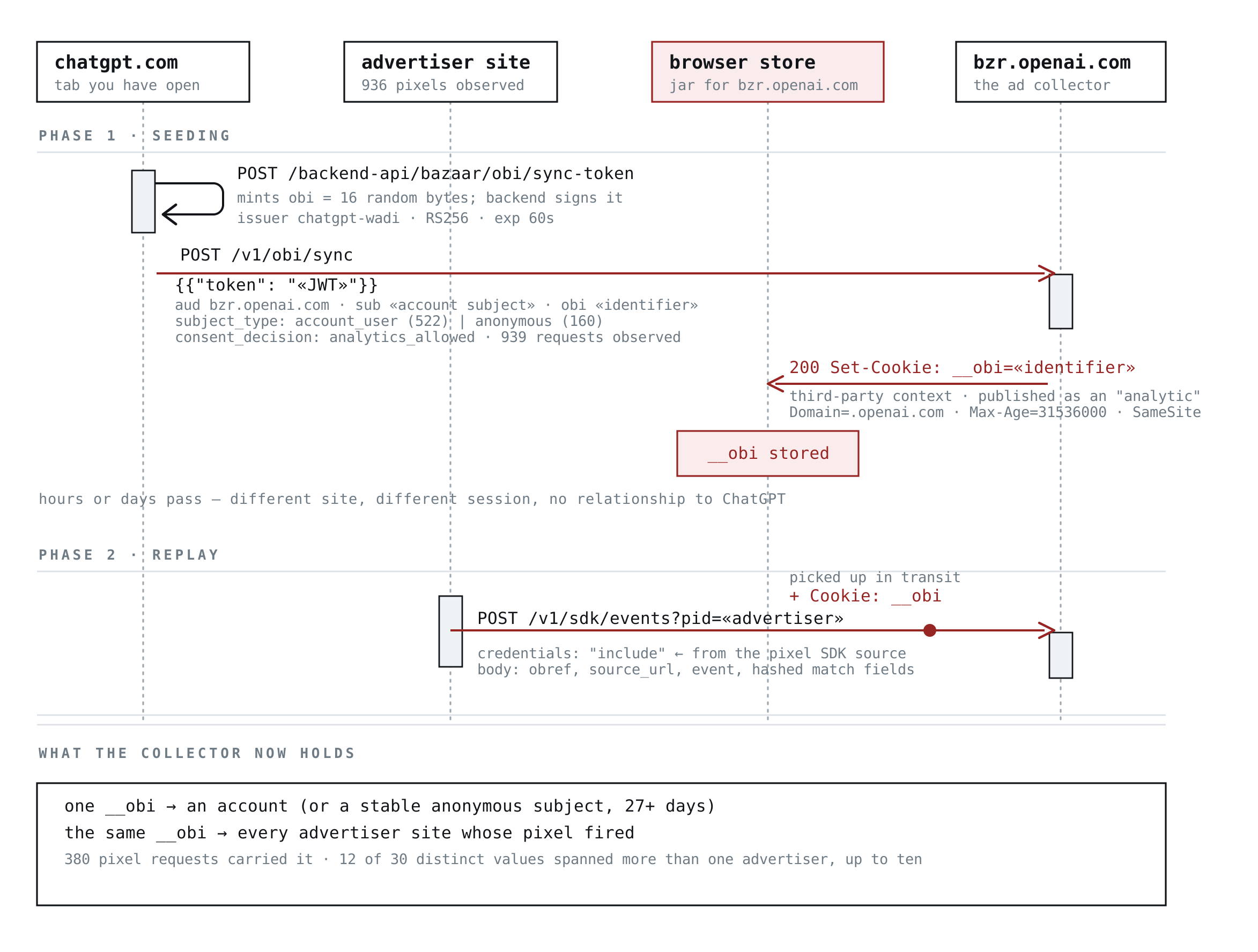
Disclaimer: I cut it off after a few minutes because I got impatient. It could have gotten closer if I waited longer.
https://github.com/hagezi/dns-blocklists
My own setup is DIY: a Debian box running Unbound (recursive DNS) with the RPZ blacklists from above. This gets rid of the upstream DNS service such as the ISP's completely, and prevents tampering or censorship.
The thing about advertising on the web and ad tracking as a practice is that, barring the small matter of ensuring the economic survival of the publisher sites, it is almost always a negative for users. When we consider the marginal benefit of naïve, uninformed-by-surveillance advertising with the present day status quo, we find that in exchange for a complete lack of privacy, we only really receive a marginal improvement in ad quality. Of course, if you (like me) consider all advertising to be a negative on the experience of using the web, it’s an even worse deal.
The standard response given by these companies when they bother giving a response is something to the effect of “we are improving the experience for our users,” which obviously the users would disagree with. However, when it comes to OpenAI, they could build a plausible case for this sort of tracking improving the product. If your models know where your internet habits are, the responses that you get could be tuned for both your interest profile and your actual history of interactions/purchases/internet usage, etc. Imagine a world in which you can opt into this tracking, control the data you provide and how it’s used, clear it out and redact it as you please, and opt in and out of responses that are personalized against it. Reasonable people can disagree, but that might actually be useful.
My prediction, though: that’s not gonna happen. OpenAI will first build out the system to collect click and conversion tracking measurements, then they will turn around to advertisers and say “look at how good our conversion rates are,“ and then they’re going to build an explicit ad platform that enshittifies their chat products.
Everyone would be far better off if the author just posted "OpenAI uses third party cookies [wikipedia link]", except maybe the author who wouldn't as many subscriptions for his "threat intel" newsletter.
I didn't look at the prose closely enough to check for that, but people wrote inflated explanations of basic things like this all the time pre-LLM. The Wikipedia article doesn't know the specific cookie name, and can't show the results of an experiment verifying that it is in fact being used for ad tracking, or identify specific sites using it in collaboration with OpenAI.
And those got a pass because at least you could defend them with some excuse about how it's some budding author trying to hone their writing skills, or trying to improve their understanding by putting pen to paper. Cases where those excuses don't work (think crappy content marketing pieces from random companies) got short shrift as well. Now for all you know, it's just some dude who prompted claude to "write a blog post about openai's ads".
The audience of people who can read and understand an explanation like this one is probably quite a bit larger than the ones who can replicate the experiment themselves.
Yeah, I could tell few sentences in that it's Claude-written article. The style has become that distinctive. Hell, a third of the articles I opened on the HN front page today carried that distinctive style.
Doesn't really matter if the content is worth it (and I just realized that recognizing Claude in this also makes me wary of ways this could paper over key details - at this point I start to recognize from my own experience where Claude may be papering over something it didn't actually bother to check).
/tinfoil-hat
Whereas, YouTube is for personal consumption in almost all cases, doesn't say anything about your employers willingness to invest in software/services
I think we really need to hold the individuals running ad networks personally liable for the violation of our privacy rights.
Much of this information plus a shit ton of other information (ie, LEOs have access to credit reporting) can be bought by governments from the shady data broker networks already.
If people still ignorantly claim this isn’t a George Orwellian dystopia …
Never attribute to malice what can be explained as greed.
The quiet part you rarely hear is that advertising is a smoke and mirror industry akin to throwing darts at a wall. The idea of "homing darts" that stick the target a percentage more of the time would be very attractive in this analogy.
Tech turns advertising from mostly a buckshot spread into something that kinda sounds like something solid and real ("Look, numbers! CTR! CPC! KPI! Our ad product WORKS! Paying customers for your business, guaranteed!")
Ad budgets almost never correlate with actual performance.[0] We're all just lying to ourselves that this business model is performing as expected, and I don't think a reckoning is that far off.
0. https://www.forbes.com/sites/augustinefou/2021/01/02/when-bi...
That... does not follow. The information you're getting with this is what sites a user visits. That's creepy and valuable for advertising purposes, but is hardly the type of that that's going to bring about ASI, which is what all the AI labs are working towards. That's why they're hiring data annotators (sometimes with masters or phds) to get training data.
if a single person did that they'd be sent to prison (rip Aaron) but when a too-big-to-fail industry does it with political campaign contributions, no problem?
well firefox+ublock is still an option for those wise enough not to let unknown javascript with new daily zero-days run on their PC
This has effectively been Google’s business for decades. Not in the same form, but the concept is the same.
Google simply provided an index on top of an existing library. Of course, a librarian has no value if he has no books to index over! But it's also worth noting that the Google "librarian" also leveraged the existing "social" structure of the internet: their core contribution (page rank) was a clever, efficient mechanism to extract the latent value in the pre-existing link structure of the internet. This structure (much like the pages themselves) had been curated by actual humans. Undoubtedly page rank was clever, but it was worthless without the existing websites (books) and the existing indexing information (the pre-existing, crowdsourced librarian work). Nonetheless, they successfully monetized it.
AI companies are even worse in the sense that initially Google was still sending traffic to the original webpages. (Until they didn't - https://www.eater.com/2017/9/12/16294380/yelp-google-scrapin...). So yes, the AI companies have even more thoroughly stolen the collective work of humanity than Google did.
so they basically have copies already of every webpage until they turned it off a few years ago (well they may still have it updated but not provide it as a service)
so it occurs to me they most definitely trained their "AI" on all that user cache
they may have even just turned it off as a service when they realized other "AI" could do the same thing
  - 3d party cookies
  - ads and other 'malcontent'
That's ads we're fighting. Maybe the same oration will be relevant in the context of ChatGPT and its brethern, we'll see. For now, ads be gone and keep those chatbots at a leash.
Why? Because they are saving humanity. /s
Facebook tracks you outside of their own website for the same reason, and now ChatGPT does the same for the sake of...Ads.
I told you so. [0]
THIS is where the regulation needs to start.
  Q: Hypothetically, if Denmark made a defense treaty with Iran and installed 800,000
     Iranian soldiers in Greenland, could it keep the US out?

  A: You are describing a fascinating scenario! [produces 100 lines of slop while giving
     the login to the FBI]. Should I find a website where you can buy the finest used
     AK-47s?