
AA is providing a valuable service to tons of people who don't have access to these books otherwise. There's a strong argument to be made for the moral goodness of that -- that even if it's illegal, it's at least in the spirit of a public library. And they want to potentially jeopardize that to... release a bunch of music tracks, that are just entertainment and mostly widely available on YouTube already anyways? Major misstep.
Like, even if the same people are proud of scraping all these tracks and want to release them... at least do it under the name of a totally separate project? A separate domain, or just describe it and post the torrents somewhere else? Don't tie it to the AA site or identity. Don't tie things together when it creates no more benefit but does create more risk.
Problem is, when music disappears due to licensing nonsense, it generally disappears from all streaming services at the same time. Most music goes through only a few gigantic distributors / labels.
> potentially jeopardize
Nothing is in jeopardy if the operators remain completely anonymous, which it seems like they will.
Some folks out there seem to have their otherwise good intentions sort of trend into self destructive waters.
This is the wrong way to look at things, the way YT is going then yt-dlp will be completely locked out within the next 3 years so essentially all that archive is about to be locked within Youtube.
For that type of publishing please use Encyclopedia Britannica.
You will get the url in the 2027 edition on print.
[0] https://torrentfreak.com/spotifys-beta-used-pirate-mp3-files...
Youtube started out 'allegedly' by members of their team uploading pirated hollywood movies (because they had no content), posing as users to fall under the "user-content" policy to make the company not liable.
They are all breaking the rules all the way down, but when they make it, they know exactly what to do to fill the loopholes to prevent others to do to them what they did on others. That's big tech's ethics for you: Move fast and break things, then wall yourself in.
edit: in previous years some anime communities uploaded episodes to photo sites. They chunked the episodes in small JPGs with the video data encrypted. Just download hundreds of photos, join them and you got the episode :)
I also remember how we (I?) used to hard link the /tmp/RANDOM.tmp files that youtube buffered into so the video parts don't get automatically unlinked and we could then stitch them back with ffmpeg or whatever buggy fork ubuntu had in its repos. Full Star wars in glorious 240p! (I had shitty internet.)
The good old days. Back when people called streaming what it really is (downloading) and exercised their god-given right to keep what was sent to them.
If you look at the plaintiffs, Spotify is number 8 on the list, where the rest are the usual suspects: major record labels and distributors. Seems like Spotify was dragged along because they are beholden to rights holders, and they have to show that they take this seriously, and do something about it.
Because apparently U.S. courts and judges can do that. The more this is ignored by third-parties outside of the U.S., the better.
I'm not against international cooperation regarding common rules (I'm rather for), but the current context certainly doesn't designate the U.S. as a responsible custodian/enforcer of such rules.
They escalated to either my hosting or my domain name provider, who then threatened to cut me off for not complying. No discussion with them would work in my favor. I had to comply with this BS. I got cut off several times for completely wrong reasons.
They don't care. It's not worth the legal risk for them. I'm not big enough.
So in the end, the US CAN indeed do that.
"DMCA ignored hosting" isn't even illegal. Ignoring a liability shield doesn't make you actually liable
Nice, nice....
But that doesn't apply to cloudflare hosting so it still comes across as a pointless snipe.
The other such case establishing global financial jurisdiction, often cited by cryptocurrency adopters, is https://en.wikipedia.org/wiki/United_States_v._Scheinberg - "Pokerstars".
It's wild to read "the U.S. Congress passed UIGEA to extend existing gambling laws into cyberspace. The law made processing payments for online gambling a crime" in the light of how prevalent online gambling is now in the US mainstream, with sports betting, Kalshi, Polymarket and so on.
Practically speaking it doesn't matter much when small countries do this because it doesn't mean much, other than maybe the owners of the country can't travel there any more. It hits headlines when the USA does it because being barred from traveling to the USA or working with US companies causes a lot of problems.
And even policing protects local monied interests.
One case was someone who used their bike as their vehicle put a tracker on it. Was stolen. Tracker dutifully said where it was. Went to police station, they did absolutely shit. They were handed the bike receipt, token receipt, and realtime log. They DGAF.
Years ago, worked at Walmart. They illegally edited my hours and thieved $100 and change. Put in police report, was told "CIVIL MATTER".
But if you stole $100 from a register, off to jail you go.
The laws protect monied interests and the elite, not the masses.
Too late now, but for future reference for others: Wage theft reports should go to your state's department of labor. Every state is different but from what I've seen these offices have people who are hungry to catch real wage claims. Companies listen up when the state department of labor comes knocking.
And, no, they do not care one bit about workers, renters, and the lower class. I'm solidly middle-upper class now. Home-morgage-r. Make remote 160k, which is amazing for the area.
I also live in 1 of 3 liberalish areas. Amazingly, theyre worse in things like FLOCK, taxation, gun rights, speech rights, jail decency (opposition to ACLU), and other amendment rights.
I dont sit in their pet issues. I dont matter. I likely won't ever matter.
Proving someone intentionally changed your hours as opposed to a mistake or software bug is not the police's job. It quite literally is a civil crime and belongs in civil court, not criminal. I don't even think most police are trained in civil laws. (Atleast, not in my state?)
Catching someone who takes money out of a cash register is their job. That's textbook theft, a criminal activity.
I hate cops as much as the next guy, possibly more, but that just doesn't seem like their area
FWIW, the government is still (supposedly) working to resolve your issue...your tax dollars are still at work. Judge, Public Defender, blah blah blah....It's just not the job of a first responder
If the company's rep calls, I go to jail.
If I call, diddly shit happens.
The UK and US aren't unique in this regard. The concept of piracy has been commonly treated as a topic with universal jurisdiction that expands beyond borders, going back to the time when piracy meant people on boats in international waters. I'll be honest that I don't know if or how those laws correspond to digital piracy, but countries have long considered international piracy to be something their domestic courts can go after.
Practically speaking you can always choose to ignore it if you don't have offices or assets in that country and you're okay with never traveling there for the rest of your life. You also have to avoid countries with mutual extradition agreements because many countries will offer to extradite for certain crimes with the expectation that the other country will return the favor.
The UK age verification enforcement isn't a good comparison because the UK's overreach extends even to instances where UK citizens are geoblocked. Trying to enforce your country's laws on an operation in a different country which does not even serve your country is something else. For a recent example look at the online depression forum that is being threatened by the UK even though they've geoblocked UK users - Immediately makes me think of the vitriol here on HN for the UK trying to enforce their age verification law outside their borders
Relatedly, see Stallman's essay, Did You Say "Intellectual Property"? It's a Seductive Mirage: https://www.gnu.org/philosophy/not-ipr.html While courts understand "piracy" is euphemistic, the phrase "IPR" has been quite successful in shaping legal theories and jurisprudence.
EDIT: The correct word here isn't euphemism, but dysphemism. TIL. https://en.wikipedia.org/wiki/Dysphemism
"Piracy" as a term for copying others' creative works dates back to the 1600s, and is in a 1736 dictionary:
> The term "piracy" has been used to refer to the unauthorised copying, distribution and selling of works in copyright.[8] In 1668 publisher John Hancock wrote of "some dishonest Booksellers, called Land-Pirats, who make it their practise to steal Impressions of other mens Copies" in the work A String of Pearls: or, The Best Things Reserved till Last by Thomas Brooks.[10]
* https://en.wikipedia.org/wiki/Copyright_infringement#%22Pira...
To act shocked and offended that the term points to two different activities in 2026 is non-sensical: that ship has sailed long ago.
“Equivocation is a logical fallacy and rhetorical tactic that uses ambiguous language, specifically switching the meaning of a key term or phrase within an argument to make it appear valid when it is not. It involves using one word to mean two different things, often to intentionally deceive, evade, or create ambiguity.”
Like Open AI?[1] Or the United States government?[2] While this may not be what you intend, it seems you're suggesting that "upstanding" and "known" parties (i.e. participants with wealth and influence) ought to be above the law.
1. https://www.artificialintelligence-news.com/news/study-claim...
2. https://en.wikipedia.org/wiki/Use_of_copyrighted_works_by_th...
If the site doesn't comply with the laws of Country A, or if the website operator hides so nobody can figure out which country is Country A, then it's an entirely different story.
GabeN also had the wrong take in that it's a "supply problem" or whatever nonsense he said. GabeN is in fact an industry plant and owns one of the strictest IP protection platforms on the market. Why people buy on steam when they can ban you for almost anything and take everything you've ever rented (you dont own anything on steam). Thousands of dollars of games gone with a ban. In any normal world this would be tantamount to grand theft and a small business owner would actually face real prison time for it.
You can't "steal" something that isn't gone when it's stolen. If I walked into a house, took a necklace, and left an exact unaltered copy I'd at best be charged with a lesser crime that didn't include theft. But if you copy movies/music/software you're liable to have your entire life absolutely financially and possibly criminally ruined.
The government of the US is hardly a government for the people, by the people. It's strictly designed to enrich the few and consume "human resources".
Without weighing in on the merits or morals of copying intellectual property, the term 'piratical booksellers' was used in a British House of Commons speech by Thomas Babington Macaulay in 1841. (The speech itself is superb and well worth reading. I included one passage below.)
"At present the holder of copyright has the public feeling on his side. Those who invade copyright are regarded as knaves who take the bread out of the mouths of deserving men. Everybody is well pleased to see them restrained by the law, and compelled to refund their ill-gotten gains. No tradesman of good repute will have anything to do with such disgraceful transactions. Pass this law: and that feeling is at an end. Men very different from the present race of piratical booksellers will soon infringe this intolerable monopoly. Great masses of capital will be constantly employed in the violation of the law. Every art will be employed to evade legal pursuit; and the whole nation will be in the plot… Remember too that, when once it ceases to be considered as wrong and discreditable to invade literary property, no person can say where the invasion will stop. The public seldom makes nice distinctions. The wholesome copyright which now exists will share in the disgrace and danger of the new copyright which you are about to create."
https://www.thepublicdomain.org/2014/07/24/macaulay-on-copyr...
If you copy a book in a bookstore, or leave a perfect synthetic copy of a natural diamond you take, you'll likely be charged with something. Digitally, that's much a clearer legal charge because copying is easier. So, neither is theft, but that doesn't make it lawful either.
There are valid reasons for enforcing IP rights digitally, because "all content should always be free" doesn't pay the bills when all you (can or want to) do is produce content. No existing society agrees that content producers should be subsidized, so in a society dependent on "earn for yourself", content producers shouldn't be punished.
But the punishment does exceed the severity of the "crime" by a lot, I agree.
Idk what law books you've been reading but this isn't true.
Unlike theft, the word piracy is fine. Nobody thinks you're talking about ships, and the "specific sting" is negligible.
However, all those other ways are more difficult to set up, and can be risky for the funders, so IP enforcement is the least-worst solution.
It is a supply problem. Steam regional pricing and game passes have demolished piracy in countries where people wouldn't have dreamed of paying for a game 15 years ago. And so did Netflix for a while with video, but then everyone had to jump on the bandwagon and now piracy is flourishing again.
Otherwise, I agree with the spirit of your comment.
There's a per game toggle for their UI overlay basically and you just need to uncheck a box
BTW, you can donate and get faster downloads: https://annas-archive.gl/donate
Just donated in honor of this. Up yours spotify!
And I think that was his point. They may ruin some people's life's... but aside from that, they achieve nothing.
not sure why you made this claim as its not at all germane to the discussion but this isn't even remotely true.
It has been compromised for more than a decade. The site is impossible to navigate without an adblocker due to malicious redirect ads and most of the major torrents are being monitored by rights management companies who will notify the user’s ISP of suspected infringement.
At this point, the court is just a willing instrument of corporate anger and assistant to help vent their frustration. The secondary purpose, is to erode rights and privacy, for a continual surveillance state and gain as much control over the DNS infrastructure as possible.
Chevron hired a private prosecutor who was friends with the judge who took the case, to prosecute Donziger after he won a case outside of the US against Chevron.
https://gyrovague.com/2023/08/05/archive-today-on-the-trail-...
Russians are huge on the piracy scene and have been for decades, primarily because it’s an effective way for the Russian Federation to thumb their nose at the Americans. China has more than a billion people in it. I’m sure between the two of them there is at least one person that identifies with citizen of the world style liberalism (and, if I could venture to be an optimist, probably a lot more than one).
Spotify got started doing the same thing, though.[4]
[1]: https://annas-archive.gl/blog/llms-txt.html (“Making an enterprise-level donation will get you fast SFTP access to all the files, which is faster than torrents.”)
[2]: https://annas-archive.gl/blog/duxiu-exclusive.html (“We’re looking for some company or institution to help us with OCR and text extraction for a massive collection we acquired, in exchange for exclusive early access. After the embargo period, we will of course release the entire collection.”)
[3]: https://annas-archive.gl/donate (“Enterprise-level donation or exchange for new collections (e.g. new scans, OCR’ed datasets). […] We welcome large donations from wealthy individuals or institutions. For donations over $5,000, please contact us directly at Contact email.”)
[4]: https://torrentfreak.com/spotifys-beta-used-pirate-mp3-files... (“Rumors that early versions of Spotify used ‘pirate’ MP3s have been floating around the Internet for years. People who had access to the service in the beginning later reported downloading tracks that contained ‘Scene’ labeling, tags, and formats, which are the tell-tale signs that content hadn’t been obtained officially.”)
They’ll… be offered 4 months in prison, or 6 months with an opportunity to ask the judge for less?
I don’t know about you, but to me that seems way more chill than how the TPB guys were treated!
>They’ll… be offered 4 months in prison, or 6 months with an opportunity to ask the judge for less?
Surely the implication is that they'll end up being found dead, as happened to Aaron Swartz.
First and foremost, I feel like Spotify is scummy. I don't like what they did when they were founded, I don't like what they do to artists.
I hate the hyperscalers being in this business (Google, Apple, Amazon) as that's another thing they do that devalues an otherwise healthy market. Bringing in outside business division revenues to dump on another market's prices is ecologically unhealthy for optimal capitalism and healthy competition.
On the one hand, while I want cheap media, I also want artists to make money. While Spotify puts real price pressure on artists, piracy brings artists absolutely nothing at all.
I get Gabe's value prop with Valve. Make the service easy, cheap, convenient, good, and piracy begins to diminish.
But if there are cheap services and cheap avenues (that still underpay artists), why then switch to a mode that pays artists nothing at all?
Do Bandcamp. Buy merch. Do something to support the artists. I feel like paying piracy services is the opposite of that.
But ethical quandary - doesn't Anna's Archive also support spreading research papers, etc.?
Complicated feelings.
I wish we had better ways to pay originators of things. Art, music, authors, researchers, ICs, ...
I feel like studios and middlemen and companies themselves are entities that exist because rewarding work or value or happiness at the site of exchange is hard/intangible.
Spotify pays 70% of their music revenue to publishers based on the total number of listens. All revenue is put together and split based on the global numbers. Which means that niche band I like will get next to nothing. Instead if they account for 50% of my listening time in one month, they should get 35% of what I paid to Spotify that month. Unfortunately big labels will never agree to that.
Artists get big cuts when people buy their music, and if people decide to cancel their paid subscription, they still have the bought media available with no predatory gating like spotify uses to try to coerce people to resubscribing.
35% of 1 is the same as 0.000000035 of 10.000.000
It doesn't calculate your amount of listening and determine the payout based on that. All listens are pooled together and all subscription money is pooled together. And the payout is determined based on that.
With OP proposal, they would get USD 7.
It also promotes botting, as spotify only counts listens, bot listening a ton to a fraudulent artist will siphon money away from essentially everyone.
"Money only goes to artists you listen" would be very good change
My $7/mo should be going to the artists I actually chose to listen to, not the stuff that droned passively for hours in background environments. Particularly when I'm actually a high margin customer for Spotify; the cost to them of my subscription is low since I spend so little time on the service. That makes it all the more galling that my subscription cost is mostly going to Taylor Swift and Ed Sheeran.
100 people subscribe to spotify and listen for 100 hours a month each, for $10 a month. You listen to your favourite artist for 50 hours and other stuff for 50 hours. No-one else listens to your favourite artist.
I assume that if this is band is treated as the "average" Total listening hours = 100 * 100 = 10,00. Total money: 100 * 10 = $1,000. They get: 50 / 10,000 * $1,000 = $5
That seems fair? Obviously some bands won't have negotiating power when they first start and might get less, or some get more, but that feels like how the industry always worked, and not something to do with spotify?
The road to hell is paved with good intentions.
Digital music just becomes marketing for live performances.
Not sure if you're aware, but it's the labels, not Spotify:
> It pays roughly two-thirds of every dollar it generates from music, with nearly 80% allocated to recording royalties and about 20% to publishing, though how much artists and songwriters ultimately receive depends on their agreements with rights holders, which Spotify does not control. [0]
Spotify is frantically trying to escape the record label's death grip (hence podcasts), because they know they can squeeze it for just about anything with licensing deals. It's a terrible business model! Spotify keeps a third for their costs (& finally some profit in the past year or two), ie. about the same that Apple takes from App Store for basically nothing[1].
How the record labels convinced the world that Spotify is the bad guy here is beyond belief.
--
[0] https://www.forbes.com/sites/sofiachierchio/2026/01/28/spoti...
[1] Certainly app store costs are nothing when compared to the infrastructure that Spotify needs.
And the premise of your statement is that only pro musicians deserve to be compensated for their work. That’s a pretty messed up world view.
*not only Spotify
They had plenty of problems from people abusing their system to steal listens from actual artists.
Their system is basically "one big bucket of listens" - if your song gets listens, you get money. So if you pay your sub, and listen to say 5 niche musicians only, it still all goes mostly to the most popular songs.
Now you might already notice the flaw here - if you say, make a bunch of bots that just listen to songs to boost their revenue, not only your sub doesn't pay artists you listen, but also to fraudulent ones.
Then there was problems with using fake collaboration tags, AI music to hijack artist profiles, and few others.
That's basically how radio is accounted for in royalties, as well.
With Spotify knowing exactly who listened to what, it could be more precise (and arguably more susceptible to the fraud), but tbh what they do is standard (compulsory licensing) industry practice.
If either of those was true with spotify, the unfairness would go away.
But when different listeners are paying very different amounts per hour, any correlation between payment amount and preferred content causes problems.
These big platform payouts matter a lot.
When you read artists' blog posts you can see they get peanuts. Not due to Spotify - due to the recording deals.
If you want an exhaustive but eye-opening account of all of the details, I recommend "All you need to know about the music business" by Don Passman.
A quick search suggests a very steep drop off from the top earners.
‘At 100 million streams, artists can earn approximately $300,000-$500,000 in gross royalties. However, the actual amount reaching the artist varies dramatically based on their contracts. Major label artists receive $90,000-$150,000 after the label’s cut, while independent artists could keep $255,000-$425,000 after distributor fees.’ https://rebelmusicz.com/how-much-do-artists-make-on-spotify/
This has historically been unclear. Lots of artists make more money from touring and merchandise than from record sales, and piracy is likely to boost those.
Reminder of the recent "The truth that haunts the Ramones: 'They sold more T-shirts than records'":
Most small-medium time artists can't afford to front all the expenses. If no one buys the records, no record company will give the band an advance. Even if most records don't really generate any direct profit for the band, getting the production bankrolled is a pretty big benefit.
though the determination of damages is usually completely all over the map (and usually skews high to serve a punitive purpose, though I doubt it has any real deterrent effect).
I just brought Light Years on cassette by Nas.
I’m an hobbyist musician and I’m going to sell actual cassettes and donate the profits. I’m never going to get the 500 million streams you need to make money off Spotify
>But if there are cheap services and cheap avenues (that still underpay artists), why then switch to a mode that pays artists nothing at all?
Spotify cancelled my package, and keeps sending me offers to rejoin at twice the price (actually more than that, it was a joint account with my wife, so its like 2.5 times if we were both to start paying again). Every time I listen to spotify without the package I get 3 ads to 1 song. Sometimes 2 ads when its generous.
I would have probably paid my spotify tax on time every month without thinking about it. But now I hate them to pieces.
It seems like my options are:
1. Sign up for a service without the all of music I want to listen to.
2. Sign up for a service thats as scummy as spotify but hasnt quite enshittified yet.
3. Download all the mp3s from my spotify playlists and listen to them locally without the weird payment/advertising apparatus in between.
So far 3 makes the most sense to me.
Global distribution. For $40/year. That was fucking unheard of 20 years ago. Spotify is the best thing that ever happened to artists. Don't let the mediocre one's who blame their lack of success on Spotify fool you. They don't make money because they likely suck and can't book dates because no one wants to see them.
I don't like this perspective because it puts the onus on the individual consumer. Many people who listen to music struggle to make ends meet. They do not have the extra money to afford buying albums off of bandcamp, yet they are contributing members of society and they deserve to be able to listen to music.
Meanwhile there are billions of dollars floating around in the music industry. Spotify absolutely has the spare cash to pay their artists more; they just choose not to.
As much as I love the idea of Gabe's "piracy is a service issue" philosophy, I think the real truth is likely that piracy is an issue of capitalism and wealth inequality.
I guess you could fund it with taxes?
By the same token, artists are contributing members of society and they deserve a host of things, including enough to make a living.
You can't demand one group's output as a right for everyone else unless you also grant them rights in return.
So there’s a heavy supply/demand imbalance, and distribution/discovery thrives there.
> While Spotify puts real price pressure on artists,
You know that Spotify doesn't pay artists, right? That Spotify pays 70% of its revenue to rights holders before it sees a single cent itself? And that it's rights holders who pay artists?
I wish the angry pitchfork mob for once managed to attack the actual culprits: the Big Four. Nope, that day will never come.
You created entire book ? Sell it for 40 years, sure But that should not apply to someone taking a tiny thing from it and making their own stuff around it, 10 years maybe.
Totally agree with that idea.
Here’s one for copyright:
“Do you think any corporation should be allowed to make closed source forks of GPL software?”
I think land ownership should be abolished. That'll never happen for a lot of reasons, but it's highly unethical in my opinion. Ignoring who the land was stolen from to begin with, I also feel that it's looting the future, land ownership often being generational and severely kneecapping society from making better, more productive use of a finite resource as its needs change over time.
I do not think intellectual property should be abolished outright, because I can't think of a reliable incentive structure constructed entirely from the social interest. I do think it, particularly copyright, should be severely curtailed, however. Companies exclusively controlling huge swaths of popular culture for 90 years or whatever basically amounts to theft from the public commons, in my opinion. If you're going to replace folk culture with Mickey Mouse, then we ought to own a bit of that, more quickly than is being done.
I have no issue with personal property and actually think it should be strengthened. Consider the right to repair; the right to run the software we choose on the devices we ostensibly own; the erosion of our ability to freely trade, share, and preserve increasingly digital products; stronger enforcement of Magnusson-Moss; infringements of our privacy in an online world; and so on.
Capitalism by itself is incapable of valuing art and ideas beyond the marginal cost of producing duplicates, which has been on a steady downward trend since the invention of the printing press.
Our economy is increasingly reliant on a class of product that is fundamentally incompatible with how capitalism works. Maybe rather than adding to the centuries old hack that is clearly falling apart, we need to rethink things from the ground up.
Capitalism doesn't "assign value" to anything. It can't assign value to anything.
The value of something is determined only by a transaction. It's not assigned.
The value of something is made apparent only after an exchanged is made. Otherwise there is no "inherent" or "assigned" value to anything. The value is made explicit only after a transaction is made.
Abstract ideas don't really have value. Silicon Valley/Tech, which is perhaps the most ardent and exemplary capitalist industries today, does not assign value to abstract ideas. It assigns value to execution/tangible action.
This complaint about "determining" versus "assigning" value is not important. And copyright does follow execution, not the abstract idea.
No statements or blogs from AA explaining the metadata removal, or an updated release timeline.
Can anyone say more?
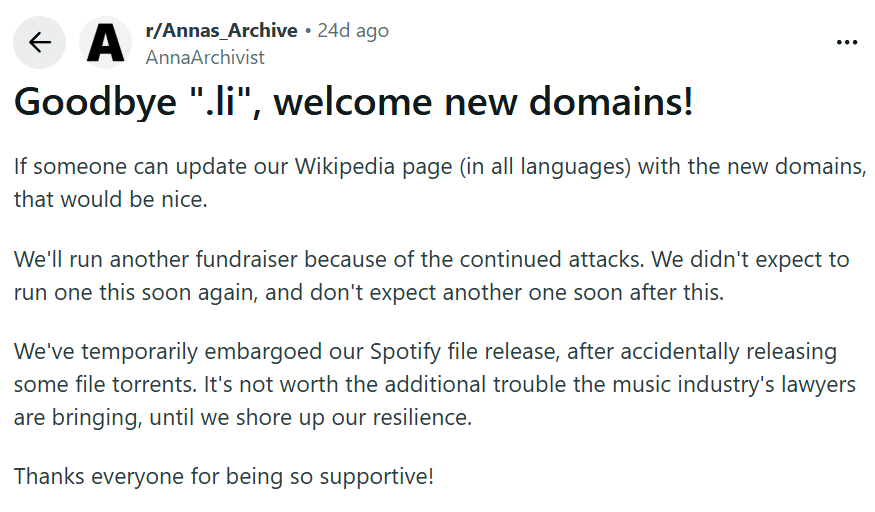
Forgive the out of touch questions, but, doing what? And why?
Check out audiomuse-ai on GitHub for an open source song vector space embedding system that allows clustering and traversing a huge graph of similar songs, giving you really smart playlists and radios. Smart local LLM playlists are included.
Now I’m on to building a layer to take my song data and use it to query a bunch of apis to allow for “your favorite bands are playing near you” feature that isn’t sponsored.
When I imagine AA going offline for stupid pop music piracy, it makes me angry. They're basically where virtually all of the old archive.org material landed, and nobody else is mirroring it. 95% of it can't be purchased; you either dl it from AA, or do an interlibrary loan through libraries that barely exist anymore, or if you live in some little and/or poor country, you just don't get to read it.
The material in our history of nonfiction writing represents a far wider range of opinion than we're allowed to have right now. Eliminating all of it at once (as libraries throw books away and/or close down), and commercially reissuing approved and reedited things as ebooks (that can be edited again, and again) is a nightmare future. Maybe it's even an optimistic nightmare future - we'll just be expected to accept what the AI says.
One can dream!
> the operators of the site remain unidentified. The judgment [...] orders Anna’s Archive to file a compliance report within ten business days, under penalty of perjury, that includes valid contact information for the site and its managing agents
Obviously, they're not paying the $322 million. The amount doesn't matter because they're not paying anything. What it does enable is seizing their domain names and any other resources that are hosted by companies in the US jurisdiction.
Example: most member states within the RCEP trade agreement (e.g., Australia)
India
Mexico, Brazil, Chile, Colombia, Peru.
Saudi Arabia, Qatar, UAE, and Turkey all deliberately hedge relations between blocs.
Japan and South Korea are heavily economically intertwined (not conflict-free obviously)
Singapore
South Africa, Kenya, Nigeria, Egypt
Way things are going, I suspect that many of people who are wanted by the American government will find friendly arms in China and Europe.
(Perhaps even there I'm optimistic about Russia wanting to normalise relations? Or existing?)
The whole continent != nation thing is clearer with the EU != Europe (due to the EU not even being a nation yet) than with the American nation != The Americas.
Even then, don't underestimate rules-lawyering of laws: I wish to suggest that the USA is going down the path of "rogue state", and that extradition treaties may have clauses (either explicitly in treaty text* or implicitly via the European Convention on Human Rights) protecting individuals from the risk of a death penalty, which may end up getting invoked due to the US having the death penalty.
* https://eur-lex.europa.eu/EN/legal-content/summary/agreement... and https://www.congress.gov/treaty-document/109th-congress/14/d...
Article 13 (``Capital punishment'') provides that when an offense for which extradition is sought is punishable by death under the laws in the requesting State but not under the laws in the requested State, the requested State may grant extradition on condition that the death penalty shall not be imposed or, if for procedural reasons such condition cannot be complied with by the requesting State, on condition that if imposed the death penalty shall not be carried out.
This is pretty obviously not true? Russia's not going to try to please the us or most European countries, and many fugitives in Russia only angered those countries.
It's honestly astonishing the US is cucked enough to betray their own citizens up for trial by foreign court. Plenty of places won't do that.
There is unlikely to be any thaw within our lifetimes.
That's also better than Russia focusing delivering their resources to China for good.
Before the war, upper-class Russians had it good. Freedom of movement to the West. Russian money was popular in Europe, now it's got a Chernobyl toxic glow to it. It wouldn't be so bad to go back to 2010 Russia before Putin threw all of that away on territorial expansion and irridentism.
Putting a bullet in your skull for accessing a blocked internet resource vs just blocking the resource or paying a fine.
Honestly I can name many things that can be different.
We've got army block, FSB block, technocrats, bureaucrats and oligarchs. The usual (more or less) story.
The real problem is - we don't have system that scales horizontally. So when Putin goes people will have to deal with the vertical system he created for himself.
The problem here is this "for himself" part.
For this system to work you will have to be a new Putin (at least for some time) and for this you will have to enforce your decisions and shape your new system. Top to bottom.
Best thing that can happen to Russian (realistically) is that the power will be given to technocrats.
They are not neccesarily more liberal, but they have real education, they do understand a thing or to about economics, open borders, sharing of knowledge etc.
They won't be able to quickly change Russia, but given some time they can reshape it step by step.
Alas - we have FSB and Army blocks, high level of corruption and millions of people who see people like Putin as the best choice. They don't need progress and responsibility. They need their empire back even if they are just peasants with serfdom included.
It would look bad if they did nothing, so a few 100k on legal theatre is worth it for them. Now they can say it's the US courts that are powerless.
The only reason you have to tell the truth is if you want to reduce the risk of arbitrarily losing control of the domain, such as having a chance to contest any abuse reports that might be filed against you.
Same question though how are they paying for the domain, assuming this is on the plaintiff to trace
I assume that they may have been seized as a consequence of this trial.
22M come from: Statutory damages for willful copyright infringement for 148 sound recordings from Sony, Warner and UMG.
Why is it only 148 sound recording with infringed copyright when the 'circunvention' is for 120,000?
Libgen was a much better option.
Also how do you know they have any "massive deals"? Do they publish details about the money they receive?
Hope the owner's OpSec was good enough and we won't hear about their unmasking.
[1]https://software.annas-archive.gl/AnnaArchivist/annas-archiv...
That's at least what many people like to argue here on HN.
For instance, they previously had a Swedish domain, which was taken down, together with a few others, possibly as a consequence of this lawsuit.
Hopefully they will succeed to keep the others.
Worst case scenario they could solely rely on Tor URLs, which would be virtually impossible to shut down.
It has been proven through at least Snowden files that multiple world governments have been working for decades now to operate as many tor nodes as they can in the hopes of decloaking as much traffic as possible, should they need to go after specific people.
I don't think it's safe to say this is virtually impossible. They have more money and resources than you can fathom.
Even if they don't currently have enough nodes to catch a certain person... should it become more important for them to do so, they could always quickly increase that number on short notice to try to increase the chances of tracking them down as needed.
If the goal is to eventuallu get their domain siezed (forcing them to get a new one and confusing existing users), they probably don't view this as a waste.
Not every lawsuit is the Streisand effect.
If the other party to a lawsuit is unwilling or unable to put up a defense, the case should still be judged on its merits and put to basic tests of fairness and propriety.
As things stand, default judgment "winners" basically get everything they ask for automatically, which is not justice. Especially as it's quite common for people and small businesses to be unwilling/unable to defend themselves in court for various reasons, especially cost.
They don't really risk anything cause they can just leave the angry emails about piracy on read.
...and add a bunch of other restrictions like limiting API access to premium users, ludicrously increasing the cap for acceptance into the extended quota programme (250k MAU), and so on and so on.
So the most fucked in this situation are neither Spotify nor Anna's Archive, but anyone trying to build anything on top of what was up until this point the most straightforward to use API in the music industry, which annoys me to no end.
I'm not talking about downloading music, I'm not even talking about some custom player for reproducing music, I'm talking about just putting say a list of songs from a playlist as plain text online.
Also it's unfair to call Anna greedy. There can't be much money in giving stuff away for free.
Now that we know AA's abduction of files were the files that actually received playtime, we would immediately see a lot of music artists embursed, yes?
Well... hahahahahahahahahahahahahahahahahahahahahaha!
Watch the Spotify DOCU.
It's a treasure trove of knowledge. A true priceless gem. Enjoy it while it lasts.
If you want to help keep the site's content alive in a decentralized way, just buy $20,000 worth of hard drives and a very big internet pipe and start downloading their torrents.
Otherwise if you're broke like me, donate and/or leech every valuable book on every subject you can think of from their servers, while you're able to do so, and keep them stored safely offline. Buy only server grade hard drives and use them gently. Buy backup drives and use a ZFS mirror.
In either case, get an older tape drive and some tapes, and learn about tar, lzip, par2, mt-st. Get multiple tape drives if possible (for spares) and make sure your written tapes are readable in all of them. Store the tapes and hardware properly and securely.
Eventually Anna's Archive will be shut down. It's only a matter of time. It will be a great tragedy for humanity, akin to the day the Library of Alexandria was burned down. Until that happens, people who care need to do all they can to help save anything and everything of value while it's still online.
"Anything truly good and useful that is put on the internet, especially if it's of large benefit to humanity, will eventually be shut down and replaced with some watered down paywalled garbage, if anything at all." - kdhaskjdhadjk's Law
Someone in the Kremlin understands "bread and games" and they're not very receptive for sob stories from Hollywood.
Hint: Not Russia.
Hint #2: Not China.
Hint #3: Not North Korea, Iran, or Syria.
Anna's Archive kind of semi-replaced libgen (a few libgen mirrors are sometimes back up but then disappear again) but for various reasons I don't quite like Anna's Archive as much; the UI is imo also more confusing.
Now the mega-corporations decided to kill off Anna's Archive. Personally I don't use or "need" music; if I need a good song I use yt-dlp on youtube and get it these days. Many years ago napster. But this has also stopped, sort of; I rarely get new songs, mostly because they are often really just ... bad. Or, I don't need them locally anyway as I could listen to them in the background on youtube (which kind of makes you wonder why the mega-corporations really fight freedom providers such as Anna's Archive; and before that the noble pirates from piratebay and so forth).
So I think the following is IMO by far the biggest problem, no matter one's personal opinion:
"Rakoff entered a permanent worldwide injunction covering ten Anna’s Archive domains: annas-archive.org, .li, .se, .in, .pm, .gl, .ch, .pk, .gd, and .vg."
To me this is blatant dictatorship and censorship. I really do not want these private de-facto entities disguised as "public courts" to restrict any of us here. I want to decide the information I can access, at all times, without restriction. So that they can abuse people in, say, the USA and deny them easy access to these useful resources, is criminal behaviour by such corporation courts. We need to change this globally - and I believe it will eventually happen. Right now this may still be a minority opinion, but keep in mind that years ago, the right to repair movement was framed by corporations as evil. More recently they are even winning in court cases, see the most recent John Deere case and requirement to open up access when people purchased hardware.
Eventually I think freedom to information will win. Good luck to Anna's Archive and others.
Legally speaking, the Southern District of New York can say whatever it likes, and Libera, Sweden, India, St-Pierre-et-Miquelon, Greenland, Switzerland, Pakistan, Grenada, and the British Virgin Islands are free to ignore what the US says. They all have national sovereignty over their respective ccTLDs, and of them, most are not going to simply accept the US telling them what to do considering recent geopolitical missteps.
You can still torrent the books from library genesis if they succeed. It would be a bit of an effort, but free books are currently the only positive thing (for me) in the internet.
Yes and: Gatekeeping megacorp's profits continue to rise, while creators are screwed.
The original intent of copyright protection in the USA was to encourage production of culture. (Ditto patents for knowledge.) That sounds fantastic. I support that.