Mozilla is also very, very far behind in this race. But the potential is real. Enterprises have both the budget and the motivation to care about DLP (including preventing employees from copy/pasting sensitive data into AI chat apps), VPN-less access to private intranet apps (including to contractors on BYOD), preventing access to sites that distract employees and have zero business value (pornography, gambling, etc.)...
If you care about an open web browser, you should care about it having a sustainable revenue model. Enterprise browsers are exactly that revenue model. The question is not whether this is a good idea; the question is whether Mozilla can catch up.
Speaking of working, in my experience, there is a considerable number of enterprise websites and web applications out there that don't work well or not at all(!) in Firefox. (Prime example: outlook.office365.com hasn't worked for me in years – I always end up in a redirect loop unless I clear all cookies, and I heard the same story from others.) Needless to say, such issues might cause new Firefox users to switch back to Chrome/Edge rather quickly. (A friend of mine recently stopped using Firefox for his work because of that.)
Any idea what to do about this? Of course with AI one could go as far as adding a "Report this site doesn't work in Firefox" button that magically sends a report (+ suggested fix) to the people operating the website/app. But I can think of dozens of reasons why this wouldn't work well at all (let alone be a good idea) in practice…
Managing browsers - portals to almost every use and risk - is a PITA and I don't trust Chrome for confidentiality of data or users. Access to actual Mozilla personnel (engineers?) would be a big differentiator. But I wonder about a couple of things:
1) What are Edge and Safari management like? Are they competition here? If IT wants to move off Chrome to a management-friendly browser, the first thought would be the platform's native browsers which might integrate easily with native management.
2) How well does Firefox's management solution work? One-off management solutions for single applications have a bad history: They are often buggy, poorly designed (how much is Mozilla investing in UI design for this small number of users), complicated to learn, deploy (is this some sort of client-server? require another app client-side?), operate (what about WAN users? intermittent connections?), have poor features (multiple profiles? per-user or per-device? multiple users per device and multiple devices per user? group management? integration with other directory services - or do they reinvent the wheel and I need to input every update in multiple applications? multiple platforms? mobile apps?), manage (the management app needs management), etc. Does it reliably autodeploy or do I need to manually do something for each of my 10,000 users? Again, how much will Mozilla invest in this small group of users, the IT admins? I already have Microsoft's / Apple's native platform management solutions and those are enough of a headache.
I'd advise Mozilla to make it a delight for IT admins - immediately remove their fears of an additional headache in their busy days - and they will jump right in. As long as it works, I don't think users would care. Everyone, users and admins, is too busy.
It's client-server (Firefox <=> management console). There's no other app needed client side, it's all built into the browser.
what about WAN users? intermittent connections?
Supported (one of our core developers often works on a spotty 5G, so we got rather loud feedback when this broke...)
multiple profiles? per-user or per-device? multiple users per device and multiple devices per user? group management? integration with other directory services - or do they reinvent the wheel and I need to input every update in multiple applications? multiple platforms?
Yes to pretty much all of these - minus reinventing the wheel - I think only "multiple profiles for the same user-id" are currently not supported. You'd essentially need to give an alternate login to the users that need this (because that's what triggers the profile selection). I don't think there's technically anything stopping this, just didn't seem like a common enough use case to get in the very first release.
mobile apps?
Not in this first release. (^_~)
Does it reliably autodeploy or do I need to manually do something for each of my 10,000 users?
We expect most will autodeploy over an existing MDM solution (Intune, Fleet, ...).
Again, how much will Mozilla invest in this small group of users, the IT admins?
I'd say Firefox Enterprise's customers are the IT admins, no? The users aren't generally the asking party to get a managed browser.
All I would say is, put something on your website that persuades admins that it won't be a headache, that it will make their workday easier, not harder - regardless of benefits to overall IT goals. Maybe a 1-2-3 screen clips/animations (fantasizing a bit of the content for this example):
1 - Deploy: Add this pref to the FFE application deployment package and FFE management is deployed in every installation!
2 - Open the management console - there's the new installation, and it's automatically listed under the user/device synced from directory services!
3 - Manage: (shows user/device in a group, and a nice set of clearly defined - non-ambiguous - hierarchical checkboxes for that group's prefs).
And actually make it reliably that easy - which I know means more work on your end and isn't always practical, but it makes an enormous difference IME. Get people talking about how easy it is. Solve their busyness problem.
[Edited: typo]
The installation of any software and management of it is norhing tnew in the corporate world.
Chrome may be chrome. Chrome is not the default on windows computers in corporations. Edge usually is.
After it's installed, professionals much more now know today how to remember which icon to select and run.
All users received an orientation and were informed that Firefox is the only approved browser.
Firefox was pinned to the desktop and taskbar, usually with the name "INTERNET" as the web browser is commonly known here.
The number of support tickets was very small. Usually if a user reported a problem with the web browser, it was a page that was also broken in Chrome or some other network issue.
Users reacted positively when they saw that there are no ads in Firefox. uBlock Origin was preinstalled.
Without ads and tracking scripts the web browser is massively faster, which also was perceived by users.
If there is any initial resistance to Firefox, it usually melts quickly.
The only bother has been the frequent UI updates to Firefox, which occasionally cause frustration until we apply a new configuration to revert whatever fresh horrors Firefox designers have birthed. With ESR, these problems are less frequent.
I hope this Firefox Enterprise freezes the UI to the classic "tabs look like tabs" aesthetic, maintaining the option of vertical tabs.
One feeling I am starting to get is server side web apps might make more of a re-emergence, because putting so much application and business logic in the front end serves as a bigger footprint for possible security issues.
With respect to resistance to browsers (or preference for something else), I agree that users seek familiarity and those who got to start with Firefox do still remember it.
Mozilla is just one org, but it's relative independence will hopefully provide other perspectives to using a web browser as a universal interface, not just for humans, but our new sentence-dna containing friends.
I remember one place simply changed the icon and watched the issues drop.
People really can be creatures of habit.
Some enterprises i've seen put in their own icon for a web browser (imagine starting with an intranet) and that helps separate it a bit more.
This might not be for everyone, nor ideal in all cases but people seemed to be OK with the idea of having a dashboard to launch their work from.
My anec-data on the subject seems to imply it affects a very specific segment of people: The "I only use a (usually Windows) computer at work" folks. The odd part of that is that almost all of them seem to own iPhones or iPads (specifically not Android devices) and since they use these devices, exclusively, outside of work and one can assume they're probably opening Safari for browsing, why do they have such a strong association that Chrome must be "the browser." This segment, though, seems to make up a large majority of "knowledge workers" outside of IT.
Now, like probably a lot of us here, I'm the tech support for everyone who knows I "play with computers professionally." One of the first things I do is remove the Chrome and Edge icon from the task bar[0] and add Firefox with a small set of extensions that generally keep me from having to revisit them due to malware. I usually just tell them "The button you use to get on the Internet changed but it's the same." ... and Bob's your uncle. I return a year later, the same Firefox icon is in the same place, updated several versions and all is well. They all vaguely knew they were using something different before, some knew it was called Chrome or Edge, but "the icon changed" is all I've had to say for probably a decade since the two browsers' core functionality is close enough that they generally cover every site the older generation would be expected to visit.
It feels like a variation of "they've got enough knowledge to be dangerous."
[0] I don't think I've ever seen my parents, aunts/uncles, extended older family every try to find a program through that menu that pops up when you click the button that used to be called the "Start" button. :)
I think it's a status play, for people who have been convinced that status is tantamount to utility. If you lower yourself to options that aren't well-known to be high status, or at least known - particularly ones that require tinkering of any sort - you are wasting time, and worse, you are signalling to other people that you're a time-waster, that your time isn't valuable, and that your choice to waste time rather than use the default or high-status option shows that you have a defect in judgment.
They lost fierefox a few months ago due to new compamy policy and with it lost access to some apps when working from home. We know it is related to the proxy config but company is so big and processes are such a mess nobody knows who should be contacted and by which email alias or service now ticket.
The internet explorer/edge issues were due to a web browser that was built into the operating system, and owned by the operating system company (Microsoft in this case).
There was a popular trend for a while that IE was the windows feature that let you download a different browser.
Apple had a similar run with Safari and from what I recall had to change.
Mozilla might have anticipated this when they wrote "Diversify your browser engine" as one of the selling points.
https://www.firefox.com/en-US/enterprise/firefox-enterprise/...
Diversification is a good idea, personally I use both Chrome and Firefox every day (and sometimes Lynx).
[0]: https://support.mozilla.org/en-US/kb/customizing-firefox-usi...
You'll still likely need to push something like an enrollment token for Chrome (ex: https://support.google.com/chrome/a/answer/9301891 ), but then the rest is done through the Firefox Enterprise console.
Along with that, push extensions to add DLP bits, etc
Firefox Enterprise tries to remove as much friction there as possible, and adds a pile of features like deployment monitoring, policy changes while running, device posture checks, various security features like SIEM logging, etc.
The other part is that you get the option to run all supporting services entirely on premise, so the browser never has to "phone home" to us, but you still have working updates, sync support, and so on.
(you still need to get data in and out sometimes, Chips can be misused as radio antennas, loudspeakers can be used as microphone and do ultra sonic data transmission to other devices etc, so still making sure the software is under control on the Air gapped computer sounds like a good idea)
90% of my colleagues use Microsoft Edge without extensions.
Other browsers are seen as exotic.
I don't care. On that machine, there is NOTHING going on that I own (all of that is the IP of someone else).
Such a machine, with Windows, MS Teams, MS Whatsoever, Symantec Whatsoever, Cloud Office, Cloud Ticket System, Cloud Wiki, ..., ..., ... doesn't get more trustworthy just by using Firefox. They run a continuous MitM attack against all https connections that I make (and a lot of your employers do the same)!!! You can polish turds, but you cannot make that environment a trustworthy one.
I would never touch that machine for anything remotely "personal". On the other hand, for work, I don't care. I'll use the default browser, and if the default browser is MS Edge, I'll not spend ANY effort into working around it. That wouldn't be "passionate", but just stupid imho. YMMV of course depending on the employer and other factors.
And if there is a page full of ads, and it overwhelms me too much, well, I'll make a walk to the coffee machine and come back when I'm ready for it. It's that easy.
I've showed them Total commander and some advanced features, panes and overall speed but no, they all went back to hunting little windows, browsing by clicking, drag and drop hunts and so on.
The obvious inefficiency and their sluggishness when doing anything on filesystem is driving me crazy but I gave up.
Can you please briefly describe the features you think make it worth it?
If we are talking specifically about windows explorer, I think not freezing randomly for no reason once in a while would be considered a nice feature.
Once proficient I am much much faster than proficient file explorer users, its not even comparable when one does a lot of things with files/folders, personally and profesionally. By far the best windows-only software I am aware of and the one of main reasons I didnt migrate to Linux. Otherwise I would need 10+ additional software installed and some features of it are best in class (on windows at least).
Its good ol' Norton Commander from DOS alive but has gigatons of modern improvements.
People don’t care about optimizing every little thing.
It seems only developers invest time and energy into their tooling and software required to do their job. It would be kind of unthinkable for a developer at a big company to not use some kind of IDE and instead use the OS built-in text editor.
Would they get a raise if they are more efficient? Or go home earlier? Well, you have your answer here :)
The concern is that they "aren't authorized apps". As I've read it, this is a proxy for "we aren't certain these apps can be trusted, but nobody ever got fired for pointing the finger at Mozilla or Google when something goes wrong, but would be fired if they pointed it at this one random guy in the Netherlands".
I could not get audio on Firefox
It was the only site I ever found where I could not get audio and I suspect some Google malfeasance
When I initiated a meeting I used Jitsi, no such troubles
If company IT gets hold of Firefox, it's not better than just using Edge or Chrome that comes by default.
Like seriously, Mozilla could probably make some serious revenue with this. I only wonder if it would open them up to getting sued, somehow.
The question is: how is that goal turning out once it meets reality?
Tons of great ideas failed for various reasons. Alan Kay keeps on pointing out how sad he is that Xerox PARC failed in many ways. Reality is a strong selector - and the evil Google empire will make competition really, really hard here.
At my unit of my Uni we have Windows desktops managed by central IT. As a software dev they gave me a bypass to get administrator access but they do enforce that we use Firefox ESR -- I recently got a brand new Firefox but after a while my Firefox does fall behind the times. I develop Firefox-first and let my tester find Chrome bugs, I think we find one less than once a year, over decades I've found that if you develop with the off-brand browser you have very little trouble with the dominant browser whereas if you develop with the dominant browser your product won't work with off-brand browsers. Developers like me have been keeping Firefox viable and probably cumulatively we create more enterprise value for Mozilla than Mozilla's own developers. I think Mozilla is the epitome of the badly run NGO and can criticize just about everything about it but... the cause of competition for browsers is one of the most important tech causes and it's one that isn't entirely lost. I try to only use Firefox except for YouTube which seems to be punishing Firefox users, for a long time I found Firefox compatibility was great but I have seen an increase in problems in the last year which is concentrated in banking and certain e-commerce sites, hotel booking and such. The only trouble we have with it is that we have an internal app that (for better or worse) loads 40,000 rows into a data table and performs really well on Chrome but feels pokey on Firefox.
re: youtube, I really think it's a place where the fediverse is needed the most, and is unfortunately the weakest. I have seriously been considering something like an outreach campaign for niche categories just to build up the fediverse video universe (e.g. asking bands if they are okay with their live show videos being mirrored to fediverse, educational content, and maybe even something like a fediverse friday). Maybe a convo for another time but I think it's a huge issue where, unlike the browser wars, there's not even an obvious second best option.
Ok, I'm German, so maybe it's genetic.
This type of dysfunction occurs quite frequently i find.
I wouldn't be surprised if those people had some techie in their life advising similar! and/or, they just really want decent adblock tech.
Why?
It allows forcing specific extensions on, and allowing user installs is a flag.
I use the policy engine on nixos to install some plugins and disable some of firefox's dumber features.
I cannot even begin to fathom that stupid fucking decision from someone above me.
When I pointed this out, they said "just ignore that part".
Nope LMAO!
Let the other side know, ensure you make the change clear and initial the change. 8f they sign the contract too, your change sticks
In my country, anyhow
Even so I would advise you to have the lawyers re-draft the entire thing.
...and this is/was the true Firefox way. You don't need to get some other browsers on the same engine made by shady companies. You have powerful plugins.
https://mozilla.github.io/policy-templates/#extensions
https://github.com/gorhill/uBlock/wiki/Deploying-uBlock-Orig...
I agree with the other person though that you should install uBlock Origin in Firefox (which works better there than in Chromium based browsers) and never look back.
It is a Firefox fork with sane, user-respecting defaults. Of course it breaks sites that do not respect their users' privacy / agency.
It takes literally two seconds to install uBlock Origin.
You can even preload it by baking in the xpi file.
Make privacy at the enterprise level the first class feature.
Too bad people won’t pay for any of this.
Can you do basic string pattern matching to prevent leaks of sensitive data?
In the case of a credit card, for instance, how would you distinguish between a user legitimately "buying something on a website" from "posting customer card to a forum" or "sending to a chatbot" (or even "inappropriately making purchase with customer card")?
Can you match the data itself against an allow/flag/deny list?
Can you run data through a local or corporately-situated LLM instructed to "Assess whether this looks potentially sensitive" via a given set of rules, and flag it to the user or a supervisor to proceed/abort?
How extensive are in-built features, and what kind of hooks and feedback/UI interaction is available for third party integrations?
Warning (instead of blocking) is possible. Due to the security logging (plus, if wanted, SIEM integration) you get the flagging.
Can you run data through a local or corporately-situated LLM instructed to "Assess whether this looks potentially sensitive" via a given set of rules, and flag it to the user or a supervisor to proceed/abort?
Not in the first version, but this is an area we are working in.
what kind of hooks and feedback/UI interaction is available for third party integrations?
We support the standard SDK for this which is also used by Chromium based products:
https://hacks.mozilla.org/2025/03/improving-firefox-stabilit...
That's how Trellix and Broadcom integrate with it as well.
(Regardless of one's feelings about generative AI, I think some features like local translation or alt text are too nice to be labeled "LLM shit", but I admit I am biased)
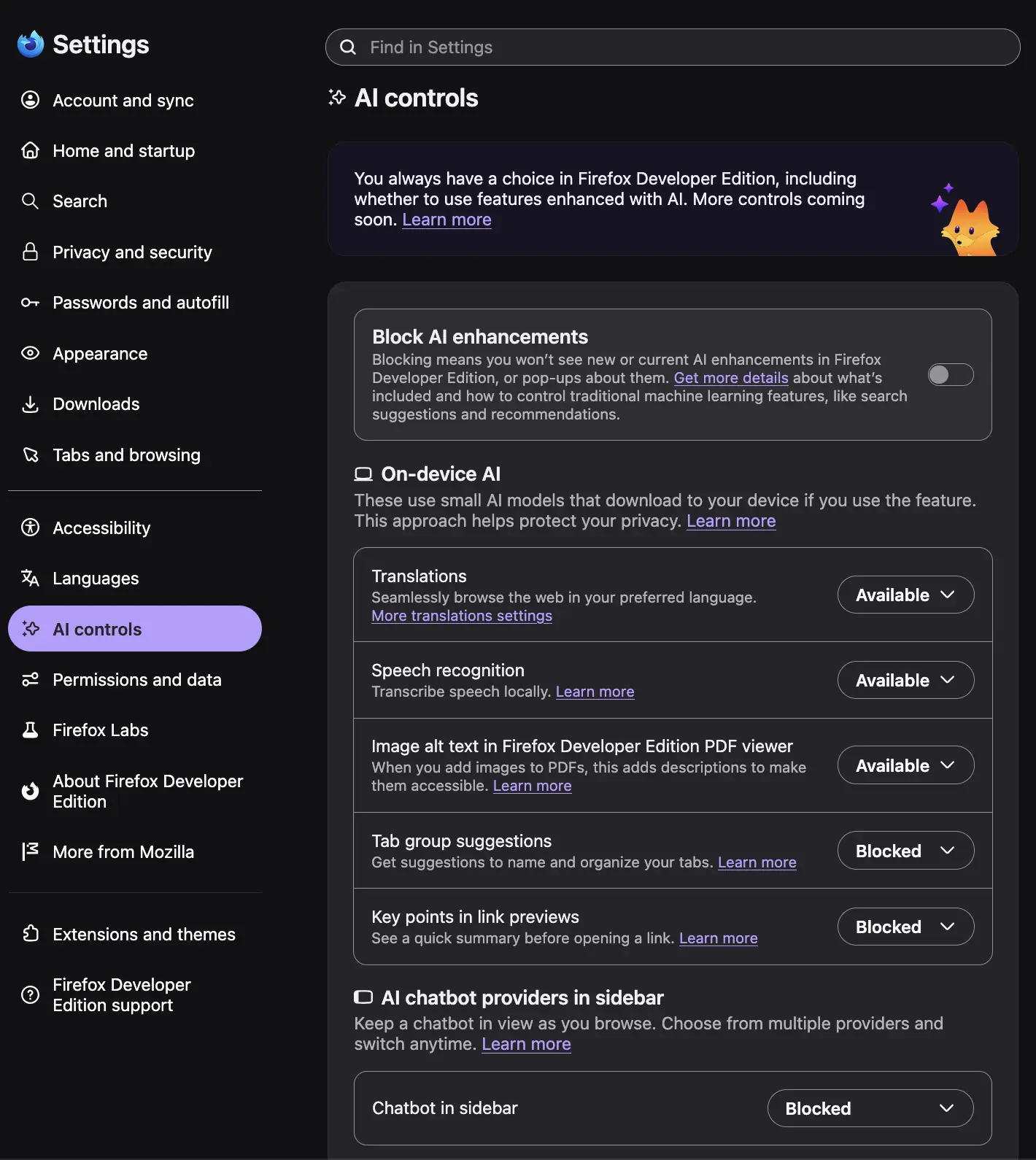
> AI controls — allow, restrict or disable AI tools
So the answer is yes, no need for making up a cynical answer.
So the answer isn't yes. The answer is we don't know if they will or will not remove the feature from non-enterprise, but it doesn't seem likely.
So the answer is no, no need for reading tea leaves and making stuff up.
And I mean, does everyone here know that Firefox is open source?
> they will remove "AI controls" from normal Firefox
which is the question the original poster asked?
My company has management software that nags me about the latest Firefox version, which is annoying, because I use the extended support release instead. Less frequent updates, and fewer sudden changes like the AI features people have been grumbling about.
Incidentally, 153.5.0esr was released today, with 140 reaching EoL.
Mozilla would have made tons of money.
It looks like they do actually offer that as a feature: "Employees can access internal company sites and web apps from personal devices without a device-level VPN"
Edit: To give proper credit, the link is from Heise.de
Some settings are flat out refused (for "security reasons"). And with each new update there are a few new popups / invitations to try this new feature / re-enabling the v2 of the thing of which the v1 was already opted out in the policy. And it seems like you cannot apply new policy while the browser is running - meaning it cannot be used to roll out hotfixes without interrupting the work of currently unaffected workstations.
And then there is the syncing. If you want to manage & sync history, bookmarks and the password managers content.. you are probably going to find that easier by overriding the builtin features with 3rd-party extensions, as the builtin sync feature is very much tailored to the needs of privately owned devices and one-device-at-a-time usage patterns.
The changelog linked above seems to hint this is specifically fixed/a new feature in the Enterprise version:
"Many policy-driven changes can take effect without restarting the browser."
And it's not just me. Looking at market share, most users are clearly underwhelmed with how they use their money.
This isn't quite a complete argument; getting money from funding sources who have strong opinions about your behavior can mean that you can't afford to do some things you might otherwise like to do, even if your bank account at any given moment may look like it would cover those things.
Solid props to Mozilla for this one. Good job.
All in all good thing, why are they so mad.
That said, I'm seeing enterprise security companies selling soft forks of Chrome with all sorts of inspection and policy built in. Basically, instead of doing DLP/URL filtering/risk management on a MITM box, they're pushing it to the browser. This helps remove the need for TLS decryption, and the need to funnel their browser traffic to any particular tunnel endpoint.
I guess what I'm saying is... Firefox might want to take a look at what those companies are doing to Chrome and figure if there is a way to make it easy to plug that kind of security into their browser.
edit: just noticed this is a paid service. So I triple down on what I said. Companies that are "buying" browsers are buying browsers with deep inspection and security features baked in. I don't know if they'll buy support for FF when Edge is free.
I think we hit all the features you mention but not sure about the above.
Edit: "website filtering" too
Seriously, this place is so damn negative these days, but not even constructively.
I think if you really want to build something like that, you need real momentum. Perhaps the ladybird folks can succeed here, the future will tell. I don't think Mozilla has enough momentum left.
https://www.digitalapplied.com/blog/browser-market-share-202...
Firefox is between 2% and 3% now.
So what before came as main advantage of Firefox is now dropped and put behind the paywall?
Page says a lot of nothing. Or just restates things that already were in place.
This one sounds new to me.
Thanks for the open admission that regular Firefox does not.
>Firefox Enterprise. Different at the core. Stronger because of it.
What's this even means
I manage these types of decisions and won’t use it.
https://connect.mozilla.org/t5/discussions/phasing-out-the-o...
Like a rich kid living on daddy's money, they're somewhat disconnected from the reality that most people exist in.