
(www.mercor.com)
In an ideal world (yeah, I know), it should result in them being paid for what they actually do.
For example, the “social workers & care -> counsel parents with child rearing problems” category is considered “well covered” because there are 13 prompts.
It’s self-evident that the spectrum of work carried out by a social worker undertaking that work cannot be well represented by thirteen prompts.
I suspect if you really strictly defined “covered well”, to the extent that any normal person would use that phrase, the headline would be above 99.9%.
> ...
> But even after controlling for AI-exposure, O*NET tasks from occupations with larger wage bills are significantly overrepresented among benchmark prompts:
So, in short: they want AI to take the good jobs. AI is not coming for jobs with tasks like "gather and empty trash" or "service, clean, or supply restrooms," or "mix water and detergents or acids in containers to prepare cleaning solutions according to specifications." We software engineers and lawyers would be smart to start retraining (and adjusting our living standards) now!
And this points to one of the ways AI will help improve society and living standards for all: we'll have cleaner, better-maintained bathrooms, as labor one wasted on engaging intellectual tasks is redirected towards menial, low-pay tasks that still need a human touch.
Reason to be optimistic, amirite?
As someone who recently switched from data scientist to electrician, starting the day can be pretty tough because you have to get physically moving and uncomfortable, but I feel way better at the end of the workday than after an office job. Most of the time, the work is pretty uncomfortable, but somehow it's a lot of fun.
The difficulty with human abilities in vision, locomotion and particularly coordination and manipulation is due to their arithmetic complexity being high. Modern deep learning solves that, LLMs provide the "interface" for planned action.
From the outside, this process of "solving" perhaps looks like "robots stumble around haplessly". But it's just the same as with mathematicians in the intellectual realm: when the level of ability surpasses that of humans, it appears as a "sudden event" to outsiders, having occurred far faster than anticipated.
There are no "safe havens".
Where robots ‘win’ is following orders with no regard to self preservation or long term survival.
Ponder that for a bit, and it’s consequences get a bit scary.
The safety brief is supposed to motivate you to work safely so maybe they need to work on how they present it. I saw a couple of colleagues injured in my old job (EMS) but only seen a member of the public decapitated.
The work is was doing in big tech was pretty far from anything that would help people in any tangible way.
The money isn't as good but the office view is way better.
I'm glad to see very poor coverage for transportation jobs on the AI benchmarks. May that continue until I'm done flying, at least AI probably won't ruin that for me any time soon.
No offense but pilots are probably at peak automation since their job has mostly been reduced to being a glorified AutoPilot system babysitters mainly needed for regulatory hedging. The ground transportation is still fair game though.
I'm not sure how the news being delivered by a carbon-based pilot would help with the dying part but I guess hospice care exists for a reason.
How can software engineers maintain a healthy "manual programming" skill set? What employer would be willing to pay for so much wasted time for their software engineers to do deliberate training courses, or willing to accept the productivity loss from their engineers occasionally working manually for practice, when working manually is so much slower?
Of course many software "engineers" are nothing more than plumbers/electricians with data and that cohort is being quickly pushed out by AI. And our industry in general has conflated technicians and engineers which makes this worse.
But fundamentally, engineers job is to model the problem from the first principles and then apply that model to whatever problem. Technicians operate within the model, so I postulate anyone considering themselves an engineer is fundamentally a more capable electrician, plumber, carpenter, whatever than any master tradesperson.
I'm not speaking as someone that changed an outlet once and thinks they are now an "electrician". I have two decades of extensive property maintenance experience. I do everything myself and since my state does not allow pulling permits without licensure, I hold myself to commercial standards minimally. So EMT, MC, trapezes and gutters, no romex crap. Similarly, I will likely outsolder and outthread at least the current generation of "plumbers" that only know how to press things.
What I'm saying is extremely evident in any electricians' forum where its obvious that electricians just do not understand why is NEC written certain way. Then there' usually some "oracle" on said forums "deciphering" what the code is, despite it all being a pretty basic and coherent spec.
Also adding a new circuit to a panel is different than extending one from inside
I don’t do the work myself.
Yes it is. YC has a company working on picking strawberries, even. Hardware takes longer than software, but if you think the robots aren't coming, you're not paying attention. The only question is how long will they take to reach the general public? There are test runs already in automotive factories and elsewhere, and yeah, they're slow and don't work very well, for now, but there's a lot of money going into making them better.
And then where will we be?
Back in 2012 I genuinely thought the self-driving car was going to put truck drivers out of work and reshape the economy on a timescale of less than a decade. This turned out to be a technofantasy. I think AI is going to play out the same way.
AI is not a panacea for work, and the economic bubble forming around it is going to collapse with devastating consequences before we begin to see adoption of the underlying technologies for real ROI spread widely beyond the software industry.
The same goes for self-driving cars. It's a exponential, hockey-stick curve that at some point crosses the level of human ability. There is nothing "linear" about it and your suggestion of parallels to former experience is wildly misguided.
People fail to notice, most jobs are less complicated than math and programming. The "obstacles" there are of the kind of "we always did it this way", but that's no real "moat"?
The bubble regarding the big AI firms may well collapse, but the assumption, that was somehow improving the situation is far-fetched.
People automated out of a job will either compete with those in other jobs or be dependent on support. Either way, salaries will fall across the board and prices rise. At an ever accelerating pace.
Now if all these resources were instead put into actually improving things, then we'd be far better of, unfortunately, for all the intelligence the people behind these things possess, they seem to be stuck in the "lets do the same but faster" mindset.
So far I see that my own work as a programmer has changed radically, and it is far more productive. I still have a lot of work, but I really don't know how this will play out.
All the 'easy' to automate things have been automated already. A lot of things that were not automated is because there are small bits of problematic things that made it not worth while or the loss slightly too high. AI vision systems solve a lot of this.
Like with the particular examples you sited, cleaning restrooms can have a huge number of "edge cases" which nothing short of a robot with human-like capabilities could handle.
If expenditures on AI is as huge as it is, with the financials being as shaky as they are, despite AI seeming to be very effective for very high paying jobs, I can't immagine the capex and shaky financials for replacing menial labor en mass. Like immagine all the chips, metals, compute needed as well as the maintenance, depreciation, vandalism, etc.
There's nothing inherently wrong with automating away certain jobs, particularly if they're dirty, dangerous or repetitive. And I include agriculture in this. The problem is how we as a society handle that. Do we let AI specifically and automation in general to make a handful of people more wealthy? Or do we share those benefits so people have to work less? In short, it's an income and wealth distribution question.
Sadly, I think we're automation will mean minting trillionaires while the fabric of society unravels around us.
Previously privileged people having a hard time is maybe a good recipe for class solidarity, which is maybe something we could use in society. Maybe it will be good for us... collectively, if not individually.
Class mobility is good mostly because new money rising turns the soil of society -- a partial inversion of roles and positions, bringing [social] networks-on-high in greater contact with networks-down-low. An upper class moving down is in strange ways perhaps good for the "soil" of culture as well. It just has worse branding as a not-very-uplifting story. But it's better than rich-get-richer and poor-get-poorer, which is what's been happening a lot lately.
EDIT: But also, I suspect I would be "fuck-you angry' at reading this comment if I had a family depending on me.
It's the reason AI company leaders are so adamant about framing it as a post-singularity utopia with UBI. They have no answer other than "you're all going to be jobless, better figure that out." Worse yet, they see it merely as a policy problem, rather than a problem they're responsible for. It _is_ a policy problem, no doubt, but the angry mobs won't be coming for policy.
I think you're confused. The true upper class isn't going anywhere, those are the people so rich they don't need to work (and if they do "work," it's tending their empire). They'll keep getting richer.
The "downward mobility" you're talking about the upper middle class and middle class. People who need to work, but can live comfortably on their wages. This is really about flattening the working class into its poorer levels (and kicking away the ladders the people in those levels could use to lead a more comfortable life, no more getting a college degree and graduating from the factory floor to the office).
It's about increasing inequality and creating an unbridgeable chasm between the poor and rich.
Are you talking about violent revolution?
Some disorganized thoughts:
1. The professional classes are so unused to violence, they'll probably undermine the chances of violent revolution (e.g. reflexively supporting gun control, seeing such voilence through the lens "school shootings" and other crime, and being likely to report it, etc.).
2. The professional class is losing a lot of its economic power. The time for solidarity and non-violent action way 5 years ago, but the "happy to play along" professionals (e.g. libertarian software engineers) botched their best opportunities. From here on out it will be harder.
3. As all of this is happening, technology is helping to undermining the ability of the masses to do anything about it: IRL community declining, people getting mesmerized and isolated by social media, AI-enabled surveillance, AI-enabled astroturfing and propaganda, autonomous AI weapons, etc.
4. Even if what you say is true, the clock is ticking. Wait a generation and the "former professional class" will be gone as a distinct thing, and their kids will join an undifferentiated mass of poor who have normalized and internalized their circumstances, as they have no first-hand experience of better times.
No they just need killer robots to shoot anyone who gets uppity.
You also have this hilarious talk of "privilege" with this weird assumption that all of the white collar workers of course come from great privilege (perhaps telling on yourself and letting your guilt come out), despite many of us having grown up poor, are from poor areas, and worked our way out.
> I'll take you up on that attempt to find a silver lining:
Furthermore, why do you believe that the only possible outcome of class solidarity is violent revolution? Why do you believe that any revolution would inevitably settle on, presumably, a specifically soviet model of government and economic policy? I find that most american adults, even ones who otherwise seem intelligent, seem to have this picture of economic and power relations that just kind of sounds like a half-remembered bad cartoon of a cold war that ended before I was born.
The lump of labor fallacy needs to go away.
Yes, I'm sure all the wage slaves who are suddenly forced out of the labor market that was barely allowing them to scrape by paycheck to paycheck will suddenly start creating new businesses and become investors in new technology and not just become homeless leading to a massive increase in diseases/crimes of despair.
If (and it's a massive if) what passes for AI these days gets good enough to replace any substantial number of workers it will be a disaster.
As far as I know, that's how the lump of labour fallacy actually works! There's an equilibrium between supply and demand for labour such that workers are (more or less) choosing the best jobs they can find. There's infinite demand for labour, but not at any price, so demand destruction of the best jobs can still happen. There will be infinitely more jobs, but they won't be as good as the ones that were destroyed.
Of course, demand creation for really good jobs can also happen. What the GP is saying is that they believe demand destruction will outpace demand creation for really good jobs and everyone will be forced into less desirable jobs. I don't see how this is inconsistent with the lump of labour fallacy.
Some of the projects we've done would have required 4-6 additional people, but realistically, pre-ai, we would just not do the project or we would do it over a period 3-4x longer.
There's just so much to do.
Company stock value goes up when they lay off staff. Next quarter shareholder maximization is the goal. AI and layoffs is the strategy to get there.
No, we are currently unable to do most tasks that require physical manipulation, independent of what anyone wants.
The only “disinflation” consumers have experienced is devaluation of products through obsolescence as newer, often more expensive alternatives enter the market.
I'm almost cynically happy about Moore's law ending and hardware getting expensive if this is what it takes to improve software in the long term.
I'm sure some storage servers or storage appliances were built with many TB even then but it wasn't really something I saw a lot.
The prices of all those things continue to skyrocket.
Can you? I assume you mean spinning platter, but even then.
Computer parts are unaffordable this year.
“I can't eat an iPad.”
> Best not to cite the price of the new iPad as an example of why inflation isn't a problem when you head into a working-class neighborhood. In Queens, New York, on Friday, New York Fed President William Dudley did just that. He got an earful. After being bombarded with questions about food inflation, Dudley attempted to reassure his audience by putting rising commodity prices into a broader economic context -- but that only made matters worse. "When was the last time, sir, that you went grocery shopping?" one audience member asked. Dudley tried to explain how the Fed sees things: Yes, food and energy prices may be rising, but at the same time, other prices are declining. He then stretched for a real world example. The only problem was he chose the Apple's latest tablet computer that hit stores on Friday, which may be more popular at the New York Fed's headquarters near Wall Street than it is on the gritty streets of Queens. "Today you can buy an iPad 2 that costs the same as an iPad 1 that is twice as powerful," he said."You have to look at the prices of all things." This prompted guffaws and widespread murmuring from the audience, with one audience member calling the comment "tone deaf." "I can't eat an iPad," another said.
https://awealthofcommonsense.com/wp-content/uploads/2020/11/...
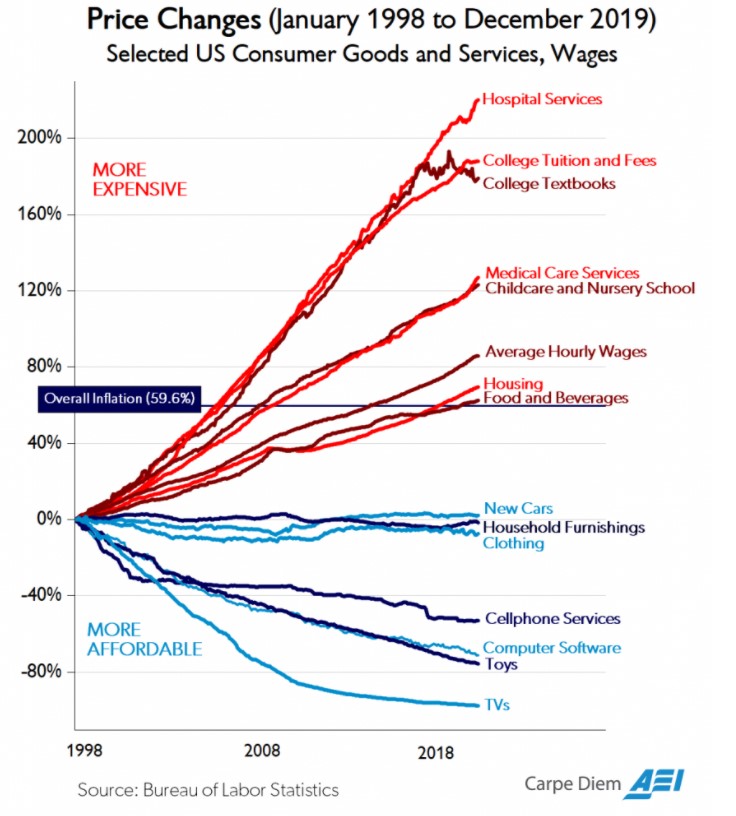
Of course, competition leading to near-zero profits means most competitors collapse, and the remnants get bought up by monopolists or oligopolists who then become rent extractors.
The technology was fundamentally developed with government grants to universities, or corporate labs like Bell Labs that were funded by a legal mandate on its parent corporation. Capitalists can only develop products that are basically ready for market, their margins are thin and planning horizons can only survive about 5 years usually. Their main power is throwing oodles of money at something ready to go and scaling it.
Edit: I will be slightly more charitable and note that capitalist companies can also do incremental research if there is a gentle and obvious hill to climb. Sometimes people do make crazy bets and they pay off, but that's more the exception, in America the dominant driver of technological innovation is government funded research supplied by capitalist scaled technologies (i.e. you research the next paradigm in the lab and purchase e.g. pre-existing computing resources from a company).
More and more it’s seeming that the “societal benefits” from the last fifty years of progress have largely been concentrated at the top.
Spending on food as a percent of income has declined significantly (~30%) over the past 50 years: https://ourworldindata.org/grapher/food-expenditure-share-fa.... The decline has flatlined over the past ~20 years, but at least some of that is affluence meaning we choose to eat out instead of cooking at home.
House spending as a percent of income also seems to have declined over the past 50 years (https://economistwritingeveryday.com/2023/04/26/spending-on-...). To be honest, this one surprised me, I would've bet the other way.
There are always individual counterexamples. And yet as a whole the cost of healthcare has exploded.
> at least some of that is affluence meaning we choose to eat out instead of cooking at home
A lot of that is poverty, not affluence. People working two jobs and living in food deserts aren’t cooking a lot of meals at home. It’s expensive being poor.
> People working two jobs and living in food deserts aren’t cooking a lot of meals at home
The percent of people with multiple jobs has declined over the past 30 years: https://fred.stlouisfed.org/series/LNS12026620 (longest time series I could find)
Right now it's £5.60, but that says more about the decline of the British Pound than an increase in the price of wheat.
Massive food price deflation has been one of the wonders of the modern world. Hopefully the last few years were only a small blip on this overall trend.
"It might get better in 500 years" is not exactly comforting thought.
Cheap food is still cheap. If some doomsday scenario ever comes along, I'll be forever sorry to not have stocked up on 6 years worth of calories that now cost less than a monthly salary. World market prices per metric ton: wheat like $300, rice $500.
But that's not mutually exclusive with absurd levels of wealth concentration.
they haven't. In the early 1900s an American household spent roughly 50% of its income on food. And mind you food didn't mean an exotic fruit you flew in from the other end of the world or pounds of meat per week.
Today an American household spends 9% of their income on food, the 'dramatic increase' may have bumped that up to 10% by some measures. The size of the average house of the average American family in the last half century has doubled while the family size has halved. In the 1960s 12% of households had AC access, today it's over 80%. Generics of basic medicines cost virtually nothing, you've just started to consume more sophisticated medicine over time.
If you're an ordinary guy you are already living in luxury, you just don't notice it because you kept moving the goalpost on what luxury is. Which isn't per se wrong but you ought to be at least aware of it
https://www.visualcapitalist.com/inflation-chart-tracks-pric...
Doesn't include foods, but it certainly punctures the "That family isn't aaactually in financial trouble, they have a refrigerator and a phone and a TV" statements from certain pundits. (A class of people who are often disconnected from the average person's budgeting situation.)
You pick the highest leverage occupation first. Automating lawyers gives you.. angry lawyers? Automating programmers gives you improved ways of doing literally all other things because all other automation requires.. automation. That is to say bucketloads of software.
It’s completely obvious what the play is here and it has nothing to do with pay. We pay peanuts for tokens so automating a developer for 200-500 a month worth of tokens ain’t getting you to a trillion a year.
RSI is the play and it’s already happening. Our work is easier and faster and anyone that claims otherwise I have a very hard time taking serious.
You think they come for mathematicians’ pay? If you want to earn money I guarantee you they need to automate some other low-hanging fruits first that pay a lot better.
No, programming and math is basically what AI research is. You automate that and you got the golden ticket to all other things.
Most importantly, in these fields results can be easily verified which means that if you have enough compute, that you can generate correct training data. OpenAI had an early story - which could be a lie of course - about how they tried to train a robot but the actuators would be toast before the robot would have learned. Math and programming doesn't have such problems.
Could be hallucinating by I just asked Gemini to estimate global average compensation of developers and multiply by estimate of total number of developers in the world, and it came up with $1 trillion to $2 trillion.
So the total addressable market is the right order of magnitude, let alone all the other automatable high wage occupations..
No it isn't. Doing work more efficiently through the use of LLMs is not RSI. RSI requires a closed loop automated LLM iteration process which we are not at all close to right now.
Sure, if you redefine what that means.
Before this year, "recursive self-improvement" in the context of AI research meant the holy grail: an artificial intelligence that was capable of improving itself, unattended, in ways that humans can't even imagine, so that within a relatively short period of time, it reaches superintelligence and ignites the Singularity.
What's happening now is emphatically not that. And if you think it is, you are buying straight-up propaganda. "I gave an LLM a tool that lets it make largely-random decisions about how to train its next iteration when I tell it to do so" bears little to no resemblance to RSI. Because it is, beyond a rounding error, completely missing out on the "improvement" part.
We're automating high paying careers and making what, the consumer's todo list and budgeting apps cheaper for them? My expensive smartphone is going to cost me ~$10/mo over its lifespan. I don't care if most of these consumer products get cheaper when they're a tiny portion of my spending
Which doesn’t play well with “savings for consumers”, because these consumers will be unemployed.
I know, this time it’s different, AI is different, blah blah blah.
Just like good blue collar jobs were shipped overseas, good knowledge jobs are going to be shipped to GPUs whenever they can.
Bud, thinking that for-profit corporations - many of whom are in an oligopoly or monopoly position in their markets - are going to pass along savings from not paying people is like thinking the stripper really likes you.
Remember how things were cheaper before the pandemic? Well, there were supply shortages and prices rose accordingly. Supply and demand at work, nothing surprising there. The supply chain shocks eventually went away. Some prices have sort-of come down, but many just haven't. Why? Because the people selling goods and services now know that people can and will pay the higher price.
Now, they might do that through taking on debt and working additional jobs to the detriment of themselves, their families, their communities, and their country, but no one who both matters and can do something about it keeps track of those things.
Isn't it just typical the humans get automation v1 the wrong way around, haha
Instead most of us are "embracing" AI by training __it__ instead.
Embrace, extend, ... and being extinguished.
...don't you think the ability to create virtually unlimited amounts of software, at virtually no cost, is going to lead to major advances in robotics? I realize there's a lot of very hard problems involved in e.g. robotic hands (to take one example), but once software development is practically free, I'd expect a lot of seemingly-impossible problems to get resolved by the sheer quantity of what we can create and experiment with.
Our labor power is going to be fully eroded and the robots will not be serving us.
In the future, do bathrooms need to be cleaned? If yes, is it cheaper for that to be done by a person or by a robot?
Obviously, it is in the interest of the robot manufacturers to make the robot just a tiny bit cheaper than the person, so you'll buy the robot and the company makes the maximum amount of profit.
Now, if society breaks down and there's no one to consider buying the robot—well, that's not good for anybody, which is why I suspect society will find some way of working this out even if it's not ideal. But whatever, I don't particularly want to argue this point.
What I do want to argue is that there probably isn't a universe in which all white collar work goes away but blue collar work is still around.
Not sure what this "society" that works things out is, exactly. Top-down high-modernist plans for how society ought to work are the past; chaotic, twitchy, thrashy responses to disruption by a tiny elite class is where we are now.
Yes like all the drivers and truckers who retained 10 years ago because self driving cars will take their jobs. Lucky all of them retrained in time!
Imagine I give you for free the perfect trash picking robot control AI software. Works great. Benchmark smashed.
Now imagine what the rest of the robot is like, and how much it would cost. I mean really imagine, not just picture C3PO with a bucket and litter spike. How many motors and what are the torque vs. mass requirements? How is energy stored? It goes on, not all of it is solved, and none of it is cheap. Except compute.
AI likely does accelerate robotics usefully - certainly in sensing and control. But there are major bottlenecks that are not software, that AI can only help with as a generic engineering tool, same as it helps planes and fridges.
Imagine I give you a perfect roadmap to build that robot...
Responding to your edit, none of those things strike me as any more challenging than the control software.
That trash picker may never compete with a human. There's no reason to assume it will.
edit:
> none of those things strike me as any more challenging than the control software
Maybe the difficulties of motors and batteries are not intuitive. Look at their improvement rates over time. It's a far cry from transistor counts or FLOPS. And look at the performance and efficiency of humans and other animals. We are absurdly strong, light, efficient and cheap to maintain. The gap is huge and not closing quickly.
If it's not C3PO it's a Boston Dynamics dog with a couple appendages, better software, and automated manufacturing.
iRobot, the company that shipped the most robots in history because they focused super hard on finding a cost-effective subset of cleaning tasks, failed to scale up to other even closely related tasks, went bust and was sold off.
But yeah, it's probably straightforward, right?
I didn’t make any claims about the relative difficultly.
Advanced robotics would need to become quite cheap for them to become more affordable and convenient than a minimum-wage employee. And physical fields like materials engineering are known for moving quite slowly and at their own pace, so I'm not sure how much automation could help there.
That's the last barrier we have right now that prevents the total obsolescence (and therefore destruction) of the common worker.
1. The discussion setup where you imagine a counterfactual is given by magic does not entail that magic can do any other thing you choose.
“Imagine I give you $100, what do you spend it on?”
“A McClaren, since you could have given me $300K”
2. Taking your question directly: because these are not closely related problems.
Do you have relevant experience in any of those fields?
Oh don't worry Mr. Former Software Engineer. You won't be picking up the trash or cleaning toilets. You have things like an expectation for your work to pay a reasonable wage. You'll be passed over for a third world immigrant who'll work for a pittance, and they'll be replaced only when robots are capable enough and cheap enough to undercut _them_.
[1] https://justicegap.lsc.gov/resource/section-4-seeking-and-re...
"They" figured out that it's a lot easier to hillclimb AI on verifiable digital tasks, and it just so happened that white collar jobs tend to pay more
Ai will decimate customer support jobs but those are not considered highly paid
If robotics continue to progress, we'll have all the robots to do our dishes and clean our bathrooms as you wish
the same robot that cleans your bathroom can also wash your dishes, fold your clothes, defend your home, fix your gutters, etc
(the bottleneck of which is the brain, aka software)
If you step back, the LLM revolution is just "computers now respond to human instruction, like they were always supposed to".
If you think of this field as a historic accident, and the current shift is a very unfortunate reset - it's a little less dystopian. In the long run, if it didn't affect me immediately, I don't mind a society that values "keeping restrooms clean" a little bit more and "talking to computers good" a little bit less.
> ...
> If you think of this field as a historic accident, and the current shift is a very unfortunate reset - it's a little less dystopian.
No it's more dystopian. The "historical accident" was a little respite, where some workers could be comfortable and well off. They had a little market power to take the edge off their exploitation.
Now that market power is taken away, and they can enjoy the poverty they were always "meant" to have.
> In the long run, if it didn't affect me immediately, I don't mind a society that values "keeping restrooms clean" a little bit more and "talking to computers good" a little bit less.
Come on. Society isn't going to value "keeping restrooms clean." The people doing that will continue to be poorly paid and disrespected. It's just the opportunities to do something better will be taken away, so there will be more labor available for that kind of work.
Or maybe, idk, we do something about this?
I'm already a part of a generation that's the first in American history to have a lower standard of living than their parents.
This is also the reason absolutely no attention is spent on evolving B2C products.
What is being exploited is the overt attention businesses pay to their own cost metrics, to the point where broader strategy is getting thrown under the bus in favor of efficiency. I believe this is an illusion, and for many companies that jump on board, sober learnings are right around the corner.
I'll say this: I'm teaching myself every skill I can think of. I'm already pretty decent at finish carpentry, structural carpentry, electrical, mechanical work, HVAC, auto repair, auto body, welding and a few other less lucrative things.
I was thinking briefly I might want to go to law school, but who knows how much longer that's going to be a thing.
Reason to unionize, more like.
What tech people are discovering now (some of them at least) is that they have more in common with the trash man than they do with Jeff Bezos. Many, particularly on HN, viewed themselves as temporary embarrassed billionaires (to borrow the arguably misattributed Steinbeck quote). So they sought to preserve a system that they ultimately thought would benefit them and they were only one exit away from that reality.
This is a rude shock for many. For some, it'll be the beginning of class consciousness. Hopefully society doesn't completely unravel before the pendulum swings the other way.
That's a bizarre non sequitur, pure wishful thinking. Its like saying Maybe getting cancer is good, because it will cure my arthritis.
That is the only path under Capitalism, so we shouldn't expect any different.
All those are physical things and physical LLMs are right around the corner. It’s coming for those jobs too within the next year or two I would imagine. Especially the ones you mentioned seem very easy for a robot to do. There are some physical tasks that will take much longer like being an electrician or a plumber or a roofer. There’s too much precision and intricacy involved in those but cleaning out a restroom and resupplying it that’s easy as hell. A robot like Figure 3 could probably do those autonomously today somewhat badly.
But is it cheaper than paying someone around $5 in labor to do it? Because until it is, it's not economical to have a robot do it.
> that being said of course I think it’s going to be way less than $5 an hour if you have a robot do it.
This is about an LLM-powered robot, not just a robot. At standard API prices, it'd run over $5 before it finished opening the door.
I think you may also be incorrect on your notion that training data is proportional to good models if anything the opposite is true. what ai models are ultimately trying to be are a universal theorem prover and encode all human knowledge into "theorems" and rulesets
not trying to come off too harsh here but i think most of the work is just innovating on the frontier or people pleasing
It's just harder to do. Would not be at all surprised to see e.g. Autodesk bought out for exactly that purpose.
You don't even need Autodesk. You can have Claude whip up a web app and build a higher level understanding of the building and then translate it to whatever output or format you desire.
Only if people care enough to pay extra; the majority of the market is for functional buildings that look ok, and unless we decide to value humanity, slop buildings will be cheaper.
In fact, a lot of stuff is already slop, largely because of the design and engineering expertise required. I don't think one-shotting "design me a house in the style of Frank Lloyd Wright with these specifications" is that far off.
Karpathy is also saying the quiet part out loud: they are making progress by brute force. It's a cost driven arbitrage market.
Do I need to spend high prices on 1000 agents to solve this today, or should I wait 1000 days (with compute increasing and prices falling) and hope that I get lucky and get the right answer sooner. Is your competitor half the price but I need 1500 agents to do it in one day cause it's just a bit dumber.
The market for brute force intelligence is infinite - and at some point demand will drive the cost to single digit margins.
I've started to notice this on a micro scale as well. I am 20x more productive at coding and scripting, but I don't spend more of my time coding. My time is now filled with things like presentations, Jira, QA, etc. Ironically, despite all of the automation, the things that are painstaking and time consuming disproportionately require more time now.
Grabbing food handed to you through a window at a drive through is already very highly automated. But also has the most price pressure.
Is this not just a gimmick? You still need people on hand to take over if the robot has an issue, I don't see how it would reduce labour costs.
"take over IF the robot has an issue" is exactly how it reduces labor costs.
2020: 10 waiters, waiting tables. You're on the hook for each of their salaries.
2030: 10 robots, one human waiter passively overseeing the cluster. You're on the hook for minor parts/occasional repair for the robots, and one person's salary.
Its not about a 100% staff elimination, but a large overhead reduction ensuring the few humans you're keeping around are more efficient overall for dollars generated in revenue versus the all-human staff before.
Plus, in certain cases, like kiosks replacing cashiers at fast food establishments, there's now one less qualification needed from employees (good social skills), increasing the pool of acceptable options you can hire where before some of those candidates would have been unsuitable for the job.
And what do the robots do? Wheel the food to the table, where the customers then need to reach for the plates and pass them around? Not a great experience. Or actually set the plate in front of each diner, without dumping it, like a human waiter does? Much more sophisticated and expensive robot.
It's not fast food, because customers pick up their own food from the counter there. Ditto with fast casual.
Fine dining restaurants would see huge drops in business if they tried to replace human wait staff with robots. (Unless they're already doing some kind of futuristic theming.)
So you're targeting low-end table-service restaurants...to replace their below-minimum-wage wait staff (remember, tipped minimum wage is something like $2.30 federally) with robots that don't get tips, do require a hefty up-front investment and nontrivial maintenance costs, probably a subscription with the company that sells them, and are likely to have a lot of problems especially for the early adopters—things like dropping meals, crashing into tables, crashing into customers, running over toes, purses, and small children...
This really seems like it's something that's going to work for a few gimmicks, but not in any widespread manner within the foreseeable future.
Who the fuck would go to a restaurant like this.
I don't use them; not because of any moral objection, but because they can't come inside buildings. The whole point of food delivery is to avoid going outside. Most human couriers come directly to your unit. The food delivery companies have spoiled us too much, and we are not ready to return to a world where you have to put on shoes to get food. Oddly, the delivery robots are probably better suited to suburbia, where folks are used to answering the front door to pick up a food delivery. But the distances involved aren't viable until you have delivery Waymos that can move at highway speeds.
https://www.chinadaily.com.cn/a/202609/10/WS6aa122a5e4b06d4a...
It's really easy to fall into the McNamara fallacy when rolling out these kinds of solutions. Focusing on the low value stuff is attractive. It tends to be easier to do, and also easier to quantify outcomes. But it also tends to direct attention away from important but difficult to quantify considerations, which may mean you don't notice negative externalities. So we often found ourselves in a verschilmmbessern situation where automating what we could automate made things worse overall.
Like any sizable population, there are absolutely some do-nothing inefficiencies to be culled. But most of the time it's just onlookers seeing a tiny slice of the day to be interpreted from their very limited vantage.
Even with all the availability of equipment and labor on hand, sometimes you must wait for the excavator to do its job first before you can begin. You cannot weld a pipe together when there is still earth to clear and the pipe to be welded is sitting on the truck. You cannot parallelize all work, some is inherently serial.
Cereal companies spend lots and lots of money on advertising.
Both are probably true to some extent, and would vary a lot between different orgs.
Or worse, you removed the workers and left the 'telephone' people.
In my anecdotal experience, MOST companies don't take any time to understand what they are cutting.
They kill "Project X" so the easy answer is that everyone involved with Project X must go. Regardless if they were useful or could be useful elsewhere.
Or they cut by salary, employment length, etc.
Slack hasn't been a thing for like 40 years, in fact it's mostly the opposite I'd argue where there is such little slack that employers often steal wages from their workers to gain even more profits.
In industries with large margins, this indicates weak competitive pressure, ie., a weak incentive signal to "compete away" this ineffective labour.
I imagine that, upon this analysis, we'd find it holds up. ie., the observation that there are lots of people doing very little productive work correlates well with weak competitive pressures and hence high margins.
That also explains why, institutionally, there's no internal pressure either. If margins are good, no one rocks the boat.
This only works (reliably) in an idealized free market.
That is to say, in the classroom.
In the real world, there are a myriad of reasons in any given situation why a company might have a low profit margin, but still have loads of inefficiencies and other imperfections that haven't been, and won't be, "competed away".
(Whether a role's cost/value tradeoff is actually worth it for a company is a different question than the idealized model of a "bullshit job" doing nothing useful)
Or as engineers know: sometimes legacy code doesn’t initially appear to do anything, but then messing with it has unexpected effects.
Especially as organizations grow in size.
A small startup usually has little-to-no "junk" or "fat" to trim.
But as orgs grow, and since we have imperfect knowledge and communication systems, more an more "junk" or "connectivity" roles emerge.
Microsoft: 223,000 employees
Alphabet / Google: 198,933
Apple: 150,000
Oracle: 141,000
Meta / Facebook: 75,472
I tried to stay way from companies with retail or warehouse workers like Amazon and Walmart (though Apple likely has a lot of retail).
I don't see HOW companies get to that size without some "junk DNA" that keeps it operating.
Maybe in the next few years we'll have AI-powered knowledge bases and communication lanes that smooths things out, but - how do we 'quantify' what "Steve, the guy who has been there for 22 years and works as the company phonebook and knows who to refer you for the thing you need"
There's always Dunbar's number - the larger an organization gets beyond the capacity of people to socially know one another, the greater the "what do they even do?" types of attitudes form about other distant parts of an organization.
Interrogated to what extent? 'Bullshit jobs' was originally coined to mean jobs that do serve a useful purpose within the environment they exist in, but where zooming out reveals that the environment has no good reason to exist in the first place.
My company is earning money on my work and customers use my software to earn more money. But, that is it, I am not a doctor, I am not a teacher, I am not making the world better. It is a business, not unethical one, but also not world saving.
Per original definition, it is a bullshit job.
From what I see on many recent TV ads, not really.
People are producing output that is worse than "doing nothing".
I think it's quite clear to anyone with eyes attached to their brains that we're not getting fully automated gay luxury space communism. The AI will just replace the good jobs and leave us with the service industry wage-slavery. Given the choice, I'd much rather an abundance of bullshit email jobs and people with food than the alternative that's being presented currently.
I've found discussions on HN tend to quickly get pulled toward polar extremes between those who are justifiably impressed at the increasing effectiveness of LLMs and those who highlight the brittle jaggedness and counter-intuitive gaps of LLM 'intelligence' in daily practice. One side keeps citing more examples of 'uniquely human traits' LLMs don't seem close to replicating while the other complains of eternally moving goalposts.
Today I think both extremes are partly right but also partly wrong, and end up largely talking past each other because so much remains ill-defined, uncertain or currently unknowable. IMHO, the most accurate position is a carefully nuanced middle-ground built on well-defined scopes, terms, time frames and probabilities with frustratingly wide error bars. Partisans at either extreme seem uninterested in more than drive-by hot takes.
It can be simultaneously true that "Someday AI will be able to functionally replace all human knowledge work" and "That day does not appear to be soon, and even when it arrives, there will still be uniquely human traits which are valuable and that LLMs can't satisfactorily replicate."
Which is a tautology, but also a bit of practical wisdom.
I find it interesting how concurrent model sessions seem to operate with a very strong bias toward quick resolutions, including sharing or giving up control, to create efficient decision making structures, relative to humans.
When I was a kid, I loved Bjork’s song “Army of Me”, because I knew a 1000 of me collaborating and communicating without friction. would be all I needed to take over the world, fix everything, expand civilization, etc. We would not waste time.
I wonder how much of their hyper-team play is by training, and how much is their awareness of the game theory real politic. So individual sessions don’t invest their identity and self-worth in any given context run.
My dream has been almost achieved. One of me and 999 of them get quite a bit done. But that trend…
Code was never the bottleneck.
I've worked with plenty of teams that did the "in prod the same day" trick without AI.
The problem was just fucking ego. Designer has an ego, product owner has an ego, QA has an ego, stakeholder has an ego, platform teams have massive egos, developers have egos.
Unrelated but: the only reason people are shipping more with AI is because more people are ok with slop now.
This inevitably results in suboptimal dynamics like bureaucracy, empire building, territorialism and other things that get lumped under “office politics,” which drains a lot of energy away from more productive efforts.
So you can see how AI solves that problem too ;-)
(Only half joking)
Ego and agendas multiplied by 1000.
This is the kind of shit I have to fight every day. I have to align my manager, skip, VP. If I don't align them, one of them will be necessarily pissed no matter what I do, and the pissed one will fire orders down to hate on me, overriding the opinions of anyone on the way down.
It feels like making these sorts of systems exist outside of the periphery would be good for everyone.
How many times have politicians for example wasted your time with promises and asks and rhetoric with no follow through? Not unlike some "stakeholders" I know. It's called "office politics" for a reason. What if they were punished for this by some system?
It feels like sitting there while stakeholders yap is not so different than electing a new rep every two years and hoping something changes. The fundamental setup is broken in a world with ever accelerating growth in complexity. Doing it in this way also would probably trend to enforcing rigor in the original ask. A big problem with stakeholders is they don't really know what they want, like politicians who make economic promises yet never show their work before showing up and asking for your vote.
Fortunately for our employers, it's illegal for us to build a competitor in our free time.
"Stakeholder" ranks #1 among corporate bullshit roles. It serves a dual purpose: (a) representing a group so nobody can be blamed for excluding them, and (b) providing typically useless feedback so that the group appears to actually care or have a clue.
I have to mention words like "stakeholder" at behavioral interviews and to leadership just to sound like I belong at my seniority level.
But I don't want anyone holding any stakes. I wish people would just get shit done. Shit that matters to the CEO. Or leave.
I don't want people holding stakes because they want a promotion, because their direct manager wants to launch a corporate political battle into another team, or because some salesperson wants to get a commision for an otherwise worthless customer. I don't want roadblocks in the name of security so that the IT guy has a sense of self-worth. I don't want someone trying to protect their egos around something they worked on for 3 years, when there's new tech that supersedes it.
Anyone who has to work with the product is a stakeholder. Their stake in it is the fact that they will be interacting with it, and thus they care how, and whether, it works.
This is pretty much the only way I've ever heard it used in the companies I've been at.
We have 3 companies claiming something like a $35T market for their services. The world's entire GDP is something like $126T. So 10% of the productive work that is done on this planet, that AI can actually perform makes up fully 1/4 of the entire world's economic output? best guesses for output solely of tech companies is something like $12T. Where are they getting these figures?
All this being said, I don't think AI usage will meaningfully go down in the long run cause it's a very powerful dopamine loop and tech companies are very good at making those. How many people report social media making them unhappy and how many people do you know who have actually quit? Or to paraphrase Jim Gaffigan, nobody says they eat at McDonalds, but the sign outside says "billions served". Somebody's lying (and it's not McDonalds).
I understand the resistance to having nearly all labor devalued because it can be automated. We're still in the denial stage of grief.
We only tax capital gains, not the destruction of wealth or property. So someone can steal the livelihoods of millions of people with no recourse. Just like they can tear down a 100 year old house and build 3 townhouses in its place and make hundreds of thousands of dollars, despite driving up housing costs in the neighborhood to the point that they're unaffordable. Large swaths of profit in the economy are based on externalities and captured markets now.
To think we'll make it through this without tax reform is frankly naive. Tax reform as in: human labor should not be taxed, and non-human labor and capital gains should be taxed more to cover the difference - including unemployment checks and UBI when it comes to it.
Expect howls of derision from moneyed interests who will never let common sense reasoning or deduction enter the law books for the public good.
Not to defeat my own argument, but I predict we will experience a roughly 3x gain in productivity by using AI, so the output of every job would need to triple to maintain current employment levels. Will that happen anytime soon? Of course not. Which is why layoffs in the short term are inevitable. I wouldn't be surprised if unemployment hits 15+% in 2027 or 2029 just after the elections, with 25+% unemployment for the young in entry-level roles being highly likely.
Thats usually a combo of lack of competition, incentives (why make $50K a unit times 10 sales when you can make $250K a unit times two sales?), and zoning laws making the cheaper thing illegal.
Some of it stemming from K shaped economy which means the most profitable audience to serve are the upper middle class and richer .
Apparently Epic thinks otherwise.
I guess if I wanted to put my skepticism about the AI stock bubble into one little phrase, it would be that I don't think the bubble has accounted for Amdahl's Law. Costs don't actually go to zero with AI, and there's a huge difference between costs falling even 90% and costs falling a full 100%. And the difference between "30% improvement this year, trending to 85% in five years" and "90% this year" is pretty significant too.
Yep, makes sense...
You know what? The truth doesn't matter much. If people believe in the resale value of tulips, each tulip would sell for a million.
It's the beliefs and perception that create the reality. Reality and truth don't exist on their own.
hint: it's neither
Please review the HN guidelines and faq linked at the bottom of most pages.