
(www.windowslatest.com)
With UTM wrapping hypervisor.framework, i have a complete fullscreen desktop running Linux (i use fedora earlier but Arch the last several months) with full graphics as if it were on a dedicated host.
Because it's running in an Apple Silicon hypervisor, i have macos tahoe running concurrently on separate desktops: no dual booting unlike when i was using Asahi.
I haven't looked to see if i can access graphics hardware directly or if it's hidden behind a virtio layer in UTM's wrapping of the hypervisor.framewirk.
Asahi only supports M1, M2, and alpha support for M3.
Not that I blame them for the lag, there's a lot of reversing work because apple doesn't document this stuff.
macOS unable to open any non-Apple application (twitter.com/lapcatsoftware)
2603 points by mattsolle on Nov 12, 2020 | 1292 comments
I wish Microsoft would separate their marketing shenanigans from Windows more drastically and stop requiring online accounts. My OS should be able to fully install and function without any internet, and continue to do so.
I'll default to buying Macs and Linux first systems instead.
I do hope these new Nvidia laptops see Linux flavors, I'd love to buy one. Maybe System 76 might build one? Not sure.
I migrated to macOS for development years ago and going back to Windows for development always felt gross, but I never had any issues with windows for entertainment/general productivity workflows. It's only once I tried 11 that I noped out for everything other than use as a Steam launcher.
That was the start of telemetry, it was forced on people with an upgrade pop-over that if uncancelled would just upgrade your PC...
Windows 8 may have got rid of the start menu, and Windows 10 did bring it back, but in a weird hybrid form with "live tiles".
Home users lost the ability to defer or decline Windows Updates.
Windows 10 also shipped with pre-installed apps like Candy Crush, and later versions introduced adverts in the Start Menu...
Windows 8 eventually caved and added it back in. I'll sound crazy, but I didn't mind it taking up the whole screen. Windows 8 gave me this interesting feeling that my OS was wrapping around an older version of Windows with Metro, and for whatever reason I loved it. I also did have a touch-screen laptop that I loved, hell I still have it... I bought it the week Windows 8 came out... and it runs Linux now.
I definitely recommend you spend a weekend checking out either Ubuntu or EndeavourOS (Arch based) and install Steam, enable Proton for all games, and add the "bypass" for native games to play natively (I forget where this setting was) and you will be shocked how many games play on Linux just as well as they do on Windows, in some cases better.
Practically every benchmark agrees with you, aside from the Metro start menu, it was solid.
Which is why it was on the market so briefly. Every commit since has been for the bottom line, not the user.
But I agree about W2000 being peak Windows.
This is literally a Microsoft made hardware product which is extra integrated with Windows.
You're not a hater, windows is hot garbage.
Windows is so damaged a this point, both in terms of rep and functionality, that microsoft might as well start form scratch with linux as the kernel. I am not even joking. And fire every mba that ever influenced the product.
Thing is, MacOS was heading the same way until the new chips saved it. The last few versions that were still running on Intel shouldn't have been as slow as they were.
Software is going to shit everywhere, it's just there's now M* equivalent for Windows and Intel.
All that to say: yes, I think you're spot on, the problem is sowftware, not hardware.
I wouldn't mind Windows if it were easy to rein it in, if I had granular control over what updates get applied and what gets trashed, and the ability to opt-out of updates. I wouldn't mind macOS if I could more easily control the UI bloat, preinstalled apps, and hundreds of background daemons/processes that are running that I never asked for.
I want to take my Operating Systems back to 2009 and have a version of Windows 7 and OSX Snow Leopard that runs on my modern computers and have all 3rd party apps work on those operating systems.
Or, just install Linux.
Anyway, what I like of this machine is the 15" screen with a keyboard without a numberpad: the center of the body of the user can be aligned with the center of the screen. The screen seems to be particularly bright, which is good. There are claims of good self repairability, we will see when it starts to sell.
I'd wait a few years before buying one machine in this product line. I want to see how Windows on ARM will play out in terms of compatibility. My build targets are all Intel servers (Linux), so I don't want to have surprises. I would have to wait years anyway because I would run Linux and I think that it takes more effort to port Linux to new ARM hardware that to new Intel one (ACPI etc.) WSL is not an option because I still have Windows around it and it's even more unpleasant than having to deal a Mac GUI.
Let's say that if this were an Intel laptop I'd be tempted to buy it, if the hands on reviews will be good.
Repairability is important, but why repair something when you can only use terrible, soon out of support operating, which spy on you? (This means practically any OS vendored by large corporations)
For ARM systems openness boils down to the custom boot process, and of course the driver support. Has ARM PC vendors standardized on a boot standard yet? I cal recall the horror on reading articles how Raspberry Pi boot was working, or how M1 Mac bootloader is locked down.
Unless that RAM fails in some way or another, then you have to replace the whole motherboard because of this.
https://www.ifixit.com/News/116152/macbook-neo-is-the-most-r...
Lots of companies buy average Dell and Lenovo laptops because they are repairable in-house.
I didn't. Sent from my Librem 5.
While I'm not exactly enthused about UEFI I prefer this to android's fork-the-kernel-tree-and-abandon model for your pocket-SBC. The last device I used with this booted fedora using arm UEFI no issue, several years ago.
I don't see x86 going away for a long while if at all - too much software is built for it so the inertia is massive.
> I can recall the horror on reading articles how Raspberry Pi boot was working
Not that I know what's nightmarish about it in the Pi.
ThinkPad P1 is the machine for you and you can run Linux on it.
Oh you mean like the incredible MacBook Pros of the last two generations that have been selling like hotcakes and have a surprisingly similar design to this device? "Redmond, start your photocopiers" never gets old.
Docks are horrifying products. Thunderbolt docks are doubly horrifying. They ordered in every single competing dock they could find, from that era's products, and found that every last one was garbage in some way or other, usually fatally so. The Thunderbolt interface in particular, and the firmware that needed to run on that interface controller, was the source of a lot of issues. None of them were particularly intrinisc to the protocol, but the hardware available was junk and the software available was worse. They couldn't really order up a custom non-garbage IC just for a $100 accessory that sells in limited volume. (Apple, however, could and would; they'd also demand to control the whole stack. This shows.)
They were very proud they got the thing working as well as they did, even though they all knew it was still pretty much trash. It was still better than the competition. Which is sad, but what can you do?
(At least it wasn't the Wi-Fi chip. The Surface Book's Wi-Fi adapter was chosen by higher-ups as the same one used in the XBox, presumably for sourcing reasons. It is trash. Again, much blood, sweat, and tears were spilled making it work as well as it does.)
(I also have the exact circuit for the LED that lights up on the charger cable. Apparently it was a big deal, which I find hilarious.)
It was a rather nasty bug. Firmware is full of nightmare scenarios like that.
I believe it. From all my years as a sysadmin, docks were by far the second largest source of headaches (after printers). Super high failure rate, all kinds of quirks, shoddy power delivery. And these weren't some cheap amazon basics dongles, I'm talking the $250+ docks from Dell, Lenovo, etc.
But no, we had to install random drivers on our machines, get blue screens and have to plug and unplug the printers until they get reset properly.
Compatibility marks/certifications like AirPrint (2010) define how to advertise your IPP printer and its features, such as whether you can directly send a PDF. IPP Everywhere is perhaps the most notable open alternative to AirPrint.
That exists, it’s called IPP.
The PostScript was created by ex-PARC people as they were founding a small startup called Adobe Systems, and it was chosen by Apple for its revolutionary 1985 LaserWriter printer. LaserWriter was partially OEM'd by Canon, and its competitors couldn't simply steal the protocol; most others to date use a 100% compatible proprietary protocols that, IIUC, aren't internally that much different from it. And PostScript later became the basis for Adobe's other publishing data formats, including PDF, which means pdf/ai/psd is 100% guaranteed WYSIWYG. macOS 10.x also partially uses PDF to render desktop.
and this ^ is why.
Nothing about what the parent wrote prevents that.
Installing the specific driver like it's 1999 works well, but most people don't bother these days. And thus the world is a bit more crap.
[1] ie a risograph
It costs more money to make a printer with good firmware, and you're more likely to throw away a buggy printer and buy a new one with new special ink cartridges.
It's not just firmware.
Printers are hardly "complex" - a few very standard gear/roller/sensor based mechanisms we've built for 4 decades pretty identically with hardly any innovation. Besides far more complex frequent-use devices don't have such shit problems and experience.
Nor is "you're out of blue ink, you can't print this b&w document" or "you didn't install the official $50 cartridge, but a third-party $10 one, you can't print" and such crap related even remotely to printers being "complex robots" or "requiring frequent supply reffils".
Most of premium "docks" (if not all) are repackaged cheap hw sold much lower as no-name.
I’ve had one cable begin to fray in all that time (a thunderbolt 4 caldigit cable). It swapped it out for an Apple cable and kept going.
I’ve used OWC docks, which aren’t known to be the best, but have worked great for charging, usb, Ethernet, FireWire, display (both over daisychained thunderbolt and display port), and SD cards. The only thing I have used them for extensively is audio. My monitor is a Thunderbolt 2 monitor with USB breakout. In between it and the dock is a two drive SATA enclosure.
I recently threw an extra Thunderbolt 3 dock I had on a USB-4 mini computer running Linux and it worked without any issue.
I’m sure there may be things that don’t work well, but its worked for me. I even wrote an app to have a global hot key to eject all my attached disks (DriveLight). Press the key combo, wait for the eject sound, pull the cable and go.
No boxes laying around, just a single cable.
This guy tears down and analyzes docks with incredible detail, he might like to hear about your experience
It is so hard to believe that when more than 1000 employees at my employers are also using at least one dock (Dell and Thinkpad both) and using them very well.
Today I swap the power brick on my Dell thunderbolt dock when it acts up. Given the hours of use and how many times it's been plugged/unplugged from various laptops/etc (it worked great off an AMD desktop PC with thunderbolt on the rear I/O), I think my employer should buy me a knew one out of respect.
We had those early "blessed by Apple" USB-C LG monitors. Garbage when it came to connectivity. Same with docks and the like.
We're now 9 years later so... I think it's all better now than before.
Only around 2024-ish the situation with USB and TB docks seemed to stabilize.
Thanks for finally answering this mystery for me.
I'd actually really like a TV that properly supports it because the idea of having one ethernet cable running to my TV and then everything else also getting a wired connection via the HDMI cable its already attached to pleases me, in the same way that a single USB-C cable on my desk giving my laptop access to ethernet, monitors, USB peripherals, and power pleases me.
I'd more be afraid than happy if a TV were to support that (and even more if laptops would use it to bridge a TV to the home network), simply because a TV that has internet access in any kind will download ads and nagware and upload viewership statistics in return.
Modern TVs truly have become like 1984 - there is no way a 4k 60-inch TV at 340€ is anywhere close to profitable on its own without milking the user's data for all it is worth. The actual cost of a TV is more like 900€+ if you go by the prices for "digital signage" TVs.
Okay, today I learnt.
That thing Didn't Work more than it Worked, but options were slim. Eventually it fully died about 14 months in. I didn't even bother checking to see what the warranty terms were. TS3 Plus, back in 17 or 18. What a piece of shit.
Sounds like it's a good thing I didn't bother trying again in the early 2020s and only recently bought a new dock.
Docks were bad, bad products in those days. They were no longer the dedicated bulky-but-reliable things of years past, or the modern finally-debugged dongles we've got now.
This was Intel's Alpine Ridge and it was hell. (At least, I think that was the one. Certainly, it was hell!)
The old bulky-but-reliable things often enough didn't contain much electronics - it was often enough the raw interfaces exposed directly on these multi-pin connectors. Simple, stupid and reliable as long as no electrically conductive dirt was around.
Plenty of cases where Surface isn't. Microsoft like to think they can make hardware but they're no better than other OEM and it's clearly not a focus for them
Then Microsoft had the episode where some of their Surface hardware would not reliably stay in sleep mode and cooked itself while being transported in a bag. At the time, Microsoft tried to excuse this by claiming that "a fundamental Computer Science problem" needed to be solved to fix this issue. Strange how other manufacturers could do this without overcoming unsolvable problems in frontier CS research.
While I'm usually a die-hard Microsoft fanboi, I have concluded that their Surface line is terrible.
It gets so hot in my bag I actually worry about it starting a fire one day. I now take it out every night.
Obviously I tried googling but no dice. Nothing changed, settings seem in order, no idea what to do.
https://learn.microsoft.com/en-us/windows-hardware/design/de...
But I completely understand why it didn't meet market expectations and the 8/8.1 UI fell off a cliff. If you weren't willing tyo overhaul how you interacted with a Windows device and use it as designed, or needed something that was better at any given feature the surface tablet presented, it was not the right option.
I would love an option for the 8.1 style start screen on Windows 11, at least for a touch screen laptop. It really worked for me and how I used a computer at that point in time. I have an 8.1 install iso hanging around in case it comes up.
Yep, that's the Surface Book (original). I've got one, and mine still works! Somehow.
That detach mechanism is insane. As far as I've been able to put together (I haven't done a patent search or anything, just heard bits from people who'd know), there's no motor involved... it's way weirder. I believe the thing actually heats up a nitinol shape-memory alloy latch in the base so it detaches from the tablet piece. That heating is why it takes a couple seconds. But then reattachment is instant, so it's just something clicking in to place. And you can't reattach immediately, because the base has to cool down (just a few seconds, short enough that you never notice unless you're deliberately messing with it). Black magic!
I'm not 100% sure of any of the above, except the use of nitinol somewhere. That's right, the weirdest piece of the conjecture is the only one I've got hard confirmation of. Like I said, black magic.
but also, it was really easy to accidentally lock the screen while removing it, at which point youd put it back on to get the password filled in again
that and if the battery got low, youd be stuck with it in the wrong configuration, so the screen would get scratched
To be fair, I've had exactly this with a Dell, MSI and a Razer laptop in the last few years. The only way I can reliably get it to stop waking up while asleep(and never going back to sleep) is disable sleep entirely and use hibernation instead. It's insane that such a basic functionality seems to be broken across a whole range of hardware.
the clamp around setup was a very poor choice
I went through a period of using a Macbook Pro with a dock. At the time the best option seemed to be the Caldigit TS3. It's a sleek device but luckily someone else was footing the bill because:
- 3 of them failed on me. THREE;
- You really learn how bad cables are. I got in the habit of ordering 2-3 at a time because experience taught me that at least 1 of them would be bad or die;
- It exposed just how bad the USB-C situation was (and still is). Is this just a power cable? Or you want data too? How about an alt mode so you can do DisplayPort passthrough? Well good luck with all that. There's no cue that the cable can do any of that. And if a cable can, it's typically 3 feet or less in length, expensive and prone to failure.
A lot of people don't know how complex a modern USB-C or Thunderbolt cable really is. It typically has a chip in each end of the cable. So the failure mode is not just the cable, it's the two chips as well. Bend or twist the cable too much. Gone. Damage the head of the cable. Gone.
Oh and USB-C is made more complex because it can be plugged in either way. The cable and the chips at either end and the controller on either side need to be able to seamlessly handle all 4 combinations (or 2 of the cable is truly symmetric pin-wise; it might be, I'm not sure).
I hope that this tech is more stable now but I honestly doubt that it is.
I'm reminded of an old quote I heard (not sure from who) that said we went from a world where no cables fit but if they did, it worked, to a world where the cable always fit but nothing works. That's USB-C in a nutshell.
Docks have to handle a lot of bandwidth. Even passthrough requires bandwidth. It's a nice idea but it's a hard problem.
Mine works pretty well — have used it with three Intel MacBooks in the past and now currently two different Apple Silicon MacBooks.
One of the Intel MBPs did not like it. Would reboot every time I unplugged it from the dock. I blamed that MacBook for that one, since nothing else was ever a problem. I sent every crash report to Apple, along with some choice words that my $2,500 MacBook should be able to handle connecting to a very commonly owned TB Dock. Eventually they did fix it and it stopped being an issue.
Has ended up one of the more reliable pieces of tech gear in my life, especially given the absolute mad complexity of TB3 behind the scenes.
I will note that mine have all functioned as docks for effectively-stationary PCs, so there's basically zero cable wear happening.
Not sure if that's still the case but truly astonishing
https://support.microsoft.com/en-us/surface/surface-dock/tro...
Or was it actually working but charging only on 5V and taking a long time to wake up?
Macs have some of these problems too, just less.
If the battery is fully dead, you have to remove it and charge it using the separate battery charger.
That means you can't travel with only a USB-C cable.
Still, Windows is a problem here. I wonder what the monthly fee is to get rid of the ads?
The build it rock solid, its trivial to run wsl for a Linux environment and I still get a windows environment for work with excel, etc.
The keys don't come off the keyboard like they do with my old mac chicklet style laptop keys and even my 10 year old can still drive multiple external monitors.
Hardware, Frameworks has replaced any other OEM in the market for me. You have to pay me to use Dell, HP, Microsoft, Asus, Apple, ...
The backrooms version of an Apple Store… I’ve been to precisely one and it was, indeed, a sad experience.
You’d also need to pay me a lot to use Windows. I even have an assigned Windows virtual desktop at work, but I also have a MacBook for actual work - the VDI is only used for the stuff that doesn’t quite work right on Macs.
A (quite large) company that I worked for stopped offering surfaces to employees after the average lifetime over the 3 years they offered them was under 1 year. We even had a terrible batch of Dells at the same time that still handily outlived the surfaces.
Small sample size (N=3) but, nobody I know that works at Microsoft uses a surface or any other Microsoft branded laptop.
Oh boy, don't get me started on Dell haha. Sure, they've got a better service model (people come to you), but at least in my experience they contract with service people who service multiple brands who can't help but shit-talk Dell. Not very confidence inspiring, particularly when the cause of the issue ends up being a connector not being fully plugged in from the factory.
Never had any issues with them. Solid hardware and a good alternative to the Lenovo Thinkpads we're also using but "don't look so nice".
Apple doesn't have this problem because they don't even make docks they're so problematic. Enjoy dongles, Mac users.
Modern docks usually run their own internal OS and require frequent reboots to even attempt to appear stable.
The worst part is most use docks to get Ethernet, but docks nearly universally use low quality USB Ethernet controllers internally (vs PCI) making the whole exercise rather pointless.
There’s a Thunderbolt dock built into every display that they sell
  - Nvidia
  - Mediatek
  - Microsoft
    - Windows team
    - Surface team
    - Marketing team
  - ...
That's the reason Framework has an advantage over all these Ad driven companies. They are working together with the Linux / Kernel developers to make their products fit - however it is still lacking the completely cohesive nature of the product, because they still loosely depend on Intel / AMD and other Hardware manufacturers.
An example: Every Apple device with a headphone jack since 2013 (probably long before) including iPods, iPhones and MacBooks has that little proprietary chip with ultrasonic chirp authentication integrated to control playback and volume by the EarPods headphone remote. Now there is a USB-C to 3.5mm Adapter as well as USB-C EarPods that still support this... No Windows Laptop has ever had this. The funny thing is, that Linux now supports these USB-C Apple thingies because they register as input and output devices and that the Apple 3.5mm Adapters now also support other brands headphones with Android.
Source? Can't find any good source on this.
My guess is, that Apple did not invent this to prevent others from implementing it or have something proprietary, but just because the iPod Shuffle used the same connector for Headphones and USB (see page 8 in [1]), so they somehow had to ensure, what type of cable is connected to prevent damage to the iPod.
Another interesting fact:
The iPod classic 2009 does support some of the features (play/pause, next, previous), but lacks support for fast forward and rewind (click + hold, 2 clicks + hold).
1: https://cdsassets.apple.com/live/6GJYWVAV/user/locale/de-de/...
Disconnects, no good ANC, pairing is beyond miserable. Use them again with another iphone and they work fine. Now somebody could claim apple engineers are so incompetent they can't implement basic bluetooth connection that plugs from china for 10 bucks can do better but I have problem believing that.
So that tight integration you praise so much can be absolute curse for arrogant behavior that apple is definitely not stranger to. Open standards and competition forces companies to behave nicely and ie buy bluetooth plugs without worry if any source device will work with it, not some wishful thinking. Main reason I never owned apple device and most probably never will, just insulting behavior towards me as paying customer.
One thing I did was completely remove them from my Apple account and factory reset them, so they didn’t try to join my iPhone or my personal laptop. Maybe try that to see if it helps with your issues?
I'm done with Apple for years, probably forever. It is hard to look at the MacBook knowing it's the best hardware and still not buy it, but I chose Openness and right to repair and will buy a framework 13 pro as soon as I can afford it.
Your story is exactly the reason I'm not buying Apple any more. However, knowing that Google does prevent the headphones longpress / hold from being handled in any audio app at the OS level is not really better and I simply have to admit, Apple does some things really well.
That said, the problem stays the same: Microsoft trying to release a notebook that can compete with Apples much smaller and tightly integrated portfolio is probably prone to fail.
I'm still glad for every alternative out there. Although I don't believe that Intel + NVidia will have a much better integration than amd strix halo in the HP Zbook G1a
Mac Neo is the anti KGB device in a svelte shell. It is a long term strategic play and nothing running Windows will compete against it because Windows is the cancer.
Windows PCs will continue their decline unless Microsoft gives up its privatized KGB aspirations. Active Directory will not carry them forever once enough of the younger generation use Mac for data possession and privacy, meaning all their bits including passwords are not dark pattern snarfed by the OS.
Windows is horrific. Mac Neo is to Windows what Keanu Neo was to the Matrix. It does't even matter how much better PC hardware could be at the same price point since the Windows is basically a conduit to storing all your data and private info on Microsoft's computer instead of yours. Microsoft is even driving that dark pattern crap into the professional space and automatically grabbing passwords etc. via Edge.
They are committing long slow seppuku and do not realize it because Office 365 is letting them bilk enterprise customers, but the IT world knows that dark pattern crap portends a change in vendor eventually.
You can't even stop edge from syncing enterprise admin credentials on the latest versions. It is like getting violated by Microsoft every day where they beat you and take your password book if you are enteprise admin.
Microsoft has gone to the dark side so far they are broom handling their enterprise admin customers with dark pattern credential grabs and no way to know where the data sits.
Bring on the Neos and an alternative to AD. Windows 11 and their new direction of hovering, copying and moving all data is such a betrayal of ethical system administration from when they were young. It will take a decade, but Neo is here now. It has begun.
Too bad the software is awful. Thankfully the Linux Surface community is pretty strong. Proprietary Microsoft drivers don't make it easy, but we're getting there...
https://github.com/linux-surface/surface-pro-x
I'll buy another one if there's some commitment from Microsoft to be more open source friendly, but since this will never happen, they can keep their HW.
Anyway, the whole trend to change from x86 to Arm on laptops is bad news for compatibility. It might be that the era where you can download an iso and expect Linux to run on a random laptop is over, and Linux users will have to stick to only a couple of devices with well known support. Did Valve release a laptop yet?
x86 Most random Linuix ISOs will boot on anything. I've seen software compiled before the hardware had finished being designed boot just fine. (in the latest case lstopo was very confused, but everything still worked!)
ARM, I go looking for a build for my chip/device in particular.
x86 I just buy hardware and it works, ARM I check for OS builds before buying, and wonder if the builds will continue to get updates.....
Why? Just to get ARM? Buy a brand that actually works with the kernel and distros to get their hardware working with linux. Get your money to the people that actually help the software ecosystem.
When you spent premium, put your money where it makes a difference.
At my bigco, we have all but given up on it and moved everyone to EC2 or Macs for non-Windows workloads.
It seems the issue on Apple hardware is the fight to get Linux booting on bare metal with full support (what Apple supplied for Windows with Bootcamp when moving to Intel), which is the fight Asahi Linux is waging. Is WSL aiding in getting Linux booting from bare metal on proprietary hardware?
People downvoting me because Microsoft are just silly. It is literally undeniable that Microsoft has done more to provide Linux support in the windows ecosystem than Apple has with MacOS. The closest thing Apple has done to “support” Linux is add a hypervisor without a GUI that they’ll tolerate you using but don’t really support. Try opening up a case with Apple about a Linux issue running a hypervisor.framework Linux vm and let me know how it goes…
Microsoft will absolutely support issues you run into with WSl.
They must have made major improvements since the last time I used it then, because filesystem issues was the #1 reason I moved away from WSL
Thankfully AI nowadays does an amazing job in issue diagnostic and resolution, and even patches the kernel to make stuff work, so this is the viable solution.
And then you install multiple Electron apps.
The developers on WSL (the Python project, Django) tend to have a simplified environment. For example they don't run Celery (I never investigated why) and run all the background jobs synchronously or they don't run those jobs at all.
The ones on Macs (the Ruby project, Rails) have the full environment but I remember that they skipped some integration tests because they always failed on their Macs (Capybara and Chromedriver, I don't remember the details.) I was the one running the full test suite. By the way: all the CI services I used in the last 10 years are particularly bad at running those kind of tests. Maybe it's the amount of memory or the timing of the operations and those CI VMs (or containers?) don't play well with the assumptions of the test frameworks. Any language, any framework.
No way I am spending any money on this future brick.
Thanks god reverse engineering with AI is a thing now, so the path forward looks nicer. But still...
Anyways, the Surface Pro X is such a nice HW. Too bad the company who built it is so bad.
Because us nerds like to say “the software is awful,” but really, the bones of Windows are not awful at all. It generally works well, it just takes a lot of work to get all of the BS out of your way.
If you’re looking for open source friendly, just buy a Framework 13 Pro and be done with it.
By the way, the other news from Computex is Dell and HP’s Macbook Neo competition, and they really look legit. So, Apple is waking up the PC industry a bit, showing them that they are endangered. Hopefully Microsoft gets the memo.
And how Linux fix the software problem?
I swear, people just live in their echochambers these days. Win 11 pro + WSL2 is literally the best, do it all OS you can get these days.
Most peoples experience is with Windows home, which ironically is about as intrusive as Mac OS. When you get Windows Pro, you can disable all the annoying AI/Advertising shit that comes with Windows, and at that point, you get a system that is cleaner than Mac OS.
Then you install WSL2, which is a full linux environment down to being able to run graphical apps, use gpus natively, and even talk to usb ports.
Ive been on Win11 Pro for 4 years. The only major things that are installed under windows for me are VPN Software, Steam (with games), Ollama, and Browser. Everything else, I run under WSL2.
What Stockholm Syndrome is this? Why should you have to do this in the first place?
Professional softwares, WSL2 and awesome native apps (Dopus, AHK2...)
I always try Linux but the fragmented nature just is not for me for desktop usage.
I run Linux in a VM and Docker on it, and WSL2. No problems with anything.
I don't see any ads. I turn a number of "intrusive" features off, but nothing is hacked; these are just settings you can switch off.
(I am running Pro, though.)
I was eyeing SP for several generations and could never commit to it just because of issue like that. I want a fast device that's 100% reliable. SP felt sluggish whenever I picked it up in a store.
I didn’t check how much this costs, but if you use AI locally a lot, it’s going to be amortised pretty quickly. Burning 100$ a month on tokens has become insanely easy. I remember when it was unimaginable for me…
I do love my GB10 Asus Spark-like though still!
Granted, it won’t run 24/7, but over a couple of years, this is definitely cheaper.
That's the most uncanny marketing for an ARM laptop I've ever seen.
As such, when you’re marketing your competing product, maybe don’t lead with the fans.
Suddenly all the Windows K2 stuff makes sense, but I doubt it'll be enough. Its too little too late for Microsoft.
I could be wrong but my understanding is that 24/7 dedicated servers are wildly economically unviable. The reason cloud tends to cost less than local today (other than the subsidization) is because you aren't running models 24/7. So like 6 hours of cloud per weekday might beat the yearly cost of building local machines, but it's not in the same universe if you're running 24/7, as evidenced by two months of H200 rental costing more than the DGX Spark this Laptop is built out of.
It's a shame, Microsoft could really do something if they created an ARM device that had the battery life of Apple Silicon, yet was a real computer that wasn't locked down, ensured/promoted ARM compatibility with their ecosystem. Heck, I'd even be OK with Windows 11, I know how to remove all the garbage now and could run WSL (though I'd prefer to just boot Linux on it).
Everyone except Bill Belichick, who famously hurled his Microsoft Surface to the ground when he was first forced to use it:
The margins on good hardware simply isn't there for Microsoft. It also don't look good if Windows works flawlessly and fast on Microsoft hardware, but craps out on the $300 - 400 shitty laptop their partners make.
Isn’t that what this is? (Or is supposed to be?)
https://www.techtimes.com/articles/317428/20260530/nvidia-ar...
I would be happy to eat my words "later this year" (per their timeline) but past Surface interactions lead me to believe it will be more of the same as in the past. Bad performance, bad battery life, bad build quality, bad compatibility.
For the sake of competition and options, I really hope to be proven wrong... I just wouldn't bet on it.
I’m curious what this means. Bad compatibility with Windows software? Or bad compatibility with Linux?
Further, it doesn't seem like Microsoft made x86 emulation as seamless or performant as Apple did during the various MacOS CPU architecture changes.
Every use case I've looked at has been a minefield of app incompatibility and poor performance under x86 emulation.
For music production for example - https://www.sweetwater.com/sweetcare/articles/windows-on-arm...
I think that GP comment is not intending to throw shade at ARM SOCs (many of which are quite nice, including those from Apple an Qualcomm), but specifically the Microsoft products built on them.
[1] https://www.intel.com/content/www/us/en/ai-pc/overview.html
Microsoft maybe had a chance when they decided to build their own Surface tablets/laptops but trying to make an OS that worked for that but also worked for your corporate issue Lenovo laptops is (as Apple seems to know), impossible.
Dell XPS series have been available with Ubuntu since 2012 at the very least.
A little earlier than that. With Intel's Lunar Lake / Panther Lake, x86 laptops are again in the same ballpark as a Mac efficiency-wise. There are reputable reviews where people are getting 16-20 hours of battery life out of them doing real work, in both Windows & Linux.
M5 is probably still better, but at least the x86 machines don't embarrass themselves any more.
Outside of that though, there's still hit and miss quality on the PC OEM side of things. 1080p screens are still the default for a ton of models, even higher end ones, and the OEMs keep missing the point of why people prefer Apple hardware.
Several are coming out with 8GB machines now at macbook Neo price points with....1920x1200 screens, probably a low quality panel, and questionable trackpad. Again, missing the entire point of the Neo.
This fancy new device still runs windows. And that is a non starter from many people.
Most people could pick up a modern Windows ARM laptop and everything they do would work just fine, just potentially with less heat and longer battery life than their older Windows laptop.
The primary annoyances would be Windows itself and its ad and engagement driven UI reminding you about Copilot and Edge every chance it gets.
I've been using a Qualcomm ARM laptop for the past year, and pretty much everything I use runs natively on it.
I have been leaning more into framework myself. My current devices are aging out but I am in a place where I am fully separated from apples walled in garden so switching is easy
Pretty much. I broke down and finally bought my first Windows machine in over a decade to play Subnautica 2. It was so infuriating to use I returned it a week later. You literally have to hack it with shell commands to bypass Microsoft login now. Never again.
Well on macOS you need to do the same to install and/or run applications so its not that fat ahead.
Also not at all equivalent to being forced into linking an online account before being allowed to use your computer at all.
It’s easily in my top 3 most hated things about my MacBook. Plus, knowing Apple and the history of that “feature”, it will only ratchet towards becoming even more of a pain over time (it was actually tolerable back before they removed the hotkey to bypass).
For me, after running Win11debloat one time Win 11 disappears into the background 95% of the time, like an OS should. Unfortunately I don’t the luxury of doing something equivalent on MacOS without completely disabling SIP.
Still unacceptable for home edition users, but Microsoft has been segregating its userbase and features into Home/Pro/Enterprise for decades.
I was excited about the ARM laptops that came out a couple of years ago because there were a lot of promises about them moving the industry forward. In the end, I think they were mostly nothing all that special. This, however, really appears to rock the boat. I want Apple to have to compete. I want the best Mac I can get and this laptop will challenge Apple to work harder. This is good for everyone.
Maybe instead of hardware they should just stick to the knitting and deal with their quality issues around both the OS and the Office suite right now.
Linux has continues to improve and in my opinion is ready to be “the free default” OS on PC’s and standard laptops.
Also unlike the rest of HN, I don't have complete hatred of Windows. I wouldn't mind picking up one of these, but I'm almost certain the price is going to be somewhere between unaffordable and completely ridiculous.
While thats true, its not what you think it is. WSL1 was VM in a traditional sense, it ran under windows. When you install WSL2, it basically changes your computer core OS to be a bare metal hypervisor (specialized version of Hyper V). Its the same concept as any cloud provider letting people provision VMs that run at native performance on the actual hardware. So WLS2 can talk to hardware like Graphics cards natively, and request ram on demand.
You can also install windows managers in WSL2. For example https://github.com/Lamarcke/i3-on-wsl. You can also install rainmeter on windows https://www.rainmeter.net/ if you want customizability. You can make windows look exactly like mac os with that.
Will never buy one if it's Windows only, though.
Microsoft cannot just throw upgraded hardware after the Surface, and expect it to compete with the Macbook Pro. The Macbook Pro is not primarily popular due to Apple Silicon, but the combination of a focused user experience (although, Liquid Glass was a significant step-down) and high-end hardware.
It's awful. It feels like it's actively refusing to work properly with Linux.
Fair - it's not for Linux, and clearly that is expected with a Microsoft device.
I've recently had to call their support for missing rubber feet. I figured I could get the replacement mailed(that was how it went when it first happened about two years ago). An AI answered, did not understand what I was saying at all, hung up the call. I called again; it told me to check the website and hung up, not even giving me a chance to say anything.
Okay. Guess I'll never buy anything from you ever. Ordered them off of Aliexpress and moved on.
Support call center is operation cost. They did they math and think this will save them more money than losing a few angry or disappointed customer.
At that point the main problem for a service is to figure out when they are dealing with someone who could solve the problem through the website, and when they are dealing with someone whose problem is too complicated to be solved that way. Although it also seems like many people don't want to spend the money on doing that analysis and serving their customers, as you have pointed out.
I use a Surface Go at home (running BlissOS) and a Surface Pro as my work "laptop" (running Debian KDE). I forget which generations they are, but they're probably 8-ish years old, so if they haven't died yet, they're probably good. They both work well for what I use them for, and are better laptops than actual laptops for what I need a laptop to do.
https://www.microsoft.com/en-us/surface/devices/surface-lapt...
But as for getting rubber feet, I'm sure it's some backwards process with Apple too, if at all possible.
My ISP has actual techies answering the phone, and their approach is more "well that's a bit crap, I can have an engineer there by Thursday". I've only needed them a couple of times in a decade, but I've been left with a mile-wide grin both times. As long as that's true, I'm a customer for life.
When I submitted an AppleCare replacement request for it, the employee said “Oh man, I hate it when that happens!” and approved it.
I figure that’s the script, or maybe he had a chronic issue of running over his own phone.
For hardware issues too it's pretty good, though I've only ever dealt with the Genius bar, and never done a mail in of the product in question.
For software I've never really seen this kind of service at scale, e.g. with Microsoft. And for hardware, it's essentially chatbots in a loop these days which I experienced with Lenovo trying to get support for a laptop that wouldn't power on (never managed to get a human to support me and gave up).
Lucky you. My ISP is so incompetent they connected me to another customer when they wanted to connect me to another support agent (Vodafone).
Surface-linux has done a ton of work to get some support, but yeah: they are quite the special devices:
> In contrast to other devices, however, some newer Surface devices route their keyboard and touchpad input via this controller. Unfortunately, every new Surface device requires some (usually small) patch to enable support for it, since devices managed by SAM are generally not auto-discoverable.
There is a huge feature matrix, so at least you sort of know what you are getting. Amazing work from open source folks! https://github.com/linux-surface/linux-surface/wiki/Supporte...
Also, USB-A in 2026? Really? That was already an automatic disqualifier for me at the start of the decade.
So vibes battery life. I'm going to assume it's like most Windows laptops and somehow only lasts 3 hours.
But it didn't age too well, the battery is giving up and the SSD is pretty slow. Plus windows being a real slug doesn't make the experience that great anymore
?!?
https://surfacetip.com/surface-laptop-studio/
notes:
>Supports Microsoft Pen Protocol (MPP)
which is NTrig --- or do you use a Wacom AES stylus? (bought a Bamboo AES stylus, but it wouldn't work w/ my Toshiba Encore 2 Write 10)
Or are you genericizing "Wacom" as "active digitizer stylus"?
Unfortunately for Surface pro, some parts of the touch screen was damaged during battery replacement. But the parts that works, works well.
It's about Conway's law in software development and software architecture, but he explains it with anecdotes about Windows, like how vendor communication challenges lead to 4 different volume sliders.
I would pass on an expensive heavy-partnership Windows device.
Or every model after that just slowed down to a crawl after a year. Or the keyboard connection not working reliably.
No thank you very much.
First one had a battery bulge and got a free replacement to the current version. I think that went from 2016 to 2017. That one actually lost a battery bank and I got another upgrade to the 2018 version. The keyboard died on that one for some reason and they just replaced it for free.
I could understand if platform decay has occurred since 2018 though. But for a while, it was excellent.
“Legendary”, not a “great”, or “good” one. Certainly not “excellent” or “spotless” but, definitely, legendary.
Who writes these pieces?
It's also a way for Nvidia to protect itself (a bit) from the impending doom at the AI datacenter sector.
Could LLM based AI prefer Linux since it's more customizable?
As an Apple user who can’t make iPad OS work I am always tempted by the surface but..
Every time I contemplate the surface (I like the hardware / concept) it seems the software I might want to use doesn’t support arm..
(But, you bring up a great point, regardless!)
Requires ancient .NET. That actually is available for Arm though.
Required Jet DB driver 2010, which doesn’t exist on Arm, although it’s only needed for the installer.
Requires SQL Server embedded 2012 and 2016, which don’t exist on Arm at all. Yep, both versions.
Also required PowerShell version 2, which was deprecated in 2017, although they magically figured out how to fix that once Windows 10 was EOL’d and Win. 11 doesn’t support v2.
The vendor has zero plans to ever support this on Arm.
They will eventually get their lunch eaten by a new competitor who decides to just release a macOS version.
Then I realized that it used the same shitty Windows with the same shitty registry that I had mostly avoided for my whole life to that point. I certainly wasn't jumping in on that tablet.
Doesn't Windows come with something like Apple's Rosetta to do on the fly translation? I expect it wouldn't work with games, but most other kinds of software should work.
Rosetta worked quite well for Apple so I would expect Microsoft could do something similar.
It's not as good as Rosetta 2 was, but its still pretty good.
Problem is not everything runs through emulation though. There's still a lot of edge cases for super old enterprise crap.
When I read it, the first thing I thought of is the NSA program named PRISM.
Anyway, I was curious so I googled for differences between the Apple and Microsoft programs and Apple included x86 translation circuitry on their CPU. I wonder why Microsoft didn't do the same?
People who actually do real work and are interested in gaming, unlike people who just buy Macbooks to run VsCode and browse the web.
Then Panay left, Windows 11 has been a debacle, and Nadella seems to give zero fucks about anything which isn't Copilot or Azure, so the Surface momentum that they spent so much time building has just coasted to a complete stop. It's sad.
These days I use a Samsung Galaxy Book 3 Pro 360 (w/ a spare which I panick bought when I wasn't sure if they would do a Book 4 --- now they're up to a 5), Kindle Scribe Colorsoft, Samsung Galaxy Note 10+, and have a Wacom One on my MacBook (both of which need upgrading....)
I’m not sure how you say that on a release that is literally about new surface hardware
And their hardware is much more locked down. E.g it cant be reverse engineered as easy as Apple Silicone because Nvidia GPUs basically run own OS inside themself.
So practically only Nvidia able to build open source drivers for this, but so far it looks like it will take them another decade with current rate.
Alas, it is a laptop from Microsoft so hardware support in Linux is probably going to be painful as always.
Hard to say whether you'll get the Macbook Pro experience though.
I just want the Macbook Pro experience, but Linux. Good, high rez, high quality and accurate display, nice trackpad, keyboard, nice speakers, quiet and cool.
Apple's the only one making good laptops now and it sucks (I say as I type from my macbook). I tolerate macOS, I don't love it.
> And with all-day battery life[ii]
If they managed to get anywhere near Apple, they'd have confidently published some kind of actual hour figure without a scare citation.
With 128gb memory this thing is going to cost a fortune.
What does this mean ? How can you make the world ?
Bloody cperciva put an end to that.
"Nothing wasted. Everything intentional."
That's the most ChatGPT line ever, where everything has to be a cringy punchline
"A machine like this should not sit still. It should be pushed. Taken to the edge. Used to make real what others call impossible."
I really hope no human would write something like that
I see you haven't interacted with marketing people. I can 100% believe that some marketing person wrote the copy.
Sorry to shatter your hopes but any garbage an LLM writes is mimicry of some human written garbage that came before.
It can only write cringe because we taught it what cringe looks like
"Taken to the edge, and pushed off this edge. To garbage bin."
Ask Shakti, Shiva's creative sister.
"It belongs in the hands of world makers."
Reminds me of all that "Lions. Not Sheep." gear I see people rockin'. LOL
But everyone saw the M1 and realized that local AI basically made integrated memory the future. People can't choose between "A computer that is good at local AI" and "A computer that runs the OS that I need".
This is the answer to that. I _must_ run Windows, and I _want_ to have a computer with integrated memory.
It'd be alright with Linux, probably better than a MBP if you're working heavily with AI (but no other reason to buy it TBH).
I've heard there's still a large backlog of both software problems, and hardware problems with the platform. The software problems could be fixed with time, but they'll still give a shitty first impression. I'd have thought Nvidia would just bury this and try again with a successor run of silicon with a new design.
This thing seems practically destined to just be a repeat of the Snapdragon laptop debacle.
I've had several Surface devices over the years, the original SurfaceBook, and a Surface Pro 4 and Surface Pro 6. The Pro 4 was the most reliable and the Pro 6 was prone to overheat. But execution in the mechanical build was quite good.
That said the battery in my SurfaceBook went all Spicy Pillow on me, the Pro 4's power slot ended up dying, and the Pro 6 just stopped responding one day (it was a work laptop so I just gave it back but still). I'm still waiting to see how folks with Macbooks experience the end of life.
If MediaTek would partner with Framework to make a motherboard I'd totally try it out :-).
What aspects are these?
I have tried many touchpads, but nothing comes close to MacBooks. The tracking feels incredibly precise and consistent. The same goes for the speakers. It is surprising that no other laptop manufacturer has matched the sound quality Apple delivers. That is frustrating, because I genuinely want that same experience on a different system. I do not want to feel locked into MacBooks. I know the Youtube channel Dave2D did a video on this experience as well [1][2].
Another issue is how Windows laptops degrade over time. No matter how many I have tried, they eventually end up in a state where the fans spin up for no clear reason, the battery drains quickly, and I start getting notifications about low disk space even though I have not installed much.
When I check the “Uninstall or remove apps” section, it does not clearly show what is actually taking up space. I often have to use tools like WinDirStat to discover leftover files from applications I already removed. These remnants build up and contribute to the system feeling bloated.
I also start noticing small but frustrating delays, like the lag between pressing the Windows key and the Start menu appearing.
BUT I do have an idea though, Nvidia will hopefully support Linux kernel, so if I have the opportunity to switch to one of these new machines, I might just swap out Windows with a Linux distro instead. Linux Mint perhaps. I am open for suggestions on good distros, specifically for daily use as home computer for both office use and browsing the web, maybe even play indie-games.
Hell no. Who would think that’s a good idea?
One of the absolutely best things about the MacBook Pro is that it’s silent when you’re not really pushing it. It’s incredibly rare for me to hear them on my M4 Pro. Normal work, including compiling, using docker, my IDE, etc. almost never does it unless I do something big over and over and over.
I’m not sure I’ve ever heard a single sound out of my M3 Air. I think it has a fan. I know my M1 didn’t.
Make the coolest computer you want. If noise is a prominent feature I will never go within 10 feet of it.
Now looking online they didn’t. Or M5.
Well I got SOMETHING confused I just don’t know what. Thank you.
NVIDIA already lowered power draw at idle by 18W with a currently out of tree driver leveraging PCIe hotplug for the NIC earlier this year.
I think that quite a bit more people bought those to use them without the ConnectX than what NVIDIA expected.
Will it be as silent as a MacBook Pro? Will you be able to throw it into a backpack without shutting it down?
At a quick glance it sounds like they're competing on specs and obviously missing everything else.
Chances for Microsoft and Nvidia combo doing the same are questionable. Better look for other non-Microsoft laptops on the same platform.
from all the comments on here it seems like that model was an anomaly and the rest of the product lineup is often pretty lacking.
https://apps.apple.com/us/app/adguard-pro-safari-ad-blocker/...
Worse than all of that, long-time Mac users are abandoning the OS.
Why are all the pictures so dark? You can't see it!
But unfortunately, you get Windows
[edit:typo]
It's a pretty low bar to meet.
Every Mac I've owned has had a hardware failure. Keyboard (x3). Dead trackpad. Display backlight. Logic board. LCD failure. Multiple drive failures. One Apple TV that shit the bed. Many within warranty, some not.
Apple's warranty service is pretty good, but to gloat about "quality"... it's more like when Sonny Corleone throws money at the guy's feet after he smashes his camera.
Yeah, sure... And that kind of work is...???
The only device I'm still happy to own from them is the Classic IntelliMouse.
For me, anything else, be hardware or software, I stay very far away from them.
... until the Surface era, when they either had bizarre designs that didn't work well (like Arc) or else were of cheap build quality and had problematic Bluetooth chipsets.
The first Bluetooth mouse I got was Microsoft's circa 2002, which was an amazing piece of tech back then.
crazy.
strix halo was released more than a year ago.
I switched from a M2 Pro with 24gb ram to the new 8gb Neo and I kid you not, they perform just the same 99.5% of the time.
…but never buy v1 hardware folks! Especially for limited runs like high end laptops.
Apple quality comes from scale. A narrow product line means they have literally hundreds or thousands times more testing than PC ultra books. (And still — don’t buy a first iteration of a new Apple chassis.)
I genuinely do not want to deal with windows that much.
Fortunately since my computing needs are met by a fast x86/GPU I don't have to make that choice.
Obviously it only hot under load.
Nvidia has also supported Linux well in general, so let's hope there's an attractive Linux option soon!
Personally I'd be just as happy with a small form factor desktop with the same hardware.
I don't really know, maybe in recent times. All I'm reminded of is Linus giving Nvidia the finger.
>The custom NVIDIA superchip challenges both Qualcomm and Apple
But it seems NVIDIA didn't have enough in house know how and they needed MediaTek to develop the chip.
>20-core NVIDIA Grace CPU (Arm architecture, co-developed with MediaTek)
The CPU is decent, but it does not have any advantage over much cheaper and also faster x86 CPUs.
Similar NVIDIA GPUs can be obtained in laptops with discrete NVIDIA GPUs, but there the GPU has access only to a very small memory.
If you really want an NVIDIA GPU with up to 128 GB DRAM, and you are willing to pay a lot to fulfill this wish, then such a laptop can be a solution for you.
The successor of Strix Halo has been announced recently. The CPU is the same as before, just a little faster, but it is significantly faster than this NVIDIA/Mediatek CPU. What has changed is that it supports up to 192 GB of memory, 50% more than these NVIDIA computers.
However, the GPU of AMD is much smaller, with 2560 FP32 execution units, while this NVIDIA GPU will be available with up to 6144 FP32 execution units, but presumably at a much higher price than the AMD systems.
Personally, I got a HP Zbook G1A, which is HP's take on an MBP based on (x86, but unified memory!) Strix Halo.
Battery life could be better, but pretty happy otherwise. Local LLM perf is great and I get to run an OS that doesn't drive me crazy.
https://www.servethehome.com/wp-content/uploads/2026/05/cpu2...
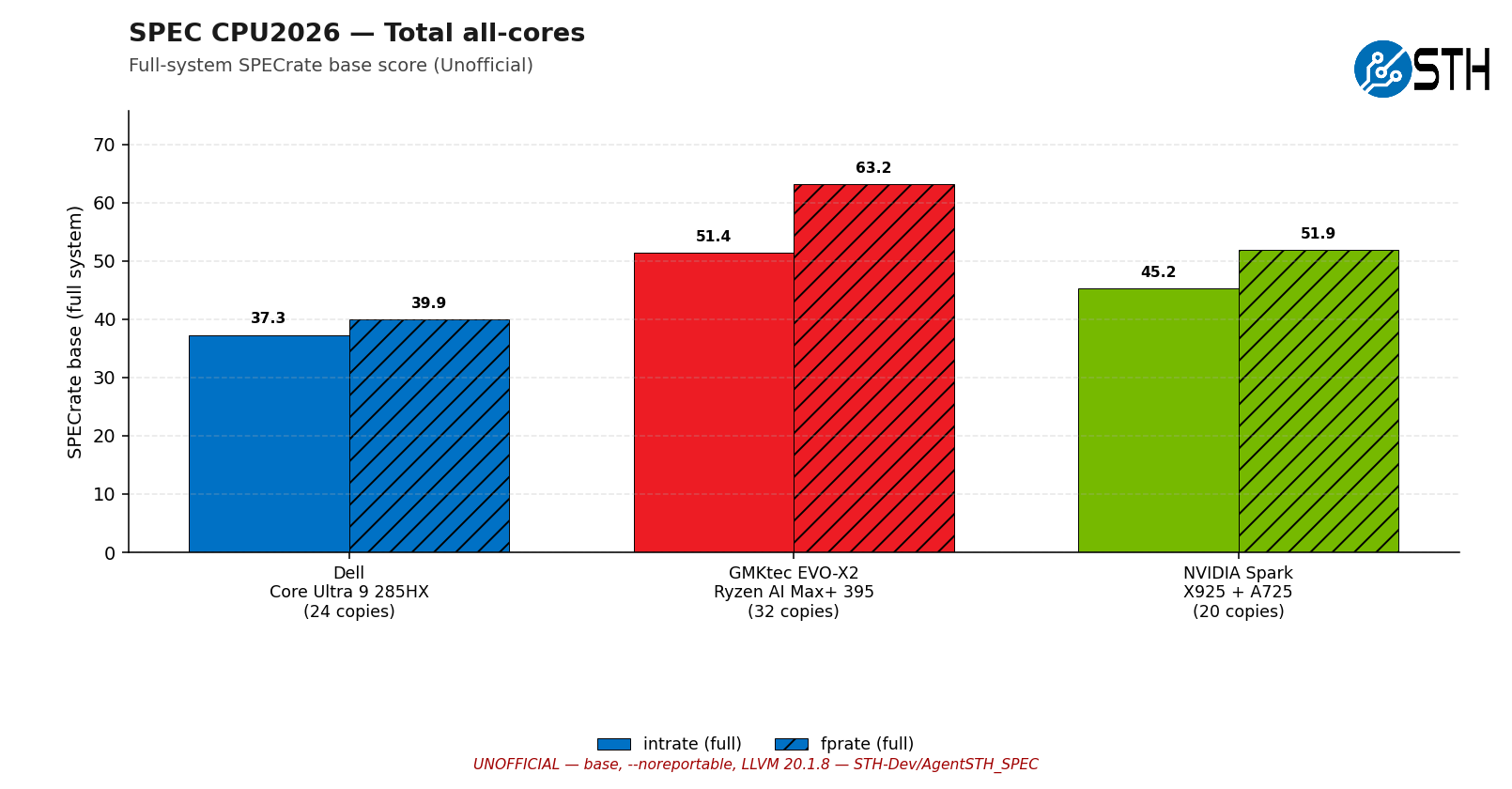
The SPEC benchmark is useful to estimate the performance of computers that will run programs that are not optimized for their specific architecture.
The Ryzen was already faster in SPEC, but when running programs that use AVX-512 the difference in speed between the Ryzen CPU and this NVIDIA/Mediatek CPU will be much greater than in the SPEC benchmark.
So it's probably Intel
Nevermind, it's totally this chip/board.
https://www.techtimes.com/articles/317428/20260530/nvidia-ar...
Cortex-X925 and Cortex-A725
What's the actual connectivity? USB4? with or without PCIe tunneling? How many ports?
How much is it going to weigh? Battery life? Battery capacity?
DGX Spark desktops idle close to 20w on Linux: that's a lot for a laptop. I'm expecting Nvidia+Microsoft stepped up their driver game some for this release, but it's wild how few creature comforts or nicities DGX Spark came with. Launched with and still has almost no power monitoring or power management capabilities. If you turn on the highspeed NIC it turns into a 40W hotbox even at idle. Nvidia has such a weird mix of supporting what they want to support well, but doing absolutely nothing else. The way Shield TV is still occasionally getting some updates is impressive for example, but it's stayed on an ancient Android version & went a good fraction of a decade without update. Similarly, keeping folks locked on rickety old Linux4Tegra and now DGX Spark heavily modified Linux OSes has been brutal. It's hard to believe this system is going to be much better than a fantastically expensive bag of barely managed idiosyncratic quirks.
There is something about Microsoft's reverse Midas touch.
We use newer Surface laptops at work, even the artists, developers, and executives (note we are not a tech company). The laptops aren't very fast but they can take a lot of physical abuse and the batteries last all day. We don't need the top of the line, and forcing our developers to use lower powered computers actually improves the quality of the apps because they get to experience how our apps work for most of our customers and take performance into account from the beginning.
aaaaand... scene!
No thank you, and goodbye
There's companies out there still handing out cheap 8GB Dells with 1080p screens.
My lie detector is going off.
> The containment features sandbox local agents like Hermes and OpenClaw so they cannot interfere with your core operating system.
Wait, isn't that kind of the point of using local agents like OpenClaw? I thought people wanted the agents accessing all kinds of applications, files, etc.?
> Legacy application compatibility is equally crucial. Microsoft optimized the Prism emulation layer specifically for the new microarchitecture. Prism utilizes the raw power of the silicon and recent AVX and AVX2 instruction set extensions to run older x86 applications smoothly under emulation.
Okay, this is pretty nice. I'll give Microsoft credit for this one. It might save my company a lot of heartache one day in the near future.
All in all, this rig is going to be quite expensive. In a lot of ways, it probably is better than a MacBook Pro. However, as a diehard Apple fanboy, it is not enough for me to consider the jump.
I'm glad the PC industry is hopefully waking up, finally. I'd like to see some good hardware with Linux support. That's all I've wanted, a macbook pro experience on Linux.
A slightly more sober announcement is available at https://news.ycombinator.com/item?id=48352627.
We need and want an open, modular architecture, and currently it's not ARM, it's x86/64. Because I can't go buy CPU retail and replace it at home.
Edit: oh cool, CPU is MediaTek. No-no, I would stay as far as possible from it.
Thank you, but no, thanks.