
It's a very cool and ambitious project, but there's fundamentally nothing substantial to it in terms of gameplay. It still feels to me, a decade later, more like a very very impressive tech demo than a video game
https://www.challies.com/articles/no-mans-sky-and-10000-bowl...
Ubisfot is a perfect example, look at their "Watch Dogs: Legion" for example. They decided to get creative and give you random characters generated by AI.. it turned out to be a disaster.
Another one is their Far cry games, where they copy and paste the same events but slightly different, all over the map and call it a day.
I think these efforts more have to do with bean counters taking over the industry than game designers being lazy. I'm sure there are plenty of talented people working at these studios, but they are held back by MBAs.
That purposefully designed settings and properly gated procedures can make procedurally generated realities…better? More fun?
Clutch Nixon is the only thing good thing about the last few games.
I've bounced off NMS several times, despite having tried quite hard to get into it. So, my take is based on ~20 hours of early game, from 2025ish. Probably the best parallel I can draw is to Elite: Dangerous, which I played for several hundred ours before getting bored of it. What I find lacking in both games is that there's no _meaningful_ emergent gameplay that spawns off the procgen. Everything is wildy different on each planet, yet very same-y, because none of the differences really play into each other. In both, one can discover random biomes and creatures, but it's not like they are inherently interesting, they are mostly just following the same scripts.
Contrast this with something like Dwarf Fortress, which takes a slightly more in-depth approach to procgen, one where things have history, and in many ways, things "make sense". Or Rimworld, where the game tries its hardest to conjure up a narrative for you, dynamically, but still in a sandbox. So, basically, NMS is a perfectly functional sandbox game, and I have huge respect for them for keeping on working at it for so many years. However, it doesn't scratch my "hardcore simulation / mastery" itch, and so far I haven't been grabbed by any of its story generation. It just felt like a long series of fetch quests and "collect them all" games.
That's basically it. It's not a simulation. So if you want simulation, then NMS isn't your game. Maybe X4 might be better suited. Or maybe not.
Sometimes people forget that not everybody has to like every game :D
No Man's Sky is much more like Minecraft in that way, you have to make up your own goals, the game doesn't really prompt you in any way to do anything.
If you’re looking for a scripted arc, wrong game by construction.
I think the multiplayer aspect is a bit weaker than it could be, maybe improved more recently, but it is a something that Minecraft has done well
Obviously NMS's original marketing was bonkers and capitalised on saying technically true things in ways to mislead large numbers of people.
A little bit of depth to go with all that breadth?
I'm not saying there aren't deep systems in NMS. Its just that they are sparse. You can tool around all day having only the most cursory interactions with most of the game's systems. They've added so many interesting things, yet last time I played it felt there wasn't much of anything to do with them. For example, the Pokemon clone they added a few updates ago -- fun for five minutes. Super simple battles. However many months of development for something that got old after 5 minutes.
If the game doesn't appeal to you, then that's fine too. But overall the game fills an interesting and accessible niche beneath games like X4: Foundations and Elite Dangerous.
It's... fine? It kept me engaged until it didn't. Part of the "didn't" came about because I was being paper-cut to death by bugs that googling showed me had been reported for a long time, if not since the very beginning.
I kept feeling like it was a game on the verge of happening throughout, and it never quite made it. Lots of things to go do to serve.. no purpose. Nothing was that unique or memorable, and I often had very little clue where I was in relation to anything. At one stage I was overseeing a town but that seemed to do nothing for me other than make me go back and make a snap decision for no discernible reason, occasionally fight hostile creatures, and also act as a sink for resources I was gathering.
I kept thinking "Why am I even doing this" until it really sunk in "Why am I even doing this?" and quit.
It also exasperated me that even though I was using a pretty fast gaming system, on a regular basis assets would take ages to appear, including buildings. "Fly to this place on the planet, land at this archaeological dig, wait 3 minutes for the dig to bother to appear before you can do anything." (saw identical behaviour on my steamdeck too, so doesn't seem "my machine" per se?)
This was also one of many gripes I had with Starfield.
It's always a potential danger to one's enjoyment to know too much about something though. :)
Adds persistent asteroid belts, asteroid mining, and base building on asteroids
Go wild
Modded Minecraft is a very different beast, depending on the mods
It's pretty cool to see what modders have done with it over the years. I genuinely think Minecraft + Create is the best factory game.
Of course, introducing mods makes Minecraft the most compelling entry in the genre by a huge margin, but not necessarily a fair comparison since the combined human effort involved in the minecraft mod ecosystem vastly eclipses what the NMS team could do on their own.
This is also the problem with the procedurally generated planets and moons in Starfield. Yeah, there's a whole lot of them, but they're also all populated with the SAME points of interest. You can only see a cryo lab or abandoned radio station so many times before it completely loses any meaning. It's basically the antithesis of the hand crafted world of Skyrim.
It's done so badly that you get points of interest spawning with outdoor food and beverage, folding chairs, umbrellas in icy moons that have no atmosphere and -200C temperature.
The alien creatures in Starfield were at least all designed by hand, and are somehow 'assigned' to specific planets and biomes in a way that's hard coded into the game.
Eh with a planetary cluster of that scale they have little choice. And Proc Gen is also in Bethesdas history, its how they built Arena and Daggerfall IIRC.
My issue isnt that you can see the same base on every planet, my issue is largely that when you have reached a sufficiently high level, most planets will be absolutely plastered with pirate bases. The universe goes from empty to full of RNG pirates and mercenaries so damn quickly. They really needed to create more unique encounters, but less of each kind, and spread them out a lot further.
Dwarf fortress or rim world solves that by generating personalities.
Compare it to even our own solar system where even so much as a new high-res photo of the hexagon storm on Saturn comes with stunning new and specific detail, or the "heart" on Pluto, we're practically ambushed with novel configurations of atmospheric dynamics and geology. It's frustratingly rare for games to truly activate that feeling of wonder.
I think NMS is still an unbeatable deal for what it is as a game but it's a frustrating near miss flyby of what I think people want a true space exploration game to feel like.
For example there might be a wormhole that takes you to a different destination if you fly through it backwards. You're very unlikely to find that out by chance, but if you explore you'll find a thing that tells you (probably behind some other puzzle).
Great game.
I'm not saying ending was perfect, but I can't think of a better way of ending it.
The game is 2 million light years wide, but a meter deep.
There's the Kerbal Space Program approach, where space exploration is tough and you need to learn a LOT to succeed at it. The tradeoff of this is a high sense of accomplishment, where simply landing and returning from another body feels like you did something incredible.
There's also the Outer Wilds approach, where the story carries it. Moving around isn't hard at all, but you have specific goals to accomplish that move you towards a final ending. Diversity in how you accomplish those goals makes it feel fresh.
Mass Effect is similar, where you have some freedom to explore, but it's again in the pursuit of this broader story. So exploration feels like a rich side quest more than the main point of the task.
Or alternatively Scavengers Reign
Personally I want spelljammer. Baldurs Gate meets Sea of Thieves in space with 80s killer clowns
There is so much drama that can happen there and the scale is the least of it.
The creatures, vehicles, and buildings weren't generated -- they were created by other players and exchanged asynchronously, then seeded into your procedurally generated galaxy.
Spore is a Massively Single Player Online Game: no real-time multiplayer, but your galaxy fills with other people's content.
That's the opposite of the oatmeal problem. Procgen gives you infinite bowls that all taste the same. Spore gave you a finite but large set of bowls, each made by someone who cared about it. Different tradeoff, different failure mode -- but not the one this thread is about.
GDC 2005, Will Wright, The Future Of Content:
https://www.youtube.com/watch?v=N4ScRG_reIw
>[...] Also I want to apologize for the title of this talk in the description, which I know was kind of hopelessly vague.
>What usually happens every year is GDC, they call me up, and they say "we want you to do a talk" and I say okay, and then a week later they say "what's your talk about" and so then I think about it for a while and oh, get a rough idea of what I'm going to talk about, and I give them some kind of generic title in that area.
>That's what usually happens. But this year was different. This year when they asked me what I was going to talk about, I just flat out lied.
>But, so I'm not really going to talk about the future of content. I'm really more in fact going to talk about a possible future of content you know.
>It seems like the theme that I'm coming away from this conference with so far is that the next generation titles are going to be incredibly expensive, we're going to have to build mountains of content, and it's going to drive most of the smaller players out of the market.
>And I'd like to offer potentially an alternate vision of that. You know I think that there is a way to deal with that more creatively. So maybe a more accurate title for this talk would be "What I learned about content from The Sims".
That was 21 years ago. The same argument is being made again right now, with a different machine offered as the answer, and Will's alternative is still the one nobody is trying.
Will's advice for game designers and creative humans in general, from my notes on the talk:
>If you have a weird idea that's so outside of the box, don't forget it. You should go back and revisit your weird ideas later, because you can never know where they might lead to.
In February 2007 PopSci, Will explains the whole design rationale:
https://www.popsci.com/entertainment-gaming/article/2007-02/...
>We thought about it. In fact, technically, based on all the stuff we've already done for it, it wouldn't be very hard at all. We've already solved all the hard problems we would need to do a persistent online world version of Spore. The hard part is, what happens when you come to a planet and the planet's offline? Which would be the case. In fact, one of the reasons why I kind of went down this path is that nobody has really explored the hybrid model. And this really is a hybrid, it's what we call a massively single-player game, where we try to get the benefits of an online game, which is all the people building the world collectively together, without the liabilities, which is that the 14-year-old can kill you or that you've invested all this time in your planet and somebody comes along and blows it up, and therefore you had to put everybody on the same level treadmill. And I hate these level treadmill games, and I wanted the players to feel really empowered.
GDC 2005 Report: The Future of Content
https://www.gamedeveloper.com/design/gdc-2005-report-the-fut...
I posted more details on the Spore Stats discussion in 2023:
https://news.ycombinator.com/item?id=36280275
>Here are my notes and summary of the GDC 2005 talk where Will Wright first revealed Spore, which I asked Will to review and check for accuracy. It's interesting to compare the design he described in the talk with what Maxis eventually shipped. Video of the hour long talk:
https://www.youtube.com/watch?v=N4ScRG_reIw
>One of the essential problems with designing a Massively Multi Player Online Game like Spore is that players at different levels of the simulation run at different time scales.
>Maintaining time synchronization between players is also the reason The Sims Online doesn't have a "Pause" button or speed controls, or automatically pause in build and buy mode, like The Sims.
>So instead, Spore is a Massively Single Player Online Game. Users don't interact with each other in real time, but instead users can create their own content, and it exchanges that content between users asynchronously.
>That's also how The Sims Exchange lets players asynchronously upload and download their Sims save files along with web pages describing their house, sims, and photo album.
https://donhopkins.medium.com/the-future-of-content-will-wri...
>The Future of Content — Will Wright’s Spore Demo at GDC 3/11/2005
>What I learned about content from the Sims. …and why it’s driven me to procedural methods. …And what I now plan to do with them. Talk by Will Wright, Game Developers Conference, 3/11/2005.
>Based on notes taken by Don Hopkins at the talk, and other discussions and review by Will Wright. The title of the talk “The Future of Content” was purposefully vague, because Will wanted to show Spore in public for the first time, but he had to flat out lie about the title and send a fake set of slides for the EA executives to review, so they didn’t know what he was about to do. A more accurate title for the talk would be “What I Learned About Content from The Sims, and Why it’s Driven Me to Procedural Methods, and What I Now Plan to Do With Them”. [...]
>Wired asked for an illustration to print in the magazine, anything he wanted. So he made a diagram of Spore that Wired published, but he didn’t tell them what it was. The design docs for Spore have been out in Wired Magazine for a year now. (It’s in the Feb 2004 issue of Wired.)
>Will’s Secret Diagram of Spore published in February 2004 Wired:
https://donhopkins.com/home/WiredSporeDiagram.jpg
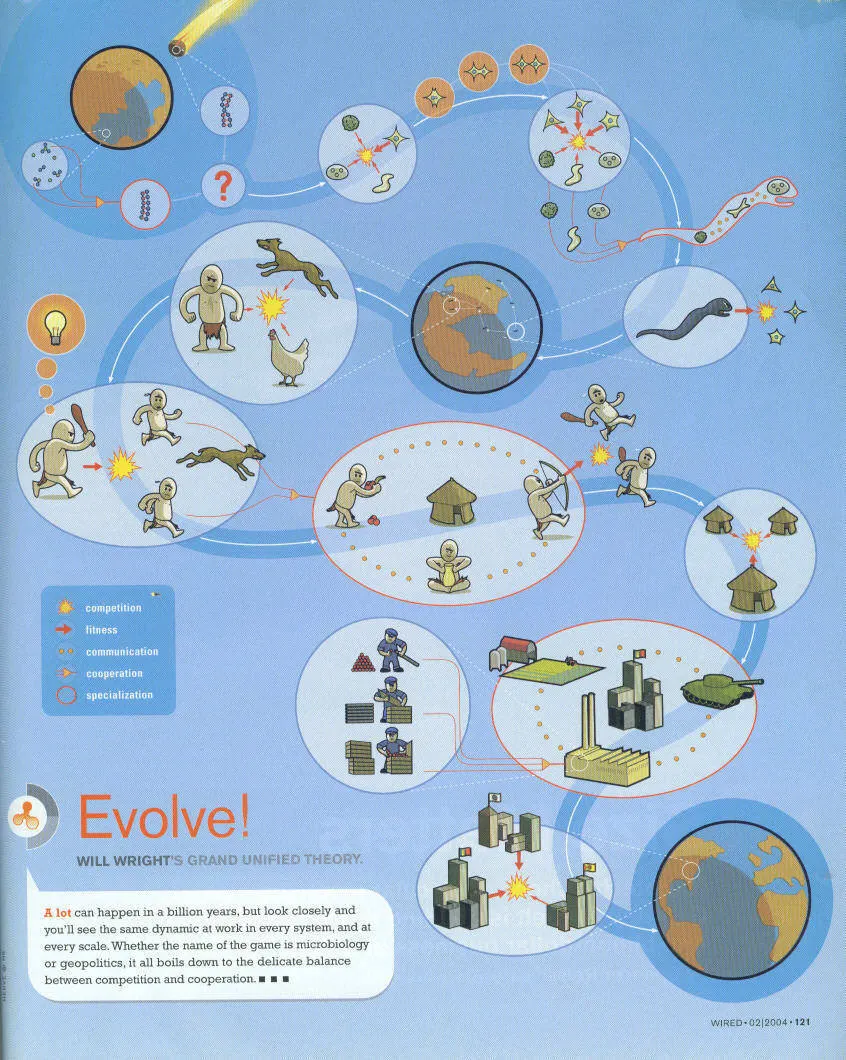
[...]
https://news.ycombinator.com/item?id=36280831
>And that is the whole point, how you win the game: become involved with the content creation community!
>The powerful but easy to use direct manipulation editor tools, the automatic content sharing system, and the online community around user created content, were together the most innovative and successful things about Spore. (As contrasted with the not as well realized gameplay and storytelling design goals.) [...]
>Chaim Gingold, A Brief History of Spore:
http://www.levitylab.com/blog/2011/02/brief-history-of-spore...
>Creativity
>Of course, these aren’t any old aliens we ask players to invest in — they’re your creation, your aliens. Once you start customizing, and design your creature, emotional investment is generated. It’s magic. Even the ugly ones are loved by their parents. Many games thrive on the interest generated by players’ creative investment. Console role playing games, for example, get this effect when players invest time in equipping and naming characters. I’ve always felt more attached to my characters as I fuss over their outfits and equipment. Creative interaction seems to always generate emotional involvement and attachment. Psychologically, it would seem that part of this stems from the sunk cost fallacy — we become attached to things we’ve invested time and energy into. Of course, it’s not just the hundreds of hours invested in a World of Warcraft character, their relationships, and possessions that generate attachment, it’s the sense that our fabrications are extensions of ourselves. As recipients of our attention and creative energy, our handiworks are reflections of who we are, tangible manifestations of our personalities. It’s no wonder we become attached to what we make, and take the success or failure of our own work and ideas very personally.
>Spore neatly solves the alien attachment problem by asking the player to design them. If a player makes a creature, and it’s appealing, they’ll be quite invested in it. Reflecting on the success of The Sims Exchange, where players shared stories, characters, houses, and objects for The Sims, Will realized that shared creativity would give Spore a broader appeal. Why not build creative exchange into the game, rather than as a website that orbits it? Player created assets are constantly being uploaded and downloaded by Spore, enough material to fill a galaxy. There’s nothing like taking home your latest finger painting, and having mom hang it on the fridge for everyone to see. Sharing not only fills up the galaxy with cool stuff, but allows the entire world to see your fridge, motivating you to continue creating.
>Of course, a lot of deep magic must work properly for something like Spore’s creature creator to function properly. It must be natural to use, easily producing satisfying results for anyone, from beginners to advanced users. And these aliens, lumps of polygons that no animator has ever seen before, must be brought to life. These are rather complicated endeavors, from a design, aesthetic, and technical point of view, but the player should never notice any of it. The game design implications are also challenging — the game must be playable and interesting, regardless of the creatures dropped into it.
But the models are fun, sure. And other people can find your models, and you can find theirs.
So if we recognize that the "gameplay" part of Spore never worked... we're left with Second Life, a much, much older thing. It hasn't been much of a success.
No Man's Sky suffers from planets being "deserts", they have different attributes but it's still a fairly lifeless empty world.
Ironically this is realistic but also not terribly fun as a player.
The worst thing I can say about it is that it tries to be everything for everyone, and is relentlessly friendly - all the new mechanics are very forgiving, very optional and (from what I've seen) rather easy. But there is sort of an in game story explanation for why it sometimes feels more like Stardew valley than a space exploration game.
That and the trailer was very different than the released game.
They apologized IIRC and then continued to work on it for like a decade - adding multiplayer and many large changes to the game
   > you must ask yourself a single tough question:
   > How much do you value technological wonder over everyday, solid, smart game design?
It probably won't be as good as an artful human designer hand-crafting a world, but it can be better than something overly random and blandly uniform in distribution.
As an example in No Man's Sky the player immediately starts with a jetpack. It makes it so the terrain is approached the same way every time: you just jetpack over it. Very rarely something is tall enough to require you to walk around.
Legend of Zelda: Breath of the Wild is a positive counter example. You have stamina so you're constantly thinking about the height of cliff faces, you can glide so you're thinking about height points and straight lines through the world, cliff faces cannot be climbed in rain so you think about the weather, slopes can be slid down on a shield, etc. There are a bunch of systems that may you think about the topology of the terrain, so even just varying the height map becomes interesting.
Similarly in No Man's Sky there are different resources but they work the same way on each planet and the player interacts with them pretty much the same way everywhere.
When I say elements should be "understandable" what I mean is that a trap, which Dwarf Fortress falls into, is to add a vast simulation which the player feels they can never really grasp. Simulations should not be a black box because then they begin to feel like a random number generator.
The aim shouldn't be to make an "infinite" game but to make a very interesting system for the player to slowly understand and master. The developer shouldn't just add stuff, but they should think about the long journey (and eventual mastery) a player might take as they spend significant time with the systems.
Weird question: do you have any tips on how one might apply these principles to a semi-stochastic synth plugin for musicians?
(I have several ideas, but I'd be curious to hear yours, independently.)
If you don’t already have a fun game, then pro gen won’t make it any more fun than it already is. It turns a fun 1-hour game into a much longer fun game.
If every single Minecraft player loaded into only a single Minecraft world, it would still be as fun as it is. Would No Man’s Sky really be that much different if it just shipped with a handful of pre-defined planets? It might have less replay value but the gameplay wouldn’t be any different.
Good proc gen changes things in your game such that the player is given interesting reasons to make different choices each time they play.
First procgen game I ever played was Starflight 2. (Pre-Internet era, so I couldn't get hold of Starflight 1. SF 2 spoils you, hard, on the major spoiler in SF 1, so if you're playing them from GOG or other sources then you should definitely play 1 before 2).
My ten-year-old mind was boggled. Hundreds of star systems, each one with several planets (usually), and you could land on each one? And explore the whole planet (in a very limited top-down 2D view, because this was the 1980's), harvesting minerals, and the map was quite a bit larger than what would fit on one screen? And it all fit onto one 720K floppy disk?!??!?
Now, of course, I know how they did it. But there was an actual game there. There were half-a-dozen alien races you could interact with (talk or shoot, as required), and there was an actual story. With a twist at the end that 40-year-old me would see coming, but 10-year-old me was shocked and amazed by. (And the twist in SF 2 wasn't even as good as the one in SF 1). And you progressed that story by following the gameplay loop:
    - Fly around looking for planets with valuable minerals
    - Land, scoop up what you can carry, fly home to sell them
    - Gradually increase your ship's capabilities
    - Collect plot-important artifacts, fly home to get them researched
    - Research tells you "go talk to these aliens".
    - Do a fetch quest so they like you, then talk to them.
    - They tell you where to go to kick off the next plot point.
    - Find out where the Big Bad's home base is
    - Find out where the MacGuffin is that lets you access that location
    - Take MacGuffin to right place, fight Big Bad, save the day.
And they timed it well: the core harvest-resources-and-upgrade-the-ship loop didn't have time to get boring before you were off to collect plot coupons. And there weren't too many plot coupons before it was time to find the MacGuffin, use it to beat the Big Bad, and save the day.
Star Control 2 did it really, really well, with better graphics since it was released a few years later. BTW, if you haven't played SC 2, search for "The Ur-Quan Masters" to download and play a totally free, legitimate, open-source version of the game, with full original assets since the copyright reverted back to the original creators who released it into the public domain for the UQM project to port to modern machines. I wish that had happened to all the old classics, but Star Control 2 is truly a good game. Definitely seek out The Ur-Quan Masters.
But before you do that, I would strongly recommend to play Starflight 1 and Starflight 2, to get a feel for the origins of the procgen-with-good-story genre that Star Control 2 did so very well.
P.S. Edited the "core gameplay loop" paragraph to better make it clear there were two or three loops, and you progressed forward through them, rarely having to go backwards.
1) is the really hard part, I think: it's a challenge to come up with enough meaningful variations that also work from a gameplay point of view.
I think the opposite. The more dimensions you have, the more "invalid space" there should be. Otherwise you end up with giant dinosaurs with tiny feet and fairy wings. You end up with a yellow kitchen with a barrel full of arrows next to a blue dungeon with a giant dresser. You end up with nothing making sense, and everything feeling random in the same way. Trying to spot the differences between 100100111101011110110001001011101 and 1101101110111010000100111001011101 is exactly the "bowl of oatmeal" problem. The vast majority of possible combinations of values should be invalid and impossible, otherwise the choices actually don't matter.
This I think is a core challenge with procedural generation. You can have procgen countries with procgen cities with procgen citizens, but if none of those citizens have an aunt in another city - who you can actually visit, in a new world from the same seed, and learn that she has a nephew in the first city - then it feels empty, fake.
Hierarchial procgen is easy. But you need cross-interactions like that to make it feel alive, and that's hard.
These are games painting with a 16 color palette while the technology exists for any shade in RGB. The more variations, the less likely things will be coherent (let alone brilliant)
Spelunky uses handcrafted chunks that are connected together like a puzzle. Each generation feels interesting because each chunk is interesting and they are just strung together into a unique maze.
Terraria does a similar thing, where all the things that matter are hand-crafted. Bosses, items, layer details, progression. The map and cave system is generated but the caves tend to string together hand-crafted experiences and hand-crafted monsters. Many areas are generated, but in a unique style for variety. And there was still a fixed progression in the background (ore and boss progression). I think its in a big contrast to a similar game like Starbound, where all the weapons and creatures and maps were procgen at first, and it felt very '10000 bowls of oatmeal'. Terraria vs Starbound is the most like-for-like comparison I've seen for "procgen done right vs wrong"
The actual geography doesn't vary that wildly most of the time ( if you've seen one lightly forested river valley, you've seen them all), but players generate a relatively low number of worlds, and in each world probably only see a handful of sites, where dwarf-scale world gen actually matters. Unlike NMS, though, the details of world gen matter to gameplay a lot. Trade caravans and invading armies can't traverse mountain ranges and ocean, so a mountainous peninsula can be extremely isolated. At the site level, you'll probably want to design your fortress to take advantage of local geography to help fortify your fortress and provide resources, so terrain and features like rivers, volcanoes, etc. placement matters a lot.
In contrast, No Man's Sky world gen feels pretty tangent to the actual gameplay. The game does a good enough job incentivizing you to explore lots of planets, but in terms of the survival/base-building aspects, there's a pretty short list of resources that matter to deciding where to setup, and geography hardly matters in terms of how you build.
1. Any imaginary world needs to be internally consistent to be interesting. Procgen does not void this rule; randomization needs to be gated to that internal consistency.
2. A world can be composed of multiple environments, and each environment can a different definition of internal consistency. Dungeon Crawl Stone Soup does this very openly and to fairly good effect, but pretty much any decent procgen game will inevitably end up with the same choice, because it's what enables you to play with various procgen systems/rules while still having a coherent overall game.
3. Generalizing 2, procgen systems generally do not start from nothing; You embed reasonably well-defined bases (races, weapon forms, etc) and then apply randomization on top of those bases to form the final element. Meaningful fundamental variation in those bases leads to guaranteed meaningful variation in the end result.
4. Games are fundamentally interactive systems. Generating a thousand variations without actually changing interaction is equivalent to generating exactly one variation. A blue orc vs a red orc is a not real variant, unless you make it so by attaching effects / statuses / capabilities. The color distinction is then a signal into the more abstracted changes that have occurred. This is where NMS falls over -- the images have changed, but the interaction has not.
5. A corollary to point 4, changing numbers without changing interaction is equivalent to doing nothing. If a meaningful damage threshold is functionally every 10 points of damage, then generating numbers 0-9, 11-19, etc is equivalent to generating just the numbers 0 and 10. This is where borderlands falls over -- a million variations in guns, but the vast majority of those variations are just numeric differences that don't change anything in practice.
6. If the procgen applies to equipment/builds, you pretty much need permadeath as a driver for exploring a procgen game and its systems, because you need players to explore for a local optima. Exploring the space for a global optima in a procgen game inevitably devolves into a gambling simulator, because players optimize out the fun, and the optimal play is to the kill unit XYZ repeatedly for the 0.5% drop. Games like Terraria fall into this trap (though Terraria resolves it mostly by making unit XYZ be trivially summon-able bosses)
7. Procgen can never guarantee interesting results; You inevitably need a system of vaults/artifacts -- hardcoded quality items -- to guarantee periodic interesting locations/items. Ideally more notable than average generation, but less than strictly optimal so as to not overpower the other systems -- an issue I've had with games like Diablo 3, where finding an item-set was vastly more powerful than anything else that I acquired for the next 5+ hours, eliminating the entire looting system (and even character skill system, since it forced my build too)
8. Decent Procgen is inevitably rule-based, with possibly multiple chained-rules each doing their own rolls, to ensure coherency. Ideally the rule-chain is roughly discoverable from the end results (by virtue of following internally consistent and apparent rules) -- an end-result that cannot be explained is indistinguishable from pure-random, and pure-random in incoherent. See any Tabletop RPG generation tables.
9. Hell, just start any procgen design from tabletop RPG tables.
10. The number of variations that can be produced is meaningless. This is only for marketing.
11. A procedural system that generates exactly once is fairly pointless. Permadeath.
12. A procedural system is inherently unfair, because you cannot guarantee difficulty, proper placement, unit composition, etc without removing the procedural systems outright. Embrace the unfairness, and design around it. Permadeath.
13. A procedural system is inherently unfair; you need to give some guaranteed items with guaranteed results to navigate an uncertain world (e.g. escape tools).
14. It's always good to enable some control by the player over the procedural generation. Choice of environments, chances at additional loot, etc. You want the player to engage with procgen rules, because they're interesting (and if they're not, what are you doing?), and the easiest way is to give them tools to manipulate it to their advantage. Also permadeath.
After generating the level structure, emplace an entrance and exit such that they are maximally apart. And emplace a strong monster in one of the rooms around the exit. And emplace a health potion in one room before the strong monster. And emplace treasure in the exit room.
That sort of stuff and be specialized and coded towards your particular games structures fairly easily.
Scale is much harder though. In something like NMS it’d be intensive doing such a constraint solver on the whole galaxy. Might work in chunks or regions though.
Obviously people have high consistent wins in StS1/2 so it’s not like they’re guaranteed unwinnable, but for the average human (mostly just boils down to “path to do act1 elites until after you probably have a counter to all of them)
Your options are:
1. All scenarios are easy enough that you can get away with just about anything sensible
2. You don’t have any counter mechanics, which is basically the same as 1, and is difficult to do anything interesting with
3. You announce up-front what you’re going to deal with, so the onus is now on the player to find a solution in the meantime
4. You give the player a NOPE utility
In a roguelike, I think 4 is the better design, but 3 is also reasonable. 1 & 2 just makes things less interesting.
The fanboy started saying how they could have endless different levels in Destiny 2... which is absurdly off-base since the entire game is just running through the same 9 sandboxes and 12 raids over and over and over again
He then went on to talk about AI creating an album as perfect as OK Computer on-demand, which was gently putdown by Kirk (who is an exceptional musician but also chill enough to suffer fools)
In my own procedural explorations, the solution to the 10,000 bowls of oatmeal problem is to manually curate them and give the user only the exceptionally good ones. It's a tedious lot of work.
Why doesn't this apply to Minecraft? People love Minecraft even though it's equally purposeless and arguably bland and empty.
In No Man's Sky I got dropped in some world that felt empty with tutorial on how to collect some stuff and how to get to the ship.
The first impressions weren't the same between these 2 games.
But, once you've exhausted those human stories, it's like wandering around a few billion abandoned malls. Interesting the first few times, but grows boring pretty fast. But also, the worst thing about the human-written stories is that they're often transparently designed around getting you to visit more abandoned malls. The procgen infinity of space is almost a negative, even though it's the game's whole schtick.
I guess now that I think of it like that, it's really impressive they made a fun game despite having to make it fit a boring repetitive universe.
In short, I found it a very fun game until it wasn't, and then I had no reason to log back in. There are things you can do to make your own fun outside the story line; grind for a better freighter, find an build on interesting/valuable planets, find the coolest ships.
Once the story ran out, I was pretty much done, but even if you just play the story and then quit, it's still an excellent value! I got many hours of enjoyment out of a game I paid maybe $20 for. It's a hell of an entertainment deal. I recommend it to anyone who hasn't played it all the way through in recent-ish times. Even if you only play the story out one time and don't find any of the other stuff fun, it's still a very enjoyable game with hours of fun play at a good price that runs well on any decent system.
If I were a designer on the game, I'd find more reasons for human players to be in the same places at the same time and have their actions have a lasting impact in the universe. Riding in someone else's ship (which is what corvettes added) aint it, though. Projects to colonize specific worlds where anyone can stake a claim in a landrush type thing and maybe you setup competitive trade networks or battle for terrain or strategic resources or whatever, would be super fun, I think.
And, I wish space battles were more skill-based, as well. I've never played Eve, but I assume the space battles require skill and strategy and not just the biggest/baddest ship? So, if NMS got really good space battle mechanics, they could implement crazy cool space wars. But, they've got to shrink the game world for that to work (not literally delete the billions of planets, just give players a reason to all fight over one planet or system). Maybe competing for unique resources, like the spice on Dune.
I'll definitely try to find time to log back in and check out the new stuff. Whether it keeps me coming back after I try out all the new stuff and run whatever new missions/stories they've introduced remains to be seen. But, I don't think anyone plays it for the "billions of worlds" thing, because they're all the same after you see the first couple dozen.
Ironically, that’s how I always imagined actual space exploration to turn out once the initial wonders are exhausted.
Space is huge, yes, and everything is kinda unique, but also not in a meaningful sense. Most of the continued amazement we associate with the idea of space exploration comes from human-written stories that fill space with a human variety that just isn’t there.
> Morty: it's boring. crank up the realism slider to max
> Rick: why does it get even more empty? Wait, I got it... because the universe is empty.
At the end, I think there is little point in simulating the vastness of the universe in a video game (even just a fraction of it).
Early game you don't have enough resources to travel quickly through the solar system you start in, nevermind between systems, it takes time. It gives a real impression of scale and wonder imo. You have to plan taking the scale into account - and it's nowhere near realistic. They got a good balance there.
"I have never thought to myself that realism is fun" - Gabe NewellFly out of SeaTac or Chicago O'Hare in most flight sims at sunrise, and you'll get a richly detailed airport, realistic traffic, realistic surrounding terrain, etc. with hopefully jaw-dropping views.
Pick a random airport at a random time with an obscure name or location in the US Midwest, and they all start to look the same (even with detailed, realistic geography): a mostly flat expanse with some hills, and either just the local city lights (if that) or a dull mid-day sun.
To be fair, those checklists are also largely there for so many pilots and those in training whom want to get the experience.
It's a sandbox game yet when it comes to its "space" premise everything is thrown out the window. Dogfights carry no difficulty or skill. Flying around a system is pretty much pointless other than to stumble upon quests (100% RNG). Most of the fun you'll get at planet surface.
You've been hanging out with Claude too much :)
The first one was dogfighting in space, all the others were so. much. space.
I found a barren planet in a black hole system where the vibe was all dark and shadowy with the light being tinted purple, and just some crystals or something on the surface, alongside a damaged robot that you could interact with.
There was also a world that had high Sentinel activity where I founded a settlement (well, more like took over managing it), however as it turns out it’d have those gravity storms often during which you could soar through the air.
There was also a world where the surface was toxic and you couldn’t stay on it for long, so I excavated a base underground, like something out of Red Faction.
For what it’s worth, a lot of it can feel samey (most of the scanning) and kinda boring, but while there aren’t that many insanely huge and cinematic moments, sometimes RNG hits just right and you get something nice.
The game is also too unrealistic for me: the planets are too close, you shoot asteroids just like you could 47 years ago, you can't dig very deep at all, your ship follow you wherever you jump to.
The trailer was beautiful, the actual game is really nice for a short while, but it's too simplistic and repetitive.
Wildlife for example you can train as pets, mounts or milk/harvest.
Once you get access to the Space anomaly the game opens up more and if you are social you will find outposts, pet arenas, race tracks and dog fighting/pvp zones. Ship building and freighters.
The latest update appears to allow groups to control areas of space.
All games eventually get boring but there is plenty in now.
Outposts sound cool. I assume they aren’t just all the same thing. What do they offer? I’m sure it won’t be something I look at for 5 minutes and think ‘yeah this is neat’ and then realise there’s nothing deeper than that, right?
Ship building and freighters sound cool. I’m sure I’ll be motivated to do that because my stock ship is really holding me back. Oh wait, combat is a joke and I can perma farm max bounties playing with my toes with my default shop I bought on max difficulty/permadeath.
Pet fighting? What’s the point of that?
The planet variety is disappointing. And the prefab 'locations of interest' get really, really boring.
But, I admit I may have to fire it up if what I get to explore is player generated now. And if they're actually making some locations more lucrative for either the resources or what's available to actually process them, I would at least want to check it out.
That, and I totally want a base on an asteroid.
And maybe it has, but the first 60 minutes of the game still feel like enough of a slog that I have yet to get to any of the good stuff.
I say this because I feel the same thing as you when I go back, and I really want to like it.
Space operas are closer to fantasy than hard science fiction: they are about extraordinary people and their extraordinary interactions, you aren't supposed to think hard about the physics.
Procedural generation, on the other hand, is all about emergent behavior, which is closer to hard science fiction: tweak the rules and see what happens. You have to build some deep core physics that are robust, make all the other systems interact in sensible ways over a wide range of conditions, and not worry when balance goes completely off the rails in some cases (in fact, that's the fun part).
No man's sky is a space opera. You could imagine it being hard science fiction: digging into the ground could be deadly (as opposed to a reliable shelter), water / atmosphere mechanics could change (as opposed to just... water and air), gravity could have a much greater range, resource concentrations could vary more, etc. You'd need some mechanics updates to avoid making this frustrating, but maybe not so many as you need to keep the space-opera plot moving.
All procedural games feel like this to me at least. I've been playing Diablo / POE recently. Same deal, once you're at the endgame - the goal just becomes bigger numbers. The maps have different themes, the monsters are different, but you sorta just look past that part as you're gathering generated gear with bigger numbers. It's why I typically get about 10% into the endgame and eventually stop playing.
Minecraft is also a decent example, at some point you stop exploring, build a base and focus on the progression rather than seeing what the system generates in the next biome.
There's a fixed set of biomes and notable geographical features designed by the devs, so there's no incentive to keep finding unseen ones, but each world gets its own layout and landmarks, so you get to explore the details of that specific generation for days without carrying over your knowledge of the previous one.
In the long term it might get repetitive too, but it does at the same rate as one gets tired of any other game I think.
When you first start playing the game, a medium sized mountain is exciting. Then the bar raises towards more interesting features (a deep canyon or a village), and then towards really interesting features of land. Finally, you look for obscure biomes (e.g. badlands or ice spikes). By the end, you can go thousands of blocks without seeing something that feels worth exploring.
Luckily Minecraft has other aspects beyond just the exploration.
For now, all I can see is "optimization" and "system limits on numbers of unique objects for things to work at 60+ FPS".
This often takes me out of immersion in reading sci fi books. Every planet has one culture, one ruler, one major city. I know it's usually just a convenience but has the author never seen earth? Why would future human colonized planets not have hundreds of thousands of cities and competing factions?
Finding only one village on each planet is kind of laughable in the same way. The stage of human evolution where there was one village is such a tiny slice of time (if it ever even existed at all).
A good start is not to try and build an entire galaxy. Procgen that focuses on the fine detail of a relatively small world have a big leg up over these "everything generators" (i.e. think of something more on the scale of Tiny Glade or Bad North)
There are enough hand built things that you don't quickly start running into repeats, and they are just melded into the generated terrain.
This sounds like it would be a great mod for Factorio. Adds other players factories but in a dilapidated and decayed state.
I think it's due to the fact that there is a fair bit of content, but the interface drip-feeds them very slowly, combined with the difficulty of the game itself that prevents users from finding all possible ways to interact with all content.
Minecraft's procgen villages and mines are oatmeal by comparison. Oxygen Not Included generates ruined stuff, but it isn't from other players, and I've never found it interesting -- just a way of handing you some advanced objects you don't have yet. Ruins with no provenance are a loot table with extra steps.
NetHack bones files, The Sims Exchange in 2000, Spore's pollination, Drivatars, and this mod are all the same mechanism, reinvented every few years by people who don't know it has a history or a name.
It has a name. Maxis called it the Pollinated Content System, and Caryl Shaw's job title was Pollinated Content Producer. GDC 2006, "Building Community Around Pollinated Content in Spore":
https://www.gdcvault.com/play/1013402/Building-Community-Aro...
"Massively single player" names the shape of the game. "Pollination" names the mechanism, and it's the better word, because pollen goes where it's needed, carried by something that isn't the plant.
Chaim Gingold wrote: "Why not build creative exchange into the game, rather than as a website that orbits it?" The Sims made you visit a website. Spore made it invisible and automatic. That difference is most of the value, and it's the part every mod-based version of this still hasn't got.
http://www.levitylab.com/blog/2011/02/brief-history-of-spore...
Placement is the hard part, and it's the part nobody proposing these mods has thought about yet. Spore's server pulled content in as needed to keep the ecosystem balanced, and the game built a model of your taste to decide what to ask for. Will, in the February 2007 PopSci interview:
>We're basically building a model of the player's aesthetic. So if you keep picking things from the shopping catalog that are like super-cute, Disney-like, then it will start offering you and downloading more stuff that matches your aesthetic... And when it makes a request to the server it's taking that into account, so the world will slowly start to represent your aesthetic choices.
https://www.popsci.com/entertainment-gaming/article/2007-02/...
Caryl Shaw, whose actual job this was:
>I have a team that works on the server like the database schema who figure out the algorithms to do the matching so that the content that you get make sense for your game and you don't have to download hundreds and thousands of mega bytes of content. You only get the kind of stuff that makes sense for your game.
https://www.animationxpress.com/interviews/exclusive-intervi...
That one mechanism answers Avicebron's "co-evolve the ecosystems", ratelimitsteve's "geography never affects the animals", and analog8374's curation problem, all at once.
Curation comes free. Download counts rank quality better than a designer can, because thousands of people are each picking for their own taste instead of one person guessing at everyone's. The "tedious lot of work" analog8374 describes is work the community does unpaid, and does better!
Payload size is why any of this is possible. Spore creatures compressed to about 3KB; 1KB of source expanded to 5MB of content, a 5000:1 ratio. Better than that: every piece of pollinated content was a "card" -- a 30KB PNG with the game data embedded inside the image file. You could email a creature. You could post one on a forum and somebody could drag it straight into their game. The picture was the data. A decayed Factorio base or Minecraft settlement is a small diff, not a 30GB folder.
https://www.gamedeveloper.com/game-platforms/gdc-i-spore-i-p...
Why it keeps dying: the mechanism is cheap to build and expensive to maintain, and it generates no recurring revenue, so it's always first on the chopping block.
Drivatars rotted. The Sims Exchange is gone (but I'm working on solving that problem). Spore's servers are somehow still up, which I always assumed was because there's nobody left at EA who knows how to log in and turn them off.
Now that EA belongs to the Saudi Public Investment Fund (93.4%) and Jared Kushner, the failure mode I worry about isn't a forgotten password.
The PIF's chairman is Mohammed bin Salman. In 2018 his people met the Washington Post columnist Jamal Khashoggi at the Saudi consulate in Istanbul with a bone saw and a forensic pathologist who had explained the plan on tape twelve minutes before Khashoggi walked in: "After I dismember it, you will wrap the parts into plastic bags, put them in suitcases and take them out." He left the building in five suitcases and his remains have never been found. Three days later they sent the consulate car to a car wash. The Saudi government's account changed five times in three weeks; the New York Times ran it under the headline "Khashoggi's Death Is Explained by the Saudis in Five Acts (and Counting)". In 2021 the US declassified its assessment that bin Salman approved the operation. Every word of that is one search away, and reality is worse than any joke I can make about it.
So the thing I actually worry about is not Spore. Nobody is going to convene a meeting about Spore. It's The Sims. Saudi Arabia's media regulator banned Final Fantasy XVI from the kingdom in 2023 over Square Enix's "complete refusal to modify the content to suit the region", and made Roblox switch off voice and text chat and delete over 300,000 games. The Sims 4 has shipped gender-independent clothing since 2016, sexual orientation as a character setting since July 2022, and since patch 140 in January 2023, chest binders under Tops > Tanks and top surgery scars under Body > Body Scars. Go look, it's in the base game. A regime that could not tolerate one man writing newspaper columns is not going to tolerate two little cartoon women getting married in a suburban house you built for them. That content is a rounding error in EA's revenue and an existential affront to the people who now sign EA's checks, cutting it costs nothing and buys goodwill in Riyadh, and the $700 million a year in cost reductions gives them a reason to say it was about money. I am writing this down with dates and menu paths so that when it happens, nobody gets to say it wasn't foreseeable.
But I digress...
"The knowledge is lost in the depths of the netcode" is the symptom. Nobody being paid to own it is the cause.
And generative models are trained to produce the conditional average, so pointing one at the oatmeal problem gets you oatmeal faster and in greater volume. The only fix anyone has ever demonstrated is a person who cares about one specific creature.
Kate Compton says 10,000 bowls of oatmeal. Phil Hartman on SNL got there in 1989, and it was a lot more than 30,000.
Stop settling for oatmeal. There's fiber, and then there's high fiber!
Shame that it just languished to a point where I think Microsoft completely lost both interest and control over that feature, where in Horizon 6 it just gives you the exact same few driveatars every race, and somehow no one at Playground Games is interested in fixing this. At this point I strongly suspect that they literally don't know how to, the knowledge is lost in the depths of the netcode.
Iirc it used a voxel engine so would have been late 90's.
I felt like I got a lot of value out of it, and have fond memories of discovering interesting planets. I really view NMS as an artistic experience. I don't care for the gameplay loops. I played this game like an curious explorer. There are infinite planets, many feel the same but occasionally you land on something so special that no one else has ever seen.
What's interesting is that there is zero procedural generation - single world with about 20 Biome, each one with all sorts of character. Monsters are incredibly well balanced, and the sheer terror I got from the spiders (which I think are a tad OP - especially the ones that launch)_ triggered my fight-flight reflex (mostly flight) more than any other game I can recall.
The game can be played in so many different ways too - you can take the factorio/big factory build out approach and speed run that, or just spend your time exploring, or, perhaps best of all - watch hundreds of hours of Youtube Videos to get a sense of the architect aesthetic that some of the top players bring to it. Epic Tech Tree. Cute back story.
I consider it the greatest Sandbox/space game ever - I don't know if we'll ever see anything like it again.
not everyone enjoys the same kind of gameplay.
The internet historian video made me buy it, thinking it was maybe worth it now.
I think I got like 5 hours in before feeling like I was just doing an endless grind. I felt like I had fallen for the hype, which I think was deserved ;)
Maybe the game doesn't get good until you grind past the first N hours, but I just don't have the time any more.
NMS is a technically impressive game. You can build a custom-spaceship, either with the in-game editor or by importing one from outside the game, dogfight in it, land on alien worlds, etc. and that's just one of the loops. However, the spaceships you build aren't simulated physical objects. They don't even feel as substantial as styrofoam fins tacked onto a model train. There's no real challenge to flying them. They all just float through space like nothing.
The game has dozens of ways to progress, finding resources and earning cash. They're all so easy to break that you have to consciously resist doing so. Craft a few donuts and you're rich. You don't have to worry about finding buyers for your obscenely high-end pastries. The market board will buy anything at the listed price. Game breaking bugs that trivialize finding resources have been left in the game forever because the developers were afraid that some people might be upset if they actually had to grind for resources. Why what is, ostensibly, a single player game with multiplayer support tacked on even has grind mechanics is another valid question.
I log into NMS occasionally, but my big problem with it is that it's gameplay devolves into a sequence of grinds that are all optional. The things that should offer a challenge (e.g. ship combat) don't. Every play session becomes a case of, "Where do I find this stupid mineral I need to build an upgrade that will make what's already too easy even easier?".
The technology on display in NMS is absolutely impressive, but the gameplay isn't. I'd love to see a fork of this game where they focus on more challenging gameplay with less focus on grinding and sandbox elements. I see the expeditions as an attempt at this, but they don't go far enough.
At that point I was still rather new to the game. I had little money, few resources, understood little - which was the whole game for me. Discovering new stuff and trying to make money. And being given all that money sort of just .. ruined the game for me. What was left was the very meh storyline and maybe exploration, neither of which had any appeal to me.
I wish somehow the complexity of eve could meet a game like this. I would sell a kidney for that
It's a weird mix of amazingly well done and absolute garbage. And pay to win. Don't forget about the pay to win bullshit.
A few years ago, I had a couple dozen hours of good fun with my starter pack just zooming around all those moons and planets, stepping out of my tiny ship and holding my breath, not knowing much about what awaits me outside - scorching heat, a blizzard, hostile or friendly players... it felt like I got my money's worth if space immersion.
If you don't expect much in the way of an actual game, but are content with a few game loops held together by string and duct tape, you can find a vast and pretty universe to explore.
Reeaallyyy gotta manage your expectations, though. It's very much an alpha, and you better not think it's gonna release, like, ever. Disclaimer: I have no idea how it's evolved in the past years.
I bought it on day one in 2016, and like everyone else, I was wowed by the planet hopping experience for about an hour or so. Then I put it down and didn't think about it again.
Then I picked it up a few years later, and discovered base building. Had more fun than the first playthrough, but it didn't click. Eventually I hear about something called the Galactic Hub, which is a star system marked by players as a central spot to build their bases. Kind of like a human home in the vast empty universe of NMS.
I get curious about it, and look up instructions on how to get there. I did some quick napkin math and realized it would take literally dozens of hours of grinding - nonstop travel - to get there. However, as it turns out, there's a loophole with black holes. When you enter a black hole, it spits you out into a totally different place in the galaxy. From the players perspective its random, but players got together and figured out that each unique black hole always sends you to the same spot in the galaxy. So they constructed a black hole "highway", along with an app that let you input your desired coordinates, and it would give you the list of black holes that would most optimally get you near your destination.
So I spend an evening playing the game, switching back and forth from the game to my laptop, inputting coordinates and slowly making my way closer and closer to the hub. Eventually I find it, and what was amazing was that it was the first time I'd seen any evidence of another player in the game.
That moment felt utterly magical, because while I was playing a game, I had an actual, real objective that I formed entirely on my own.
So yes, the game is an odd duck, but it can really open up with the right mindset.
The RNG space is part of the problem - planets and biomes kinda start to repeat after while and it is not really important any more on which weird planet or station you are.
It is actually interesting how many games with much smaller RNG generated world maps work just fine because you don't travel so much like in NMS & kinda learn to know the landscape and also shape it yourself or with your friends. Like you know there is a lake next to you base and that deserted town, then there is that forested mountain where you got ambushed by zombies once & built a secondary mining base later, etc.
In NMS you land on a random planet, build a base on it and - like, what is it good for, if there are millions of similar planets & coop multiplayer is almost non-existent.
But a few hours into the tutorial, at a point of yet another "go gather 20 wolf Pel^H^H Ores from that other planet and bring it back", and I lost interest.
The inner gameplay loop didn't work for me, and I need that hook.
Have there since been improvements to that inner loop?
In contrast, Destiny 2 keeps hooking me back in because its inner loop, the gunplay and abilities, and variety of builds, really works for me.
I still sometimes hope that the actually rewrote the entire procedural variety system but it cant happen because people built persistent shit on those planets. They probably have to launch a new game.
And the story aspects are played out no different than Hollywood
NMS has more in common with Minecraft. It's a virtual chat room that looks Star Wars-y
Also don't discount simply not being a kid anymore. Biology isn't static. Memory does not allow for that same initial burst of excitement.
I think video games are art, so take my opinion in context of if this is right up your alley and you really love it, then keep on keepin on!
To say everything in this game is half baked is giving it too much credit. It's 10% baked at best. This isn't a game; it's an underwhelming tech demo. The only cool feature of the game is the planet to space flight transition. It's seamless, and looks great.
Everything else is baaaad: the quests have less logic than entry MMO quests, and are mainly fetch missions. The planets are randomly generated slop. The economy of building up your ship/fleet isn't fun (you just sell your ships over and over again). Understanding alien languages isn't fun (and weirdly, has no UX thought put into it?)
It's been a decade and I'm tired of seeing ads like this that are clearly just trying to trick folks into buying an elaborate space game tech demo. Can we move on from this "game"?
FWIW, most of the systems in the game that have been there since the beginning have changed significantly since v1.
IIRC, back in the v1 days you'd give an NPC a species-specific valuable trinket and they'd teach you a randomly-selected word of their race's language. Learning words was useful for when you'd encounter a historical relic that presented an important scene from history, and when you encountered an NPC that was requesting assistance. In both cases, they'd make their speech or request in their native language, you'd be given a few context clues in the form of dialog describing gestures, NPC attitude, etc, and then you'd have to guess what action you needed to perform or resource of yours they needed. If you get it right, you get something nice.
Like many other systems in the game, this got reworked several times into what it is now: "Find an NPC, ask for language assistance, select a category of word to learn, and Bob's your uncle.". I won't claim that either the v1 or current methods of learning language are fun, but the v1 method did consume a resource that was often difficult to come by... so it made learning the language much more difficult. They could have cooked up three whole-ass conlangs and built in gradual language tutorials for each... but that'd be a surprising choice for a game whose most difficult puzzles are "Can you do basic arithmetic?" and "Can you understand which direction this list of numbers is rotating?".
There's never been much _game_ in NMS... and most any player who's made it to the center of the galaxy and both got what they were being told by the story and weren't enraged by the implications gets why. The game's first story (such as it is) is why I'm always amused by people who don't dislike it, but also take it very seriously and want there to be a ton of stuff to do in it.
Having said that, Hello Games has apparently been more than happy to add in a bunch of stuff [0] over the years. I'm amazed that they're making enough money on the game to still be working on it a decade later, but here we are.
> It's been a decade and I'm tired of seeing ads like this that...
Eh. As someone who pops back in for a few hours when there's a major change, I don't mind at all the detailed patch notes.
> Can we move on from this "game"?
Go for it! I'll still be popping in every now and again to screw around with it.
[0] ...some of which is clearly playtesting for things planned for Light No Fire...
the only game that seems to hit the mark of what im actually itching for is star citizen that is in a perpetual state of never-finished but i can't even quite put a finger on what it is i'm after. beauty, art, real weather, being able to fly up through the atmosphere and just let me escape into a sci fi movie. i can acknowledge star citizen has actually come a long ways and i think they do deliver that, though i haven't played it myself just going off vids ive seen.
NMS somehow feels like a visual and playable interpretation of depression to me with a Dr. Seuss world backdrop lol. Like it reminds me of times in my life where I've just been stuck in the motions, unhappy, resigning myself to the fate of doing absolutely nothing of inspiration because I felt like I had no other options and gave up.
Shout outs to steam for refunding when my reason was "This game is actually depressing"
If anyone has any recs on PvE/looting/base building games in space with the polish of NMS, please share.
It's a completely different game, it just doesn't look like it if you picked back up where you left off. Without the right context, you have a tendency to just repeat what you were doing before, and it feels like nothing changed.
But believe me, everything changed. You should revisit it, because I don't think you've seen the actual changes to the game.
i have an idea for it,
Let users populate the universe with custom quests. Scriptable quests with dialog and multipart structure. You need a custom script language and some limitations on it. Example quests:
- "Bandits have occupied our town", but actually bandits are tax collectors. You instead may help them document the goods.
- "Our star is dying", instead a huge starhip is recharging and refusing to move without some condition.
also add a rumor system to lead players to quests.
you can use my idea Hello Games, you have my permission.
Some games are problem solving, others are competitive, yet others are elimination but an awful lot of games have a component that requires you to inject imagination. The Sims and even Minecraft (despite it having a survival mode too) spring to mind.
That's what NMS is. Some people like to find the perfect looking ship. Others build bases to look a certain way. Others just explore. Yet others make money.
If that's not for you, that's OK. But NMS can't be dismissed as being repetitive or boring.
to me that has become a big positive aspect of the game. The non-teleology of it, that you just run around and immersive yourself in it is pleasant in its own right. Especially modern games to me seem to have substituted games as an experience with reward system driven busy work. Everything is always instrumental.
I started to notice this when games like Journey came out, or Death Stranding during the stress of the pandemic. No Man's Sky is obviously not as artistically strong as either one but the exploration only for explorations sake has me come back to it very regularly. It genuinely is a game about nothing (so is Seinfeld, never hurt the show) but to me that boredom is a genuinely good thing.
This game just doesn't scale well from mid game on - it's way too easy, even on permadeath + hardest difficulty. Like, making money is way too easy, combat is way too easy, everything is too forgiving. And the entire loop is centered on like, 3 things to do that are all variants of the same exact thing. Really hope they do a much better job in Light No Fire.
To the guy who replied to me: Our genius overlord moderators rate limited my responses so I'll post here.
> I wouldn't say it's too forgiving on resource grinding
You and I have very different ideas of what forgiving means. A reasonably intelligent 7 year old that enjoys and has experience playing video games could play this game on max difficulty settings and not have any issues. And while I never had an issue finding anything (shit is literally everywhere), resource scarcity doesn't equally an unforgiving game mechanic unless it's gated by some sort of difficult fight or something, which this game doesn't have. Combat is laughably easy and repetitive. I've got a couple hundred hours in the game, and at one point I was running the same bounty missions over and over again for some outrageous amount of money - the mission took 7 minutes round trip, the combat encounter was literally the exact same every time, same number of enemies just with different names. And that was the most efficient way I could make money in late game on the permadeath server on max settings. If that's the best economy loop a game can come up with, a 100% brainless combat encounter, then the developer has done something very wrong.
you spend most of your time finding/farming resources and unlocking builds
most of your time is traveling between planets/systems/galaxies for different resources
I wouldn't say it's too forgiving on resource grinding, which is the core gameplay, you can easily miss it if you don't play for 40+ hours but there are entire varieties of star systems you can't access initially, an entire race you literally can't see without completing some strings of missions, etc
Played 30 minutes. Found a start of game bug that blocks progression.
Looked online, everyone claims this exact bug had been squashed years before.
Started a new game. Bug returned. Left it for a few days. Bugs still there. No workaround.
Raised a thread somewhere. Got yelled at for "Pretending" to have the bug.
Uninstalled the game.
My 2 cents is that it looked like a really shitty MMO with nothing on top, but I cant really say because it never let me leave the tutorial.
The game always looks far more dramatic in the trailers than it actually is in practice.
One example that struck me is how they show players flying in formation while in practice that's almost impossible to do : your ship always flies faster or slower and it's really hard to follow someone else, even the NPC ships.
They also often show in trailers situations with 3-4 players doing all kind of cool stuff but the game never is that busy and multiplayer is still very janky you often dont see quite the same things as other players.
So I am excited about Light No Fire, but also not expecting something mindblowing. Unless they only port engine improvements, but no gameplay improvements from LNF and one hopes with LNF they really improved the combat mechanics which is the weakest element of NMS.
1. Total Revenue - ~$500m-$700m
2. Copies Sold - ~15-20m
3. Steam Review Score: 84.36%
4. 40 Free Major Updates
I don't know where the negative comments are coming from. Maybe players who played early.
NMS is a great example of a developer who was devoted to their customer base, kept updating the game for free, and saw great market success in return.
This is a story to be celebrated.
I don’t like playing with others, as the experience of being fragged by a 15-year-old, shouting biologically impossible suggestions to me, is not really on my bucket list.
A lot of people simply aren't as enamored with the shallow gameplay, even in the current version. I'm not surprised that they've sold a lot over the years since they've been putting out free content updates year after year to lure people into reinstalling it every six months or so.
Another thing to point out: technical patching is top notch. I’m talking about how fast they come around to support new console, new VR helmet etc.
The problem is the game itself, gameplay wise. It's just boring for many (including me)
Funny how this is exactly the same sentiment I feel about NMS. Go figure, different strokes, ya know?
Two hours is like three or twelve story missions, depending on where in the story you are. Did you spend most of that time farting around doing stuff that wasn't main story [0], or are you just not really into the stories being told? IME, Rockstar's 3D games have always been not-all-that-great third-person shooters, but made up for it with the storytelling and world-building.
> ...because these games didn't respect my time.
If I were Global Overlord for a month, I'd permanently banish the sentiment "This video game doesn't respect my time". It's fine to say "This game bored me." or "I just didn't enjoy this game.". Unless we're talking about predatory "free" to "play" games [1] that survive by deliberately reaching deep into the wallets of whales, mixing pride into the discussion and claiming the injury of disrespect is very silly.
[0] ...of which Red Dead 2 has an absolute assload -most of which will bore folks to tears who don't really dig the "late 1800's outlaw going on about his day" thing-, and GTA V has a fair bit...
[1] Games that you have to pay up front to play can also belong in this category.
Most of it is not enjoyable gameplay.
While several people are complaining about a one-time-cost game with an absurd amount of updates that had a rough launch, thousands of people are continuously happy, the subreddit expresses joy. It’s okay to “not get it”; but at some level, this much hate and dogpiling over a game that’s not harmful and not fostering a toxic community is … embarrassing for those participating in the hate.
I sense a lot of unwarranted defensiveness from certain fans of the game. Having sustained concurrent players on Steam isn't going to transform the game into something it's not for the people who just aren't into it.
I've relaunched it multiple times over the years when a new content update comes out, and I get the same feeling of shallow blandness every time and move on. The core gameplay simply does not do it for me.
It's the sandbox concept. Some people load into Minecraft and think, "AWESOME! I'M GOING TO BUILD A MALL!" Some people load into Minecraft and think, "WTF is this? Why is there no story? What the hell am I meant to do?"
I'm not going to cast judgement. It's a preference. The people who bounce off NMS are the latter. NMS is a very fun sandbox. The story is secondary to making your own fun.
I feel like the same thing happens to other sandbox games too. Minecraft is one of my favorite games of all time and I could easily spend a thousand hours in a vanilla world and still find things to do, however the game gets constantly shit on by the community no matter what it does. They speedrun through the progression and then lack any creativity to do anything else in the game.
I personally love building bases and customizing and collecting things, which is a large part of the gameplay in NMS. I could spend hundreds of hours doing that but I guess some people just need a constant sense of progression and the game telling you what to do because they aren't capable of setting their own goals. Anyone who says NMS lacks content or things to do has barely touched the game.
I enjoy being creative to an extent, but I like to solve problems, so I naturally gravitate to something with a long-term goal to achieve like Factorio (I rapidly lose interest after launching a rocket though).
But a game can have 1000 hours of collectables content and still not be an enjoyable game to people. For example, I don't really enjoy collectables purely for the sake of collecting or building without having some sort of meaningful functionality. Every time I've tried to get into NMS (and when I ask others about what you can do in the game), I get the impression that 99% of the game is just flying/walking around, scanning things, collecting some random doodads, base building, and hoping to find a "cool" ship in a station to buy. Which is to say, the same things every base building survival game has, but in space.
I don't necessarily need forced goals, but I need things to work toward that aren't just collectables. For example, in certain other space sandbox games I can build up or destroy political factions. The universe around me dynamically updates in ways that actually affect me meaningfully. I can build up industry to harvest resources, refine them, and produce various goods either to use or to sale. I can have a goal of building all of the infrastructure needed to produce ships, or colonies, or what have you. With a larger industry, maybe some of the political factions try to attack me, so I then need to defend against them. I could build up a fleet of ships that handle defense and transportation of resources. I want to feel like the universe actually responds to my input.
I hopped back in a couple years later after a few updates, and agree that the quantity of content was pretty big. But the quality was not -- it still felt "empty", and never held my interest long.
Last year, the same thing happened. I hopped back on after a few big updates, probably spent another 10 or so hours on it (I think I started over), and felt like I had explored all there was.
I feel like all the criticisms it gets are valid. I agree that the effort of maintaining a game after 10 years is incredibly admirable, especially since ever update has been free. That's amazing. And the devs should be acknowledged for that.
But the game itself still feels largely empty. The progression feels mostly repetitive without feeling like you're really moving forward in a meaningful way. And, as others have said, the proc gen still feels "vanilla".
I probably won't hop back in after this update. I've learned, by now, that while many praise the new content, it'll probably just feel like more of the same to me.
This is the whole problem in a nutshell. I want a Game™ and they're providing "stuff to do".
In SaaS and YC, it's ship early and ship often, right? Is that absolutely not the case in games? Also, how true is it in SaaS? Genuinely curious here.
Stuff like this, it's why I often avoid big releases for the first year or two then go play it when it's on sale.
For another perfect game example - Star Wars Outlaws. Terrible, buggy release with obnoxious gameplay loops. They fixed it, now it's one of the better games I've played recently. You can go look up gameplay reviews from the last year to see people shocked at its reputation, it's a very good game now and arguably would have been a candidate for GOTY if it had released in its current form.
NMS really is an exception, that they sold well enough at launch that they can keep providing free major updates for 10 years.
Reception for both games is largely positive despite their poor initial response.
NMS is no crown jewel, but Hello Games did add multiplayer and held pretty close to the original vision that was offered. It's much more "fixed" than current Cyberpunk 2077 is, at least IMO.
Different strokes, I guess.
> Mile wide and inch deep is exactly the way to describe it.
Aren't you doing the same thing you're saying? Plenty of comments in this thread disagree with your assessment. If the game isn't for you, that's one thing, but it's a factually untrue thing to say "there's nothing to do, game is sparse after a few hours and novelty wears off" like many comments say. This suggests the person did not actually see a lot of the game, which is fine, but it's still not a trustworthy evaluation to me.
Every time I come back to the game and try a new update, the game is indeed sparse after a few hours, and the novelty wears off...
Some are, sure. But -I say as someone who enjoys the game for what it is and still pops in every now and again to mess around with it- there's not much game in the game. Like BoBaitlyn said, it's a sandbox game. It has always been a sandbox game, and there are some folks who spend a few minutes fucking around with the sand in the box, go "WTF, this is boring as shit. I'm out!" and are boggled at the folks who enjoy playing with all the sand.
There's nothing wrong with being boggled or talking about how much you hated the sandbox. Specific sandboxes tend to appeal to specific sorts of people... each one often has its own gimmick that will pull in different sorts of folks. Suggesting that most complainers are complaining from a position of ignorance when they're complaining about a lack of things to do in a game that doesn't have much game in it kinda sucks. I've been playing off and on since v1, and have played for about half of the major patches. Hello Games has added a lot of stuff, but they haven't really added in much game to the game, if you see what I'm saying?
The story and those quests will be rooted in building something. The space exploration will be rooted in finding a cool place loosely intended for your next base. The space battles and encounters will be part of the same core procgen survival craft cycle.
I won't deny there's probably only 20-40 hours of "real content" in the game. Most of what is there is shallower, or easilly missable, without the expedition(limited-time event) that launched it. A lot of things do seem like "grind X yourself, order team to do Y every few hours, fly to Z and talk to someone" which will get repetitive if/when you keep getting the same ones.
That still sticks around as people who've never played it comment & upvote the same things.
I've never played it. Just witnessing the cargo culting. If I were wanting to give an opinion on this post without actual information, the 'empty procedural generation' critique is exactly what I'd say, since that's all I associate with this game from the briefest commentary when it was released.
So the system is fairly shallow, since what you end up doing is just jump from system to system and buy and sell everything.
But if you want to get rich just find a few player farms and harvest. You will make millions in no time.
top comment is all about the game being empty
Missions: fly to randomly chosen planet in solar system and to same generated structure and find the object in the same spot as it always is in this generated structure. fly back. your crops are ready again for harvest, press x, x, x, x, x, x...
There's something interesting going on with certain kinds of activity - exponential progression and incessant busy-ness. It tickles something that shouldn't be tickled.
Incidentally, I can't place it, but Minecraft is an infinitely more enjoyable hangout and break/build stuff game than NMS. NMS is just very sterile to me.
It is like what if they were putting that undiagnosed hyperfocus into the local lawncare industry instead. Start off with a $50 mower at Level 1. Grind all summer gaining xp and unlocking more quests. Get enough for a riding mower with better DPS so you can do more lawns in a day and improve xp rate. Get enough to unlock a helper. Get two helpers. You stop mowing and its the helpers going out with your name on the side of the truck. Now you are a successful small business owner.
Same sort of mind that optimizes the in game meta could play the real life meta too. No one tells you about this when you are 14 years old though. None of your friends are doing this. There aren't forums and discords talking about this. Everyone's gaming though.
And it can be even a tar pit for smaller stuff than one's career. It is a big meme for someone to have say a beautiful base built in some game, really carefully done and really ornate, and the room they play in is an absolute disgusting disaster of trash and unclean clothes tossed everywhere. All in game chores done to a T of course.
I wonder if they won't add generative AI to create infinite stories/missions inside it, that would get rid of the 10K bowls effect.
i also happen to enjoy the game itself.
It's simultaneously an amazing achievement, worth the money I paid, a redemption story for Hello Games, and yet disappointing in a way that e.g. BOTW is not.
One of these years I plan to dive back in again, hoping to find that the sum of all the updates has provided some new story progression I will find meaningful and give me a reason to exercise all the new game mechanics. I'm hopeful!
All I know is that they worked hard on this game and found plenty of people who enjoy playing it a lot and that’s that. Doesn’t mean they are wrong, doesn’t mean I’m wrong in bouncing off. I do think it is interesting to explore why I bounced off and others might not – I can identify with many of the negative comments here, especially the 10,000 bowls of oatmeal one regarding the procedural generation which probably was the one thing I was most fascinated by when I decided to install the game – but there are so many other systems and elements in this game that if you more into those I can easily see why the game works much better for you.
The gameplay is completely engaging and this update looks like it fills in even more spaces than were hoped for.
Early access, early release, beta, whatever is just an euphemism of becoming a backer. You thought you buy something final, and in the end you become a financier. You lend your money upfront. All this because a group of pampered kids can't keep a deadline. And think that the world is a playground and they can keep their game 5 years in early access. Get a grip.
Sorry. You release your shit, it gets evaluated, end of story. Nobody cares the rest. Gaming space is already half dead because people think that sitting at a game company means you get to have knitting lessons during workhours, and you can daydream and chitchat all day long. Ridiculous.
this is very obviously untrue, as evidenced by no man's sky.
Also what was it when the game released? It was waaay negative.
yeah, it was. and now it isn't.
this is known as a "turnaround".
They launched an empty, hollow game. And the features they've bolted on "for free" haven't addressed any of the core gameplay or emptiness issues people have with it. Most of their new systems are half baked—confusing and only adding to the game design mess the game came out with.
I'm convinced the reputation that they executed a "turnaround" is based on them staggering a few nonsense releases and being good on social media ad spends. The game is still bad and not worth the money.
The benefit to the NMS team for this is they'll have people half willing to try their next game because they "didn't give up". Not the worse idea, but I think we're over stating the heroicness of this.
why scare quotes around for free? they were free.
>haven't addressed any of the core gameplay or emptiness issues people have with it.
i went from hating it to really enjoying it. i am not the only one.
>based on them staggering a few nonsense releases and being good on social media ad spends. The game is still bad and not worth the money.
my comment comes from my opinion and my experience, not social media. i think its a good game, and i would say it's absolutely worth the money.
That said, I don't agree with their take at all. Hello Games offered a mountain of content that's right in the bullseye center of game's core vibe and identity; and continuing to hold the original critique against them based on the "not procedural enough" argument is increasingly equivocating between two different things. You've been given a game that's more than worth the cost of admission, and you'll see dozens, hundreds, of slop space games come and go with less than one tenth the value proposition of NMS. That should be more than enough to quell 99% of the criticism.
The fact that it's not procedural enough amounts to, say, feeling that The Odyssey was good, not great. For however true that is, it's not a scandal.
Here, NMS launched with abysmal content and atrocious systems. Now at least it doesn't have abysmal content. A bad game is a bad game (yes, my opinion).
Not that they're bad, but wording them like they're some huge act of generosity from the studio instead of a reasonable expectation pushes the baseline away from where it should be.
the game now has Y and Z. i did not purchase the game expecting those updates. i did not pay for those updates. so it seems completely reasonable to consider those updates to be free.
wording it as something i paid for when i didn't pushes the baseline towards dishonesty.
Were it an early access game, you would in fact be purchasing expecting updates. Not guaranteed updates, but certainly expecting them. This game was an amazing early access release in all but name.
I'm not saying you should word it as updates you paid for, you just don't word them as if they're an act of generosity. Just call them "updates", not "free updates" like you did right before the reply that put "free updates" in quotes.
that sums it up.
Yeah. Back in the day, those would almost always be paid expansions... if not whole-ass sequels.
There's a subset of video game players these days who expect years and years of substantial changes to a game. Why, back in my day you had to pay for anything more than a game-breaking bug fix... and you counted yourself lucky if you even got those!
There's a difference between DLC and providing "the base game content" – which No Man's Sky was doing. It wasn't an actual game on launch and it's barely one now. They could have cut their losses but it would've ended the studio.
Now they're being touted as a paragon of scrappy game dev. Which is wrong.
I'd argue that it was barely a game at launch, and it's still barely a game today... it has always been a sandbox with very little game in it, and that's fine. [0] But that's neither here nor there.
They released a "game" ten years ago. They've updated that "game" many times and never charged for updates.
That makes those updates free. You can justifiably be angry about the circumstances of the launch, and justifiably be angry that anyone's saying anything good about the devs. That doesn't change the fact that this [3]
And the features they've bolted on "for free"...
[0] See the fourth paragraph of [1] as well as most of [2] for a little more commentary on this.
[1] <https://news.ycombinator.com/item?id=49630148>
Not that they wouldn't mess up all the time, but the punishment for messing up was severe.
And paid expansions were often the size of a whole game by themselves. Those are a lot of value, and there's nothing wrong with them. They even still exist today, though rarer.
Maybe the NMS's updates did amount to one or two expansions throughout the 10 years of updates, but they were done piecemeal. Were it not a game that massively under delivered on release, they could've gone that route.
Sounds like being required to ship a "complete working game" didn't matter much. Weird.
> And paid expansions were often the size of a whole game by themselves.
And many were not. Plus, if we ignore shovelware -both past and present- most games these days are way larger than they were back in the day.
Have you ever gone back and played those old games you fuzzily remember through a haze of nostalgia? Many of them [0] would be derided as low-effort asset flips [1] these days. Many of the NMS updates (and tragically many updates to other games) definitely would qualify as "expansion pack"-sized. Some updates are big enough to be whole-ass overhauls. It's _nuts_ how much work some industrious indie game devs put into their games.
It's fine to be angry at how the circumstances of NMS's launch, and be sore that Hello Games is getting any praise after all that. But it's dishonest to refuse to recognize both that a very vocal subset of gamers expects that games will come with months and years of substantial post-release changes provided free-of-charge and that many devs -for better or worse- provide what these folks are demanding.
[0] ...but definitely not all of them...
[1] Granted, all sorts of things get called "asset flips", so the "low-effort" part is the important bit here.
Now, as someone who is an avid retro gamer, I play plenty of those old games you're talking about. In the very old days, games were definitely shorter, but by the 5th and 6th gen, the gap isn't quite as big. If anything, they're often too large now, but that's neither here nor there. Budgets are bigger, teams are bigger, and most importantly, the consumer base is bigger. So size of games and expansions needs to be looked at relatively.
Regardless, for non-early access (of which NMS is an example of in all but name) and non-live service games, there mostly isn't an expectation that content will be added, only that updates will be made that improve and fix what's there. The exceptions are mostly when there's a pattern of content uodates happening before, or when something is clearly incomplete compared to what's usual for a series. See the Monster Hunter series as an example for both the latter ones.
Overall, it's natural for customers to want things that are at least as good or better than before when technology improves. It's the opposite that should not be happening.
> based on them staggering a few nonsense releases
This has to be a troll. Or you haven’t touched the game in years.
What other game has had 10 years of free updates that has dramatically changed the game?
You can build bases, manage settlements, maintain a fleet, build ships and exocraft, build multi-tools, have pets battle each other, cook food, manage the economy... but there's only a thin relationship/lore system and not much of a difficulty ramp at any point.
You're space farming, if you expect anything else you won't like it.
I'm certain there are some people whose brain is wired exactly right to love it.
But I have more fun playing the n100th Call of Duty clone hearing real voices on the headset in a tight, fun game loop.
But the company behind it deserves to be applauded. Might be the best value for money / care / support of any game, especially one so poorly received initially...
There's also not very much I would say is technically impressive about it at all, and definitely not anything people normally reach for. The bandwidth of the asset streaming they accomplished on the PS4, with such a small team that still had to build the rest of the game, is the only thing that makes me raise an eyebrow. In fact, that may as well have been the real gain of crunching down how planets are described rather than the huge number of planets themselves. Even that's not particularly groundbreaking if you take away the context of the small team. And at that point we have to ask ourselves if it's groundbreaking, or just very intelligent and clever pragmatism. Impressive in a labor lens, not a technical one.
> NMS is an amazing game with no soul.
I found the game in the early days to be incredibly soulful - it was almost an interactive poem. Full of emptiness and loss. I loved it back then.
It’s all very shallow but it’s also “cozy”. This game is much more Animal Crossing than Minecraft. Other than the planets with extremely dangerous atmospheres and storms (and only in survival mode) it’s all pretty chill. If you like making your own fun and just like doing stuff like using photo mode and chatting with friends this is a great game.
My son was really excited to see the new customizable base station any space station updates. It’s like they made this update just for us.
Really looking forward to see what they’re cooking up for Light No Fire.
This game came out before my son was even born and it’s his favourite game and it’s a constant source of bonding for us. Thank you Hello Games.
Noctis IV is an old DOS game, or perhaps more of an art project about flying through a galaxy and exploring (sections of) planets on foot. Notably, you can name stars, planets, and place markers with notes on planetary coordinates, and then you can share those with other players via an "INBOX" system. While it technically has even less gameplay than NMS ever did, its primitive but custom 3D engine produces absolutely striking landscapes to explore [0]
While the author's webpage seems to have died at some point in the recent years, the project lives on through two community made mods, Noctis IV Plus [1] and Noctis IV Community Edition (NICE) [2].
[0] https://mooses.nl/nice/screenshots/city2.gif

Yep, me too. It's a decent sandbox to spend a bit of time in, and it's fine that that's all it is.
> Adding new content is great, but I'd rather see them spend that time on UI, UX, and tutorials.
They have spent substantial amounts of time on UI, UX, and tutorials... several times. Unless you're proposing they convert everything into a brain-dead "mobile" game UI (which would be a significant downgrade), it'd be very difficult to do much better than they already have with the inventory management and conversation UIs.
> It still feels like there are rough bones under all that content.
I mean, it's a sandbox. If they did all of the UI overhauling and tutorial creation you wanted from them -and nothing else- would that keep your interest for weeks and months... or would you play for a few hours and get bored? There's not much _game_ in the game and it's been that way since the beginning.
I really wish they would just focus 100% on Light No Fire.
In hindsight I think the great thing about NMS was that it shipped in such a raw state and they continually improved it based on community feedback.
I have faith though —- they know a lot more from building NMS and managing the community. They absolutely know what a good game feels like.
Additionaly I do not like flying Fighters I enjoy larger Ships. Put it as me enjoying space combat like Star Trek more than Star Wars.
If a Star Trek game similar to NMS came out, that would be my JAM imagine flying a smaller explorer vessel beaming down on procedural worlds and interacting with flora and fauna there. That would be up my jam.
But I still have to stress what Hello Games did is probably the best Redemption Story in Gaming. And they deserve all the good for it. Also please finall get me light no fire.
I spend a lot of time building / designing my base. In that aspect, the enjoyment of the game is limited only by my creativity. I've definitely got $25 worth of entertainment from it. I will say, though, it is more fun if you have others to join your squad.
It's vastly better, imo, than Starfield. That was a game which really let me down -- I wanted Skyrim in Space, but I got 1,000 planets with the same cookie cutter quests on each. Or a team member saying something like "I can't believe we're the first ones to set foot on this temple" when there is a randomly generated outpost plopped down right next door.
Given that they don't (often? ever?) advertise Light No Fire alongside the NMS updates, I'd say that the updates into NMS are large-scale playtests of LNF engine updates, game systems, or both, rather than marketing.
I'm not so sure about that, but otherwise agree with your comment.
I'll gently point back to my hunch that many (most?) of the NMS updates are large-scale tests for things they're thinking about having in LNF. Given that it seems likely that both games are using the same engine, it'd make a lot of sense to use a preexisting playerbase for large-scale, no-cost testing of new changes.
They’ve done an incredible job fleshing out the universe, giving us new things we can build, simple city management for people that want that, and the same exploration system for those that wanted that.
It was sold as, is, and will always be a sandbox game with some simple, procedurally generated “missions” to get you going to the next point of interest or having the next, relatively low-stakes fight.
And that’s okay. People play Animal Crossing and Minecraft. People can play this. Some of us are happy to. Some of us see a $50 game and say “yeah, 50-100 hours of time in this is my money’s worth”. And some of us spend 3000 hours in the game because we love the creating and sandbox feel of it.
Some people like Farming Simulator 2020 - I’ll never understand it and it’s not for me, but plenty of people do. Some people like Powerwash Simulator.
It’s okay if No Man’s Sky wasn’t the *specific* game you were hoping for and if it hasn’t become it; but that doesn’t make it a bad game, it just makes it “not for you”.
I wish these threads weren’t always filled with people complaining about a game that wasn’t made for them. It’s been a decade. It’s time to move on.
In that sense, I’d argue it’s almost more of an environment simulator than a traditional game. I can totally see why someone coming into it expecting a strong narrative, memorable characters, and lots of character development might end up disappointed.
For me, though, this is the game I keep coming back to. There’s just nothing quite like heading into a world that nobody has ever visited, with a pretty good chance that nobody else will ever visit it, and still leaving your little mark there.
Minecraft is another game that made me feel utterly depressed due to the loneliness factor.
At least in Fallout 4, there are companions, a robot, a dog, etc. and a lot of conversation and decision-making. I can't justify wasting time on NMS ever again.
I still haven't got around to playing Outer Wilds despite knowing enough to know I should. Because I keep thinking "I can only play it once - I should play it in VR" and then never getting around to it.
Maybe this is the nudge to move it higher in my queue.
It's not
It's a chill sandbox and that's fine.
Props & respect to the devs for so many years of free updates!
how would we get a procedural thing or an AI thing to spit out truly new weird cool stuff? connect it to a good random number generator?
Not even worth pirating if I have to set up a container with wine, I'd rather spend that time drinking wine.
The version I bought on Steam runs fine on Linux (in Proton of course). I just click "Play" and it plays.