
(groundworkcollaborative.org)
Most online retailers (Amazon included) still give free shipping above a certain threshold ($35 per order or whatever) so for things I need, I wait until I reach that threshold to place the order, and often purchase at other retailers or directly from the brand.
Also, everyone does "Black Friday" sales nowadays, in many cases matching the same window as Amazon.
Since I stopped using Amazon I realised most websites now have a super easy purchase flow with Apple Pay or Stripe and the convenience factor just isn't a big difference any more. I also most of the time pay less than Amazon.
Overall it's frustrating and feels like it's intentionally designed to trick you into buying things you don't want.
They also remove older audiobooks from their store and replace them with their own inferior Audible Exclusive versions which is very frustrating when you're in the middle of a series with a professional narrator you like and the replacement is some modern celebrity they've picked for name recognition.
Hostile indeed.
I experienced a similar situation but it turned out to be the latter. It's confusing because they make it feel like you own the titles, but in reality it was free access for a limited time.
https://www.reddit.com/r/audible/comments/1nj2joa/the_martia...
https://www.reddit.com/r/audible/comments/vrd4a7/omfg_they_t...
It's so annoying.
So much better than the app and nobody can take away or change the content :)
Calibre[0]?
Oh yeah, and they had multiple false-positive screens where you think it's a "Successfully cancelled membership" screen where you can close the tab, but they're actually more like "Successfully got to this screen where you must click Confirm again".
They have a lame, pointlessly limited "pause membership" system you're supposed to use instead, but it's less insulting to just cancel forever.
Pay a subscription for access to a literal audio player and a book library? Oh but you get free credits! (That expire and get stolen if you ever stop paying for your membership)
Miss me with that bullshit
If you don't use them and cancel the subscription, you lose them. Yes, it's dumb, but it's been that way for over a decade, this isn't news.
If you buy books with them, THEN cancel, you can still listen to the books through the app.
The REAL reason to slag on Audible has to do with how past "purchases" seem to just vanish and the app itself is actively hostile to the customer who just wants to listen to their library.
They disappear but the books you “buy” with them do not, and you think it’s ok?
Now some of them are “rental only” and you don’t get to keep access to the book either.
No thanks.
I don't think I've seen any book on Kindle that is available for "rent" only? I purchase and de-DRM all my content.
They don’t cost that much more, a cut goes to your local library, and the subscription is easy to turn on and off as needed. They don’t penalize you or set a limit on how many credits you can bank, and they do sales all the time for a few book at a time (weekly? Monthly? I forget).
I’m not sponsored by them or some nonsense. I just think everybody should use it. It’s an actual honest to God modern digital service that does best practices for users
I bought 2 Xiaomi tv boxes, both had issues after about 6 month. No question asked, I sent it back and got refunded.
AliExpress, one time I had issue, I had to provide video recording, photo and even though it was obvious they still only agreed to pay back 20% of the product when I wanted to send it back.
Each time with online reseller, you flip a coin. Some takes 2 weeks to get delivered also whereas Amazon you know their estimated delivery date will be respected.
I choose to pay more by going on Amazon in exchange of convenience and peace of mind.
Compare it to an actual store.
Some notes/concessions that may cause our experiences to differ: I have an ad blocker, so maybe I don't see ads as much as you. I don't mind the UI at all. It's a lot of stuff at once, but I also think it's one of those "catalog" experiences where it's better to get used to the busy UI to maximize utility over the long run when you're trying to compare many products. I am also largely shopping for cheap electronic parts, random toiletries (shampoo, hair gel, etc.), books, and replacement clothes (underwear, etc.).
I recently ordered a game for a friend's kid's birthday present. They sent me the wrong item. I returned it and requested a new copy and explained to their CS rep what had happened and that it was urgent I get the correct item before the party in two days. He assured me he had somehow flagged my order as some higher level of priority and it would be at my house no later than 2pm the next day.
It arrived the day after the party and was the wrong item again, the same wrong item they'd sent me the first time.
Mistakes happen but they didn't fix it and they didn't offer me a free or discounted replacement, because they don't have to. They're too big to care about an individual fuck up. If I cancel Prime and never use Amazon again and tell all my friends to do the same, it means literally nothing to them.
The proliferation of Shopify has also made a night and day difference for the typical shopping experience on small online stores.
I remember trying to fight my way through broken checkout flows and eventually just buying on Amazon instead because their store actually works. These days, many of those small retailers have migrated to Shopify, which gives customers the peace of mind that the experience won't be hopelessly broken.
The shipping is longer in general, too, which I find lowers my impulsive shopping. If I know it'll be a week or two before something shows up, I think about what I'm buying a bit more carefully.
The Target/Walmart equivalent here (The Warehouse) is so low quality that I basically refuse to go in and I just don't buy anything or go to the thrift store instead. Our local thrift store still prices everything in each category exactly the same instead of increasing prices for fancier stuff, so I can get great deals.
Overall I'm a lot less consumerist than I was back in the US, just from these forces.
It's also great when you buy a "New" product and just get someone's greasy hand-me downs in new shrinkwrap. Happens to me with blu-rays at least twice a month.
I really need to stop giving them my money.
The thing is, shopping on Alibaba often takes weeks unless you pay through your nose for expedited shipping.
And for Europeans, the ADDUGAZ stuff is already in the EU. With Alibaba I have to pay the 3€ per line item tariff surcharge. That alone is valuable.
[1] FTC lawsuit: https://www.businessinsider.com/how-amazon-forces-customers-...
Devs and publishers are free to sell their games outside of Steam for whatever price they see fit- just not the Steam keys, which I see as fair
Woo Commerce and the various smaller web stores that existed 10 or 15 years ago can’t compete.
I see you haven’t had the experience of being ghosted by an Amazon seller. Item arriving in (now+2 days) for two weeks, then cancelled (& refunded) with no explanation.
I've chosen the slower option and it'll still show up in a day or two.
Granted, I'm in a major metro area, so I'm sure that helps. But I don't need Prime shipping. If I need something faster, I'll just go to a physical store.
After a bit shit chat with the (probably indian) customer service guy and me ranting a bit too hard I got an immediate refund. I was happy in the end but the process is declining rapidly...
The amount of stuff available in the one place is a benefit, for reasons of shopping convenience and limiting how many companies have my credit card details ready to distribute in the next leak.
There is a lot of drop-shipped crap on there, but that is the case for most online services these days, especially those that pretend to be locally made…
Their friends policy has been excellent the few times I've needed to use it: pop the item in a locker for collection of drop it in at the post office, and a refund generally appears within a couple of days. No need to post back to somewhere expensive. It might be that my account is in particularly good standing through years of use and no abuse, so YMMV, but the return has never been questioned even for expensive items (a phone that wouldn't charge, a laptop that was not fit for purpose (that was deceptively advertised, irritatingly the listing was still up and unchanged some months later), a lamp that arrived broken).
When Prime Video was rolled in at extra non-negotiable cost I nearly canceled, but the other factors where still worth it and it gives me justification for downloading their stuff by other means (I'm paying for the license to view the content, after all). Not that I need that excuse these days: it would seem that pirating content for training intelligence models is deemed aceptable, and I download stuff to train the model running between my ears.
There are a variety of things I would never buy via Amazon, or other online markets, of course, like for instance anything remotely relating to safety equipment or parts there-of.
The problem is that this is rare. Once a company begins chasing the dollar, often times in criminal ways (so, following McLuhan as a loose model, the medium is the message - the Youtube homepage is crap. it's been serving up terrible recommendations for years, as a site generally. is it just coincidence when you report predatory ads the company does nothing?), you can reliably tell who's really in charge, the character of the people in charge. Scumbags tend not to change their behavior overnight. If the trajectory seems to be a certain way it will tend to continue to develop that way
More often the belief that most other options, save for going to a local shop of some repute, are as bad or worse in some way.
God I miss being able to walk into a store to find a quality item that I need. Nowadays it's really only Microcenter where you can decide "I need this thing" and come home with that thing.
At some point, we lost the plot on online shopping. Sometimes physically going to the store to hold an item in your hand and bring it home within the hour is far more convenient than comparing 4-8 items online and waiting several days for it to arrive.
We really lost a lot when almost all shopping went online.
I loved being able to shop and explore things in person, its a MUCH better experience than whatever the hell Amazon tries to pass off as "shopping". There used to be Fry's electronics where I lived which was amazing, you could always see the latest and greatest, aisles full of hobbies, etc. When they died, it felt like the death of retail.
Once the national chain big box stores started, Circuit City, Best Buy, etc, it became less and less of a "deal" and more of a ripoff compared to online. At Fry's I could get stuff priced pretty close to Newegg for bigger items like CPUs and motherboards. But if you went into Best Buy they want to charge you $60 for a 10ft HDMI cable, or $50 for a 25ft Cat5e cable. It was the massive 5x markup on those items, the ones that would regularly draw me into a store, that killed retail shopping for me in favor of online. If I'm not going in when I need a cable, I'm not going in when I need an appliance - they trained everyone to price compare with online stores by ripping everyone off. This worked for a single generation that had no experience with technology or knowledge of what a fair price is, but it killed every savvy generation after that.
Without ecommerce I'll be running a shitty Asus or whatever consumer laptop they sell in stores.
I'll still have to buy a new headset every six months because they only sell garbage products.
I'll still have to buy a new blender every year because they only sell the low-power ones.
I live in a big city so there is some niche stores were I can go and get actual quality products, but the big stores are all selling the same trash they were selling when I was a kid, and I don't see the point of going there when I can buy quality products on niche websites.
Also how would you even get a catalog for B&H? I'd never even heard of that place until the 2010s. Certainly no one in Texas in the mail order catalog days knew about a kosher (closed on the sabbath!) camera store located in the big apple
Back in the day, you'd buy a computer magazine and find reviews for the computers, and there'd be ads for the computers with a phone number and address. You could request a full catalogue, and get the niche thing ordered.
I think the main reason their ecommerce attempts didn't succeed is they didn't appreciate how important fast shipping was. They treated their website as another front end for mail-order with 4-6 weeks delivery, until it was too late.
https://www.cnbc.com/amp/2019/04/18/sears-sues-eddie-lampert...
Even though it's all just blatant consumerism, I genuinely think kids today lost something cool when they could no longer convince their parents to take them to the mega toy store, filled floor to ceiling with cool stuff.
Even though it was corporate magic, it was still magical to have a place like that. Now it's just all ipads.
Did we, though? I think much of this boils down to personal preference. I grew up pre-www, so I remember having to go to a store for everything. I remember when it could be a 45 minutes drive depending on the kind of product, not knowing if they'd have what I wanted, not knowing where in the store it was. Sure, we had mail order catalogues, but that was a strictly inferior experience to online.
I've never enjoyed shopping, and have always looked at it as one of the most annoying chores of life. Now I can open up my laptop while sitting on my couch and have an almost limitless variety of products at my fingertips. Sure, it's not perfect. I can't see it before I buy it, and I can't get it right now. But to me, those are minuscule trade offs for what we've gained; I am more than happy to wait a day or two (or even a week) for most purchases if it means I don't have to go into a physical store.
Amazon sucks these days, sure, definitely. It's a flood of ads, promoted crap, and cheap, unaccountable, Chinese brands with alphabet-soup company names. But overall, the idea of ecommerce has been an amazing success, in my eyes.
These were items that would undoubtedly be behind the locked counters at Walmart, where it would take some time to get a worker to retrieve the items. But at least they would be directly from Walmart's supply chain, with no chance of getting fakes co-mingled in Amazon's warehouse.
Amazon is nowhere as good or special as they used to be.
There will probably come a day where the walmart online shopping is just a blue and yellow version of amazon with few benefits.
If you want same-day delivery you are limited to what is in stock at the nearest local store. And even then, sometimes they will only offer in-store pickup, it may depend on how backed up their delivery is (they use gig workers, at least where I am).
Set your search filters to "sold by walmart" to eliminate the third party stuff.
I feel like all of these threads just get derailed by people not really staying focused on the value proposition offered by each store [0].
When I'm thinking about Walmart, I'm thinking about items that Walmart themselves are selling/fulfilling. I have never found a third party listing on Walmart.com to be compelling. In my estimation they must exist because listing is essentially free for Walmart and the seller [1], people get confused (especially browsing on a tiny screen on mobile), have no idea where they should actually buy a certain type of item, have no idea what things should cost, etc. [2]
So having said that, to me Walmart is actually an outlier in being different among [online] shopping. Most of the type of sundries you'd actually buy at Walmart get delivered quickly from the store (gig work courier?). Or if they won't do that for a certain item, or you don't feel like meeting the "shipping minimum", then you can do a store pickup.
Contrast with say Target where everything gets shipped Fedex (or Ontrac now I think), and basically takes at least two days if not several because it's coming from a further warehouse. I'd say this is in the same logistics bucket as Zoro, Newegg, etc - large shippers that still wholly rely on delivery companies for fulfillment.
[0] the thesis of the original article doesn't match my experience at all, but I also keep an eye on prices for what things should cost, and the idea that you'd just hit buy on some boots because Amazon itself told you they were a good deal is utterly foreign to me. Like yes, fuck their dark patterns. But the real check here is shopping around, or more pertinently, being able to have automated software that shops around.
[1] there is very little exclusiveness to third party listings. the same exact 3P-fulfilled listings are generally on Amazon, eBay, even Zoro / Home Depot / Lowes depending on the type of product.
[2] I'm more than willing to accept someone chiming in and pointing out something compelling they have found from 3P Walmart sellers [3]. Just do it within the framework please! Or point out where my estimated framework is wrong, that's great too! Just don't analyze things as if "Walmart" consists of everything returned from a naive query on walmart.com!
[3] eg I think the return policy might be better (90 days, and you can bring to the store for free?), but prices are also generally a little higher.
Each store (or really each fulfillment method of each store) has types of items of items they're good at. That is my primary key for where I start looking.
Most items that I've found Walmart is good at, are going to be nowhere near a Whole Foods. And for food items specifically where they do manage to overlap, I would expect Whole Foods to be much more expensive for little gain. But YMMV, as food is like the one single thing where I still go to physical stores - I haven't found any online+delivery that provide enough value to justify the various fees they want.
In my experience, for most items that Walmart is going to be good at, Target is likely also going to be good at. Some of them will also be on Amazon at reasonable prices.
Does that mean commingling for "shipped and sold by Amazon" or does each third party seller get its own non comingled are ?
It used to be the case that there would be big bins containing all of a given product in the warehouse, whether they were being sold by a legitimate vendor or a counterfeiter (though I think vendors could pay extra to not commingle). When you bought a commingled product, there was no way to know whether you were getting one actually sent in by the vendor you made the purchase from. You could buy a product from a legitimate seller but get one sent in by a counterfeiter, or vice versa. Now (since they ended commingling) there are separate bins for each vendor selling through Amazon.
I don't remember them previously announcing the end of commingling.
(And note that I'm simplifying over some asterisks on various points)
As of two days ago, I am now able to get "Free overnight delivery" on many items with delivery windows from 3am-5am or 5am-8am. That's pretty awesome.
They're also testing drone delivery nearby.
I'll admit I have a Pittsburgh metric wrench set, but if I could go back in time I would've just bought the Icon set instead. I tend to avoid using them unless I have to.
A lot of their hand tools are getting better. I got the big quinn set to put together a to-go kit with as few skips as possible and they've been very nice to use.
Also one major thing I feel that is missing from all of these discussions every time "Amazon" comes up is that different types of stores have different value propositions. IMO for the bulk of their products, HF's is that you're paying a bit extra (even after sales/coupons/etc game) for more predictable quality compared to hit-or-miss GENSYM brands on Amazon/eBay/AliExpress.
I'll probably end up cancelling my membership at one point in the future because I won't have the need for tools as frequently, but I tend to go at least once every couple of months since I work on my cars and fix stuff around my old house.
In regards to the physical location, I recently purchased a sectional online. The store had a showroom at the mall, so we could test the comfort of the couch and its various add-ons. We ended up going with that store vs comparable online options because we actually understood what we were getting.
The only disappointing part of the process was that there is no incentive to purchase the couch from the physical location. I was looking to get a commission for the store while also maybe scoring a free add-on, but the employee said there was no point because they don’t get commission and they don’t give out add-ons. It’s a bummer because I want to reward the location for its help and keep it running, but it was a worse experience to do so.
But I remember back then it wasn't unusual to see a retail price sticker at $59 the shop, to find the exact same thing on Amazon for $19.90.
We figure staff walking around doing nothing need paid, prime real estate isn't cheap, even when the shop is empty.
When I was growing up you might have a nearby mall with e.g. Babbages or similar, and there were a handful of other stores that might have stuff you wanted (Radio Shack, Service Merchandise, Toys-R-Us actually had computer equipment for a little while; I've never seen a Microcenter or a Fry's), but you were still limited to whatever they had locally. If you wanted something else you ordered it from their catalog and you could pick it up later. The catalog was always bigger than the local stock.
And before all the e-tail stuff, in my hometown, there literally was no place to buy a chassis fan, RAM, thermal paste, CPU, or motherboard. Eventually newegg showed up, thank God, because I was able to upgrade my Dell box with better parts eventually.
I feel like people complaining about how e-tail is inferior must've spent their whole lives in the Bay Area, Chicago, or new York City. Must've been nice not having to spend six hours in the car just to buy a hard drive.
The problem in Sweden where I am is that it's close to impossible to find certain type of items, and Amazon has thousands available for next day delivery. Also things like German products, which are often very good, is easily accessible, while the Swedish stores all carry the exact same inventory more or less.
In fact, in my experience the latter is less likely to randomly delay a package by one day.
Both of them allow you to pay using the same online banking site that's as easy to use as Google/Apple Pay, with the random local store also allowing you to send the package to a pickup point in case you know you aren't at home. Amazon pretends to offer this option as well, but in practice the website constantly throws weird errors at you about the pickup point being full or unavailable.
In short, the shopping experience at Amazon is much less user friendly than any random online store you can find here, and I only end up buying there if I need Chinesium that's not for sale anywhere else.
Weirdly, even more well known brands like Belkin, seem to offer some of their products only through Amazon and it's impossible to buy them anywhere else, meaning that I often have to use Amazon against my will.
For comparison, the nearest UPS distribution center from me is a 40 minute drive at highway speeds. Fedex is similar. The nearest USPS post office is only 10ish minutes at mixed speeds, but they have to receive something from one of their own distribution centers first, so same day isn't happening.
It's possible to get same day shipping from exactly one local store, and that's only for items they have in stock on the shelves that I could just go pick up myself. Next day shipping isn't available from anyone but a few big box stores, again for items they have on shelves, because the population density is low enough they don't send out trucks for just the one delivery.
OTOH, there's a lot of items on Amazon that are consistently two day deliveries (especially with Prime), because enough people are buying that they have at least one, if not more, deliveries from their distribution center to our post office every single day. It can get as high as 3 or 4 semi trucks dropping off packages at our post office during the holidays.
Edit: it's worth pointing out that I'm considered in an area that is only borderline rural, with my town having a density of roughly 90 people per square mile (34 per sq km). There's counties in my state with a population density of less than 1.
If the shop was in Greece, at least Greek people could have fast shipping. But you're suggesting nobody gets fast shipping.
Fast shipping for customers near the store is common. Advertising it prominently and focusing on the local region is not. I imagine any store that sells online wants to sell to the entire country, and loudly proclaiming "we serve the NYC area" is implying "buy from someone else if you're in Chicago" and they wouldn't want that.
"I can order a toothbrush from Amazon and start a chain of human suffering several hundred miles away".
Online returns are rife with nonsense. I still need to print out a receipt and take it to my local wholefoods anyway.
With a brick-and-mortar, I need to go back to the specific store I bought from, which might be a 3 minute walk, or a 45 minute drive. They're likely to be fussy about the original receipt, or whether or not I've opened the original packaging. And in general I just don't know what their process is going to be, whereas Amazon's is consistent regardless of the product or seller.
Not sure where "rife with nonsense" comes from; Amazon will usually refund me as soon as the person at Whole Foods or UPS scans my QR code into their system.
Interesting. The normal workflow they present to me is that I initiate a return, I get a QR code that I take, with the item, to Whole Foods or UPS and they scan it on my phone and everything "just works."
In my case it is most times: "Click I want to return. Select how I want to return", go to parcel box (which I have ~150 meters from my house) and send it. It is exactly the same process when I order, but reversed (I receive 90% of my parcels at the parcel box, you know the automated one)
What’s fun about this is time is the absolute most expensive thing you can buy, and that’s been the case for all of human history. Empires have been built on the back of rich people’s willingness to throw away fortunes to not have to wait a couple days to get their desires filled. It’s a pricy way to live.
This is literally in the definition of "impulse buying" (the desire for instant gratification). I'm not sure why you need to qualify it incorrectly.
https://assets.aboutamazon.com/dims4/default/3b0f46f/2147483...
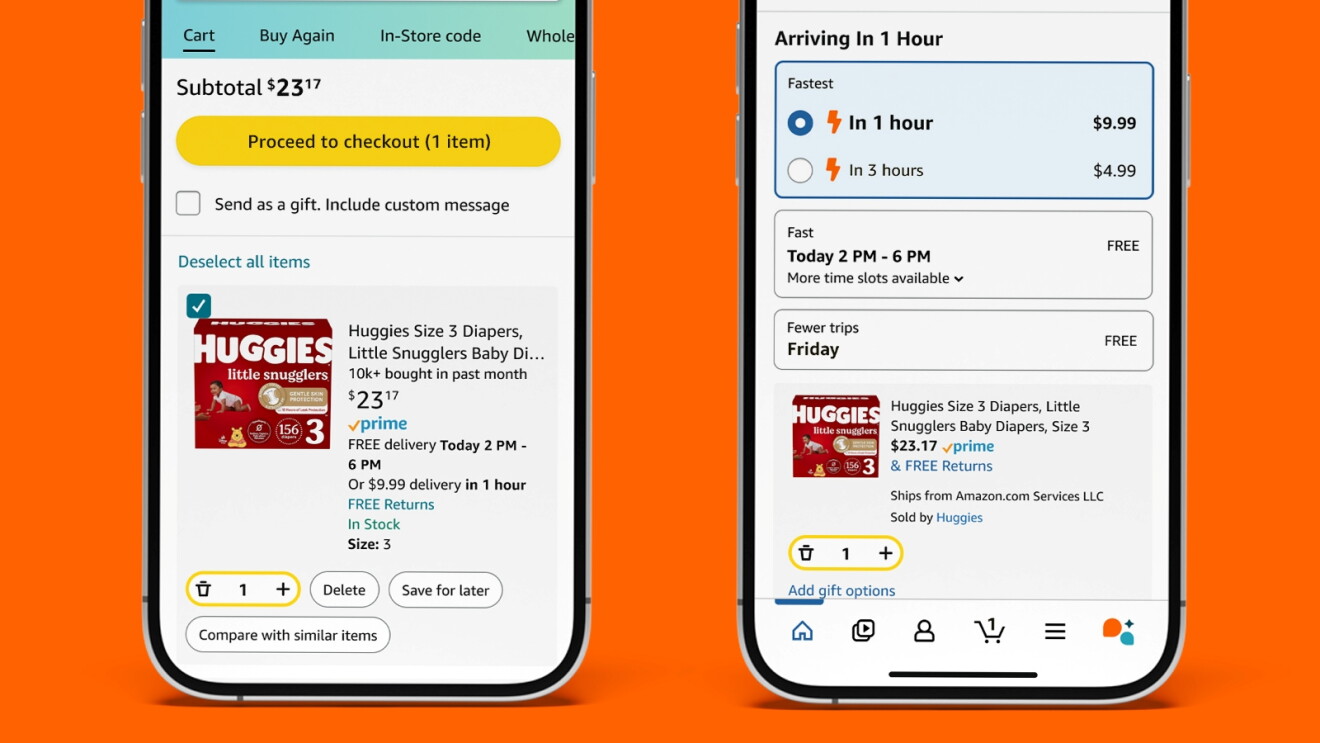
Of course, you need to be near a fulfillment center for stuff like this.
I recently bought a baseball set for one of our kids. I wasn't convinced about any of the sets on Amazon, so picked what I thought was a better alternative, an actual sports retailer which had an online shop. I had to pay for shipping, but I figured it might be worth it.
Ordered around lunchtime on a Tuesday, think they shipped it Thursday, it arrived Monday. Is it just me, or is this fairly meh service?
This is why they offer (at least in my case) free trials (worst case scenario: 3 months for 0,99€) year long.
Black Friday predates Amazon by decades, by the way.
But Amazon has gradually expanded the definition of what Black Friday means ... first with "Cyber Monday" ("BFCM") and then to a huge chunk of the month of November.
Last year, it was 10 days long.
for me, its almost completely: tools that will make something slightly easier or are so much cheaper (e.g. large SDS+ core drill bits), misc cheap hardware/parts that are too specific to reliably find at Lowes/HD/etc...
Nick nacks. Shirts. Household supplies (that's fine), anyway at my house about 1/10 purchases are generated by me. And many of my male friends commiserate to similar. Plus I see the trucks... And stacks of boxes at neighbors doors so I know it's similar even outside my domain of personal knowledge.
I went back in Amazon history until I found the first bit of "junk" I bought (the 3rd thing I bought period, reverse-history wise).
Household: 32
Random junk wife bought: 14
Random junk I bought: 1
The household category is mostly kids' stuff (diapers for the growing baby, underwear for the growing toddler, etc).
So my wife definitely buys more junk. She also definitely buys more real household goods. The ratio of needed things to junk is similar between the two of us (2:1).
I definitely purchase some actual junk. I also purchase stuff that I could imagine someone else would categorize as junk. e.g. I bought some cheap squeegees for our vehicles. This was not an impulse purchase (researched and debated this for way too long) and I don’t consider them junk. But objectively they are cheap junk, just cheap junk I needed.
Is that junk spending? To me, it is superfluous. But every time I look at it I think, man am I glad to have that lamp in my living room.
Males can be pretty spartan with their quality of life choices. If it were me I'd order fast food every day because of convenience and cost. But sometimes you have to let your partner elevate your standards even if you don't have those standards yourself.
So my wife spends a lot on amazon, but its probably not a lot compared to her own standards. She is likely proud that she can west elm wife but on an 80% lower budget.
Consumer goods is a mature market, there's targeted audiences personas for every spending level. If you factor in quality of life as well as cost, IMO Amazon has the best cost for value ratio.
Your comment pretty much just says you married someone with a shopping addiction, and your friends (unsurprisingly) are similar to you and marry the same type of people as you.
Sitcoms also consistently show that men are fully incompetent so maybe don’t try to cite them as evidence of anything in the real world.
> WIVES
I don’t know. I see lots of guys who buy lots of crap. Anecdotally I also see men buy more expensive things even if the count of things is smaller. “I definitely need to purchase this high end tool for this small task.”
Guilty as charged. "Buy once, cry once!" A really nice tool does have a certain satisfaction, even if a bargain basement Harbor Freight tool will often be just as useful. Though I have to say, HF has stepped up their game over the last 5-10 years and has several lines of tools that are legitimately good. More expensive for sure, but very competitive.
If you have family members on the plan, all kinds of other things get ordered.
The next thing you know, Amazon deliveries are coming two or three times per week, and you realize you have a problem.
That makes me think, why do I always buy from Amazon before other sellers when prices are the same? It's definitely Amazon's UX. Its fairly fast and low friction. I only pull away when I can save money elsewhere.
The Amazon software will set my purchase to subscribe to Prime and then I have to scrutinize the order page to find an opt-out. A real Pain In The Ass! Every single purchase! This behavior drives me to shop other vendors, of course.
https://www.dw.com/en/a-pre-christmas-warning-cheap-toys-can... https://www.sciencedaily.com/releases/2025/11/251128050532.h...
I don't know what's up with people's consumist impulses (you're not the first one from who I've seen this argument), but I can guarantee that I do way less impulse-driven purchases with Amazon vs. "add $7.35 more for free shipping!" and the induced psychology of "well, at this point if I don't buy that I'm losing money".
Being forced to plan has definitely reduced my spending.
I find waiting a bit also helps me avoid buying things I ended up not needing thanks to finding a workaround, etc.
I basically use AliExpress for 90% of what I used Amazon for, it's cheaper and I like the excitement of waiting for stuff. For everything else I wait for the free threshold to fill up, like you. It's good to be disciplined.
Agree. The irony is I didn't do this because of the shopping experience, it was when they added adverts to their video service. They tried to squeeze an extra dollar of "money left on the table" and have instead lost thousands from me alone because of it.
I subscribe to tons of streaming services, not just the big ones like youtube, netflix, disney, spotify etc, but little ones like paramount and some wierd anime one. Amazon though is the one thing I don't do.
Walk into any store (JC Penny etc) half the items are on sale. Even groceries - go to Safeway, there is a newspaper style coupons - multiple pages. This whole thing is just bizarre and tiring.
20% Off! 8€ instead of 10€ (lowest price in the last 30 days: 5€)
and you know it's a junk sale.
Yeah, I think it made things even worse after companies learned how to play with this. Somebody managed to lobby such a short number of days? Should be year. Now it gives false sense of credibility that the sale is legit, while they just bumped the prices 2 months ago. Very easy to see in price comparison. e.g. close to Black Friday. They keep increasing prices so that they reach the highest price around 30 days before Black Friday and then give "credible" big sale.
The alternative feels absurd: "hey let's raise our prices above what our consumers consider acceptable and lose 2 months of sales, just so in 60 days we can convince them with a nice-but-not-really discounted price!"
For a lot of products, the only sales that matter are around Big sales event (Black Friday etc). Theo other days, nothing is sold. So it's easy to raise prices if they sell very little anyway and they wait for the big sale event to become "black". Basically have a profit.
Agree that’s a fucked up society but they play by the rules.
I work for a big retailer in the US and I recently saw that we also have to disclose price history as well. However, we were engineering ways to still optimize higher sale prices. I think a year should be minimum, but then of course everyone will just change the SKU (which is what they do Black Friday too).
Given the number of directly competing products, I wonder if this is true. Often, you are not buying "a thing from Amazon." Amazon is the fullfillment. Amazon is acting as a warehouse and logistics machine. In theory, as Amazon is simply acting as a storefront for many companies, at some breakpoint the higher volume of sales at a lower price and increased consumer confidence that they are getting the best deal possible (and thus likely to buy more in the future) would offset the lower price paid by the consumer on each individual sale.
For a while now I have been sticking to the rule that I buy nothing from Amazon that is not ships from & sold by Amazon. It avoids most, but not all of the worst issues people have with Amazon purchases.
Them buying Whole Foods made drop off more convenient (than UPS, which was convenient!).
Customer review quality isn't as good as it was "before", but it's world's better than the next best storefront I'm likely to browse. The internet/Reddit/Wirecutter do the heavy lifting of curation, and low-effort returns means a low-stakes trial for anything.
I also believe they are best website anywhere for cramming a ton of information onto the page but also maintaining intuitive navigation (I've been using Amazon a while, so maybe it's just familiarity. I've heard like phpBB, so you can get used to walking on Legos I guess).
State laws are more specific. Oregon, for example, specifies 30 days, but they do not require notification of the lowest price in the previous 30 days.
I see those a lot here in Brazil. Sunscreen vs Sunscreen + free carrying pouch. Detergent with 350 ml right next to the “275 ml + free 75 ml” SKU. I’m pretty sure they’re skirting some law, but I don’t know which.
Technically model 20261116 has never been sold before and is on sale for $10. Please ignore that model 20261109 regular list not on sale price was $9.
It dovetails well with shrinkflation, make the product 10% smaller and lower the price only 5%.
https://en.wikipedia.org/wiki/Ron_Johnson_(businessman)#JCPe...
I wonder how much of that was conditioning customers to believe something that wasn't on sale was a bad deal.
People don't have an "actual price" database for many items in their heads, so we have to make decisions based on heuristics. One valid heuristic is: "everything at this store is marked up 2x, so if it's not at least 50% off, I'm getting ripped off." It's really hard to get people to change their heuristics, and it takes a long time (time which you may not have).
And I have an anecdotal experience: I went to a JCPenney for another reason, and on impulse grabbed some socks I needed. When I got rung up, the socks were unexpectedly expensive. The clerk said they weren't on sale this week so they were a bad deal. I abandoned the purchase.
Yes, JCP products are completely different than Apple products.
An iPhone is an iPhone regardless of you buy it at Apple, AT&T, Target, or Amazon. So people know exactly the actual product and price.
But clothes look all the same even if their quality is dramatically different. People struggle to tell the difference between name brands and store brands even when they can physically inspect the product, and most stores have their own unique sub-brand that cannot be compared to any other products. This is why fast fashion and eventually drop shippers like Temu have been successful.
This has also been happening for a long time in the mattress and TV markets, where no one can compare prices and "look and feels the same" becomes "basically the same".
I would be a customer of Johnson's version of JC Penny, but not of the one that is built on coupons and pricing games. But I don't shop as a hobby, so maybe I'm not the target market for any retailer.
I hate shopping. I just want to buy the same plain clothes every time and not worry about timing my purchases to sales or what combination of products qualify for a discount. As someone who needs tall clothing, it's usually a miracle to actually find things in stock and JCP actually had a good big and tall section.
Big ouf of a quote.
Shopping and “deal”-hunting are fun activities for many people. It can be social (go with friends, or tell them about your favorite shop/product), self-expressive (show your discernment or imagination through what you buy), exciting (a treasure hunt), soothing (a familiar, structured process).
And why not? Shopping is how we discover the economy, one of the most mind-bending social structures there is.
Yet I, like you, find shopping tiring. Too many objects, it’s hard to find what I want, I get paralyzed trying to do price per unit weight conversions between ounces and grams, I get cynical about the “deals,” and everything starts to look the same to me. My hobbies are mostly centered on technology and information, and mostly require a few big deliberate occasional purchases. Books, gadgets, or subscriptions to data sources and digital tools are probably my biggest impulse purchases, and they can add up, but the shopping itself doesn’t take up much of my time.
My wife is the opposite. She’s a cook and loves to grocery shop to pick the best produce or find a new ingredient to try. She will spend 45 minutes searching for a new restaurant, and spends lots of time on instagram (half ads) or Facebook Marketplace. She loves going to farmstands because it feels like a discovery, and uses deal-finding apps not just as a way to feel like she’s saving but as a way to add a “side quest” (as we affectionately call them) to her day. She has various tangible hobbies (plants, crafts, pets) all of which require material inputs. I benefit from this because she adds a lot of beauty to our home and variety to our lives that I know from experience I won’t manage on my own. But it has also required communication to figure out how to get us to budget better and not turn everything into a shopping excursion.
There's also legitimate times when items are discounted for 1-2 weeks a year, or items that get discounted every quarter, or items that are routinely discounted at the end of a season. If you are willing to delay purchase until they are discounted then you can get additional savings. Often times these discounts are predictable, such as brands often offering Black Friday discounts.
It depends on what you buy, and where you buy it from, but there are legitimate deals out there. I probably save about $1000/yr total in these sales just by asking ChatGPT how frequently a brand has sales and then leaving the items in my shopping cart until the next sale.
It’s really unfortunate the lack of good faith pricing nowadays.
I recently just went to one of their (resurrected) stores and the overhead banner was a blown-up copy of the coupon, so they know their target audience.
I just backed a tennis ball machine that was offered at 55% off intended retail price, only to find it was listed online immediately after the campaign for the exact same price, and I felt betrayed.
Watch start-ups are notorious for this. They'll post insane original prices to make the watches appear higher quality, and like they are playing in a different market... these are almost always cheap watches from China that should cost $50. No one ever pays the original price, and no one should. They shouldn't even pay the listed sale price.
I dunno, maybe everyone is doing it because they have no choice? If every store in the shopping mall is doing it, then what choice does a new store that just opened in the same mall have?
Or maybe nobody in management positions who make these calls want to even try something different? Afterall, we are in an age where most people in management don't think beyond the next quarter...
I personally hated shopping there, because if I wanted a pair of shoes, its like a casino, roll the dice could be $159 this week could be $39 this week, who knows? This lured in another demographic subpopulation who really enjoy gambling, and bragging about their wins while not mentioning their losses ...
There's only one number that actually matters at the end of the day: the price. And that number is very straightforward to reason about if you've paid attention to what something has cost (even in that Microsoft website example).
It's not like we're buying brand new categories of stuff all the time. Shady discount tricks on the internet have been around for 15+ years now.
Apple has, for many years, done “back to school” promotions in late-Aug/early-Sep. These are legitimate deals with the student discount and a gift card or free item on top of it. However, these promotional periods very frequently happen less than a month before new product announcements and spec bumps in late-September, so they’ve effectively dumped soon-to-be-outdated inventory on students under the guise of a deal. It’s a different sort of scummy behavior.
It's hard to argue that maintaining that resale value is scummy for the students who bought on discount when they get a job and want to upgrade. (Recently Apple even raised trade in values within the same cycle, while the new price didn't go up.)
Perhaps this is a frame of reference short term versus long term thing.
Not just jacking up prices and having fake sale prices (they do that year round) - but a specific pattern to throw off naive URL or SKU based price trackers:
They delist old models, and add them back in, sometimes with different model names, but the same specs. The week before the big sale, there were hundreds of delistings, and the average price rose nearly $80 - so that the $50 off becomes an increase.
https://minipcs.zip/aliexpress-11-11-pricing-tricks/
I've been tracking Mini PC prices on Amazon for months now and am excited to see if the same pattern repeats for Black Friday. (There's other weird patterns on Amazon, such as listing the same PC 10 times with different prices, all from the same seller, I guess to profit from consumers who don't research much?)
The only method I’ve found to work with Aliexpress is to add each item from each vendor to cart and get all the way to checkout to see what the real price will be. It’s a lot of work, and then I discover they all end up about the same price with discounts factored in and feel stupid for getting tricked into playing their game.
Recently I had a—I forget what it was called—sort of "first item" discount. I was ordering three different items from one storefront, but only one would qualify for the discount, and the discount varied per item. How it determined the eligible item was based on which was added to the cart first.
I had to remove the less expensive products until the highest discount one remained in my cart, then add the others back, for the maximum discount.
Was able to find some similar deals on slick deals and that was useful as a second point of comparison
Both of these are probably either costly to implement or difficult... or both, but:
- A way to see price over time for a particular SKU.
- A way to filter by dimensions/size/form-factor
The second point is what had me shopping around this past 11.11. I was looking to buy some more of the _super_ tiny "cube" form-factor PCs that I bought a years ago. They are maybe 4cm in each direction and _sip_ power. At least a few years ago, 8 gig ram, 128 gig ssd, intel N5015 all for $99.00 shipped. Prices will have gone up, but a super efficient x86 die with some ram and basic ethernet is all I need for some small clustered workloads and it would have been awesome to get some of the super micro nodes but I was struggling to find any.
Thank you again for that site of yours :)
Currently working on adding this - particularly across stores, so you can see the lowest Beelink SER9 price across all stores at once. Just tricky to make sure the data is clean enough to do that reliably.
> A way to filter by dimensions/size/form-factor
That's a great idea! Definitely harder to find exact specs for that, I already have a hidden heuristic to classify the small Lenovo/HP/Dell thin client machines as 'small' not 'mini'. But within the mini category there's a large variety of form factors.
Chinese sites like Taobao (amazon of China) have been doing that for many years. I remember when 11.11 first started (we were living in China at the time) and for the first few years you could find really good sales, and then after that it ended up being not worth it to shop on 11.11 anymore as the discounts were a sham or worse
Just like most consumer protection laws in the States, the answer is obvious and trivially legally enforceable. Simply define a sale as lower than the average price of the item as a period of time, then enforce it.
Frequently disgruntled customers will leave dozens of one star reviews on a seller's entire product line because they didn't like one single product. Arguably competitors of that seller could be doing that too. There's nothing to stop them. The reverse presumably works too and many defective products could be getting shady five star reviews. Allowing only verified purchasers to review products and deleting all unverified purchaser reviews would go a long way towards fixing things and re-establishing customer trust IMHO.
It also started to became meaningless in many contexts, for example in Poland the 2 main supermarkets started selling butter for much lower price if you buy a 3-pack - it turned out, that barely anyone buys it outside of the sale. So the sale price became the actual price we care about.
Germany had lower prices in general but if you stuck to sale prices, Austria was cheaper. The thinking is that Germans will recognize a more expensive store and not go there again even if some stuff is cheaper sometimes. Austrians are unconcerned and if they are price sensitive will buy what's on sale and just wait (and if they're well to do then they can have a different experience in the same store of just buying what they want when they want it).
Hence the failed JCPenney straight forward pricing experiment:
https://time.com/archive/7101886/why-jcpenneys-no-more-coupo...
One of my resolutions this year is to always search for independent sellers (online or brick and mortar) to compare before buying products on Amazon. In nearly all cases I have found a webshop with a better selection and a lower price, even after paying shipping.
So you have to be REALLY sure that you want that product and/or be ready for the hassle of trying to get your money back.
Credit card companies are also not nearly as ready to back you up as they used to. So when the store violates its own terms, you’re going to have to go through a whole process to “prove” it to the credit card company.
So much hassle, I still try here and there but that’s what steers me clear of smaller shops.
Unfortunately this is starting to filter in on Amazon too. So now I need to look for sold/shipped by Amazon to make returns easier.
Especially in Canada for me, other online options often are terrible compared to Amazon. Often even when a company has their own website for their product, it will still be much cheaper to buy it via Amazon. And when I buy their product via Amazon, I get all the added protections that you're talking about like the easy refunds.
I've ordered when I can on websites that are not Amazon, and it has burnt me in some cases. Even if a website offers a refund policy, a lot of the time you're also having to at least pay the shipping cost to return the item. Which is on top of the shipping cost you already had to pay to get the item.
Overall the experience is often just worse. More expensive shipping, slower shipping speeds, slower processing times before the shipping, no support for pickup points, etc....
Approaching Christmas, one may buy an alternative gift, delay the decision up to the 25th, then return (or not) the item not gifted. That's likely the whole reason why Amazon makes the return window larger in the Holidays. If you don't return it, out of laziness or from not wanting to part with it, the policy results in you having bought more than you otherwise would, to Amazon's benefit.
Also most things you can find on AliExpress for cheaper. Don't do edibles, beauty products etc though. I limit my purchases to tools and electronics
Is it not possible outside ?
CamelCamelCamel is controlled indirectly since it is only allowed to do and report as Amazon permits it via what it does and does not provide in its data feed. Amazon's API does not update in real time or provide all data points. Flash sales, Lightning Deals, and rapid algorithmic price changes often expire before the API refreshes for its inclusion and Camelcamelcamel then actually misses the lowest prices. Amazon's API usually reports the price of whichever seller currently holds the "Buy Box" which its current in court for manipulating via multiple means that may not be legal in various jurisdictions let alone ethical. The exception just pile up here…If Amazon runs out of stock and a third-party seller takes over at an exorbitant price, the chart will show a massive price spike even though the item's standard retail price never changed. The Amazon API reports the public base listing price, and never captures "clippable" green coupon boxes, Prime-exclusive discounts, or checkout promo codes. Third-party sellers frequently delete an old listing (swapping the product altogether) and create a brand-new product ID (ASIN) for the exact same item. This wipes the price tracking history from Camelcamelcamel and starts a new tracking item. Sellers can often edit the "List Price" or "Was" price field on a product, which can trigger inflated MSP price. Marketplace are always messy, but I think we will see that at this scale without adherence to its leadership principles, Amazon is going to find itself more regulated overtime to be more fair to all parties involved, as it’s unable to behave ethically independently and has repeated shown and displayed its inability to do so overtime.
The reason camelcamelcamel still exists is amazon gave them a special permission. Amazon affiliate program which allows CCC monetize their links does not normally allow for price tracking / alerting functionality without special permission from them, and they don't let you store information for more than 24 hours. Amazon API request limits are also pretty low, unless you can drive significant volume, and for a price tracking site, this is essentially catch-22. Without volume, the skus you can track are limited. Even with volume, they still cap you at a number i don't recall right now. They have banned my account as pricetracker.wtf was doing tracking/alerting and i wasn't fully aware of this restriction. I eventually got it unblocked, but had to criple/remove this functionalyt for amazon links, which essentially is the most important thing due to incidential purchases people make on amazon (ie people buy stuff from amazon every 1-2 days, so if they click on a link on your site, that's enough to get some sales from them even if it's not the product they bought).
There was so much I wanted to do on pricetracker.wtf but without amazon, and SEO, it's just not getting enough traffic to make it sensible for me to spend time on.
On the seller side, amazon has strict requirements on pricing, and expect you to price lowest on their platform. You may have direct sale web site, with significantly lower cost, but amazon does not normally let you advertise lower price elsewhere. I follow a seller (creator of brainflakes that you may know) on twitter, he brought this topic up a few times: https://x.com/Molson_Hart/status/2118617556152156408
Overall, amazon is enjoying being a large platform, that's for sure.
I don't believe it gives any price history related to third party sellers or the used markets like these other services do, however I personally have found that I almost don't even need 3rd party tools now.
and the fact they not only still exist, amazon shows the exact same graph as them, is suspicious
https://affiliate-program.amazon.com/help/operating/policies...
https://affiliate-program.amazon.com/help/operating/policies...
Often time (not always) as part of joining an affiliate program (like target affiliate program on impact.com) you also get access to their data feed. The feed is usually daily, but sometimes more frequent.
Some others like Walmart + Amazon + best buy have their own api end points (even if they may be using impact for management). When they have an API, it tends to be realtime or close to it
Does that make sense?
And given how little traffic I get, I guess it doesn't matter!
Also, the products you find using this method is normally sellers selling that item at a loss or break even to get market share. That’s why the seller and product have little to no reviews.
The search tactics on Amazon are purposely misleading for consumers, and no technical glitches can explain the behavior as it is clearly demonstrating the intent to serve Amazon’s bottom line and not the customer in total purposeful violation of their “leadership principles” that they are clear violating systematic and systemically with seemingly no will to change unless regulations require it locally (which is not the case for protection of the USA consumer at least and has gotten worse under the current consumer protection which are not currently being enforced or protected).
Last but not least, if you attempt to search to correct the likely future illegal tactics, Amazon will start throttling search, not returning search, or changing over to a suggested AI search with no ability to get back to regular search display. I saw this not from one experience, but numerous overtime and it is getting worse by the month right now with no end in sight.
This goes along with their tactics to sellers on and off the Amazon platform which the ongoing and future lawsuits will show.
`then filter by price -> lowest first` - this method won't protect you from a historically high "low price" being presented as a special deal. "25% off" a newly raised "list price", that in a month might be back down to it's normal pricing.
https://camelcamelcamel.com/ helps - but there should be some kind of consumer guard in place here.
Now it's just used as a free advertising board. 50% of restaurants on there have fake deals, and 5-10% force a prix fixe menu that costs you more than you would have spent normally.
Any affordable distribution/marketing platform will get abused eventually.
It's kinda nice because it does help prevent some of this crap from happening as much in Amazon.
https://europa.eu/youreurope/citizens/consumers/unfair-treat...
I've randomly sampled ~ 10 items I'm interested in, and they don't show any price update around October. But they got -20% today.
Amazon.ca for me provides a price history option and I can see that they are as cheap as they ever have been right now. However they do also very often dip in price. They only briefly for maybe under a month were at the regular price and then prior to that it looks like were 25-30% off.
I see this a lot on Amazon where the prices of items go up and down a lot on some items and I'm not really sure why. In the last year these headphones had now 7 price dips. This is the lowest dip, so I'd say they are somewhat faithful to the black friday sale pricing?
It's the after effect of dropshippers who popularized this kind of cheap, solo entrepreneurial e-commerce and the factory owners realizing they could cut out the middleman. The quality you get is a total crapshoot - either it's an imitation in similar housing with much worse parts or it's very close to the original spec, you just never know [0]
[0] https://www.modernretail.co/retailers/the-rise-fall-and-pote...
Most of Amazon brands appear to be ephemeral and I really think you're giving them too much credit.
For the brands that seem like they're trying to be Western with names like Zorslesy (or BaseUS or uGreen, for eg), sure, they're probably not initialisms. They probably have at least one marketing person or exec who trained at a Western university who was tasked with generating a brand name that made sense. And not all unknown brands are Chinese, of course. Just most of them.
edit: your second example, QFEISETH, is named similarly too: https://thepatentplace.com/iplibrary/trademark/99232875/
The anglicized name used for USPTO is "Zhongshan Qifei Daily Products Co., Ltd." QFEI is obviously Qifei and SETH is probably another fun anglicization tack-on that only makes sense if you're ESL.
I bought a 15$ music CD sold and shipped by Amazon. They sent me wrong CD. The listing says it's the edition with a bonus track, but they sent me the edition without a bonus track.
I'd like to have them send me the right item, so I look at the return process on the website, but there's no option for "you sent me the wrong thing"; the closest is "the item is defective", but that option specifically says they'll send me the same item after they recieve my return, which is exactly what I don't want. There is no "something else" option.
I look for a support email where I can make a request with the full details. The support website is a labyrinth, and there is no support email.
There is a chat option, so I use chat support and explain the situation. The support person says I have to wait 48 hours after recieving the item to begin a return, I point out that's contrary to Amazon's return policy. The support person doubles down and refuses to start a return.
There's no support phone number, but there's an option to request they call me. I make the request and am called by an automated phone system. It eventually connects me to a human support person. I describe the problem to the support person over the phone, and he redirects me to a different support person. I describe the issue again to the new support person, including that the "defective item" option on the website says I'll be sent the same item. He explains that he cannot resolve my situation, so he reccomends that I file a return through the website with the "defective item" option anyway, but he can't guaruantee they'll send me the right item. He never mentions the supposed 48 hour cooldown period.
I file the return through the website, and drop off the item for return shipping the same day. A month and a half later, I recieve the replacememt item. It's the same wrong item.
I request another callback from Amazon again the next day. When I get to a human support person, I explain that I was sent the wrong item, then sent the same wrong item again as a replacement. I'm transfered to a "specialist". I confirm that I recieved the wrong item and replacement again. I'm told I need to upload a photo of the wrong item to a link they will send me by email. Immediately after the call, I take a photo and upload it at the link.
12 days later, I haven't heard back. I request a callback for the third time. I explain the situation, and that I called 1 or 2 weeks ago and submitted documentation. I'm told a return is the only option; Amazon will not send me the item I ordered. I double check that there's no way to have the correct item sent, since I just want the CD I ordered, and the support person confirms it's not possible. The support person opens a return, and I drop the item off for return shipping the same day. 12 days layer, Amazon refunds the money to my account.
Overall, the process took over two months, a chat session, three phone calls, and Amazon paying for shipping both ways two times, all for a 15$ CD, and in the end the problem wasn't even resolved. Any sane company would have resolved the problem on the first contact with support with a simple "oh yeah, oops, we sent the wrong item. We'll send you the right one." I have not ordered anything from Amazon since.
If you're in rural America, you get screwed with week+ long delivery estimates and deliberate in-warehouse deprioritization. I can't even pay for overnight or two-day shipping even if I wanted to, I'm stuck with "standard shipping". Even with Prime. Early Prime, they paid for the two-day shipping to get shit here. Now, they tell me I should be watching Prime Video instead of buying things (including with letters nagging me for not watching anything on Prime Video).
Meanwhile, Walmart's own Fulfilled by Walmart system has orders picked in less than thirty minutes from when I slap the checkout button, and the FedEx box shows up the next day.
About a decade ago, the state I live in used to have a "sales tax holiday" where, for one weekend, they would waive sales tax.
What all the retailers did was stop having sales for that weekend. Everyone still came, even though the normal sales usually took much more off than the tax savings.
A 10% restocking fee, plus a bunch of stupid questions. It should be illegal to charge a restock fee unless you disclose that to me when I buy it.
I’ve never been charged a restock fee with Amazon. In fact I recall assembling a table wrong, and simply telling Amazon.
They refunded the whole cost as store credit.
Buying online has way less friction than going to a store and arguing for 15 minutes about what I really need and turning down financing options.
RIP retail, not sure if I miss you or not.
"2 out of every 3 shoppers got savings"
and
"9 out of every 10 offers were cheaper"
which makes me wonder what the article is screaming about. It certainly doesn't sound bad at all.
The hope (and result) was that you'd find an amazing "deal" that enticed you to buy at all and once you had that in your cart you'd stick around and see what else we had to offer.
So... keep pervasive cynicism at bay as best you can, folks. :)
I later learned that $0.50 was the standard price for a single taco.
My local petrol station though sometimes has deals on say £6.50 wine like '2 for £14'.
https://en.wikipedia.org/wiki/Third-pound_burger#Marketing_f...
It seems those store liquidations are a giant scam. They seem to work though as the store was picked through.
Except tower records, I got some good metal shelving from them.
IIRC, liquidations are handled by an entirely separate business from the original store operator. I believe one of the first things they do before starting is close the store and reprice everything higher (like to MSRP). Those "50% OFF, EVERYTHING MUST GO," prices aren't relative to the store's typical price, but the liquidator's initial price.
See also, the slop from the horse's mouth: https://hilcoglobal.com/perspective/how-gob-and-store-closur...
It attempts to be a damning report, speculating that many households are waiting for holiday sales to afford necessities due to inflation. However, while they are quick to point out that their own data shows nearly 1/3 of the items researched were the same price leading up to the sale, and that about 1/10 of the items were priced higher, the corollary is that 2/3 of the items were truly "on sale" as described. They also did not differentiate between items sold by Amazon and those priced by third-parties through marketplace.
So customers still have to do their own price research (as always), and trust me I have MANY gripes about Amazon, but this is far from an obvious scam.
EU demands that all discounts show an anchor price that is the lowest price for that item since at least 30 days (https://europa.eu/youreurope/citizens/consumers/unfair-treat...).
Seems practical and sensible to me (not perfect prevention, but causes lots of delay, and going "against the spirit" of rules like this is somewhat legally risky, too).
That is, how can a customer use this to distinguish between (1) an item cost 100€, the seller raised it to 130€ and then offered a sale at 100€; (2) the item originally cost 130€ and the sale brought it down to 100€.
It's not a panaceum, but it introduces enough delay to curb the worst offences (e.g. weekly/biweekly "sales", or absurd price hikes days before a "sale") that used to be common in the past.
In the EU, the law is that advertised discounts must use the lowest offered price from the previous 30 days as the reference price. That seems fairly straightforward.
I'm the cofounder of PriceLasso.com a price tracker for 250+ online stores, and we see stores increase prices a few weeks leading up to big sale days only to drop them to the original price and call it a sale.
Checking price history is the only way to fight back.
This analysis focuses on the top 50 promoted items on BFCM, which means we're talking about massive sellers from massive brands like kitchenaid, bose, ninja, etc. So maybe those huge brands get special treatment around these rules. But for joe shmo small sellers like us, the discount policies are strict and real.
Considering the insanely huge number of SKUs sold on amazon, drawing such broad conclusions from such a tiny data set is irresponsible and clearly for clickbait purposes. Their analysis uses Keepa data, the most famous pricing data aggregator. They could have easily broadened their query to the top 10k or 100k skus with minimal extra work.
I say all this as a small seller who's planning to de prioritize amazon because we just can't make a meaningful profit on the platform. So I have no love for the platform and agree with the criticisms of its buyer experience etc. But this article is so highly misleading it only serves to destroy the credibility of its authors.
So when Amazon (or any other shop) says "20% discount" it's easy to spot that the 20% discount is related to MSRP and that the product is regularly discounted 15%, therefore the actual discount is just 5% more and not a whopping 20% over the regular price.
The Groundwork Collaborative is a Washington, D.C.–based progressive economic think tank, strategic communications hub, and issue advocacy organization founded in 2018.
"change economic policy and narratives to build public power, curb private power, and create an economy that works for all of us"
Who's us? When did we sign up for this? Why are we included?
Who's masquerading? "lobbyist" and "think tank" (progressive or otherwise) are synonyms.
For big business brands like Costco or Walmart, not so sure. They have stable income and they can issue investment grade corporate bond, so they don't need to use black Friday as a marketing gimmick, they could do this all day every day if they wanted. It's just the cost to acquire customer is different and they have the volume to amortize the cost
I don't care so much, I'm not in any hurry with most of them. I'll just bide my time. The black Friday thing is something we don't really have much with here, it was the retailers that tried to promote it, bringing it over from the US. Same with the Chinese singles day and others. But it's not a big thing for us here.
This isn’t a new accusation. Amazon started addressing this very concern some time ago.
It does have a limitation that I don't believe it is including any third party sellers or the used options like some other services do. However at least for my use case I don't usually care about that info anyway.
Latest example: I bought a Calibrite ColorChecker Studio spectrophotometer. Amazon suggested that a photo camera calibration target is a good addition, and offered a Mini ColorChecker Classic Target as an additional item to buy. I did so, without knowing that exactly the same target is included in the box. Now I have two.
- Speed indicators in cars are systematically biased to overindicate speed (just compare with phone/satnav).
- Assuming a certain "acceptable risk" threshold, the "correct" speed limit obviously depends on traffic, road, vehicle and driver condition. So if conditions are exceptionally good (and/or your risk tolerance above average), exceeding the limit might make sense.
Not really. They put up a basic speed measurement system and sample the range for a time and then find the 85th percentile and that’s the new limit.
So the speed limit is a function of how competent or, rather, in competent most drivers are in that area.
Washington state is similar, except a city can have a 'comprehensive speed plan' to set limits however they want, no survey or other engineering required.
I had not realized there was a significant deviation from the international standard of following the physics and regulating for pedestrian safety in setting speed limits. At 50kph/30mph a pedestrian has a high potential for fatality when struck by a vehicle, while at 18.5kph/20mph has a roughly 90% chance of surviving. I wonder how this 85% percentile decision effects the outcomes of pedestrian collisions where the 'herd mentality' approach is used.
I much prefer Australia's "over is over" scenario.
People think they know how fast they can drive safely, and they tend to drive closer to that speed than the speed limit. They often fail to take into account a lot of the factors, like children that might run into the road or blind streets, when they do so.
Depending on your car model, the odometer may significantly over report your speed by even 7-10 kph around 80kph! So when you’re going “78” the car behind is pissed you’re going 70 in the 80 zone.
It seems US odometer calibration is more accurate as the leeway with speed limits means there is less risk of an odometer under reporting 1mph
US federal requirements were always pretty tight for odometers, but speedometers used to be essentially required to read significantly fast (IIRC about 10% faster than you were traveling). Modern US cars tend to have pretty accurate speedometers though.
Some things are a good deal but lots of stuff is just 30%+ more than what it would cost at a local store or other online retailers.
Oddly it makes little sense at times why some things are a lot more and others are cheaper. With its logistics network Amazon should be able to offer the best prices, but it’s definitely not consistently the best price. Not even close.
A lot of this is driven by FBA stuff that’s just folks reselling stuff at a markup on Amazon. It’s a double whammy of higher prices and search results full of 90% FBA junk.
Amazon also used to stock a lot of off-price or liquidated products back in the early days of Prime - as they've scaled up those days are long gone
Do you have evidence that supports this claim? I don't think it's true. Black Friday is the start of Christmas shopping on a day that many people have off due to the 4-day Thanksgiving holiday. It was not about "clearing out old inventory", it was the kickoff to selling all that new Christmas gift inventory.
If you want to buy something, use a price search engine and research the market yourself to get a good price.
It sucks. :(
Whether or not a slashed price is actually a lower price has been debated for a long time, I don't find this "research" groundbreaking though it does help confirm some hunches.
I did find it fascinating that this news site hyperlinked itself within the first sentence of its own article.
Who allows that?
Amazon explicitly https://sellercentral.amazon.com/help/hub/reference/external... says it's against their policies and that they can penalize you for it.
They'll even enforce rules on your off-Amazon sales. https://www.theguardian.com/us-news/ng-interactive/2026/jul/...
There are consumer protection laws for this kind of stuff (usually some requirement of a product having to be at the "original" price for some length of time or some sales volume[1]), but retailers typically time their price changes and discounts to work around this requirement for peak sales periods like Christmas. If you catch Amazon actually immediately marking stuff up and down to create a fake discount you can probably complain to your attorney general.
[1] https://competition-bureau.canada.ca/en/deceptive-marketing-...
(I did find my regular pair of shoes in one of the Prime Deal Days; I basically always buy a pair at that time of year to get new treads for winter, and then wear them flat throughout the year)
As in, the prices for Amazon products, the article makes sense, but what percentage of the stuff on it is still Amazon? I assume (and, i do not know) that Amazon has some influence on the pricing, but not full control.
If you need it, and can afford to own it, buy it.
If you can’t, don’t let a supposed deal entice your purchase.
its just the new version of see price in cart
Amazon seems to have decided, on their MBAs infinite wisdom, that because of their return policy, there was no need to police the resellers, and they would behave, under the threat of being banned. What looked like a genius idea, let scammers and bad businesses roam free, since no manager has the power to enforce rules that drop revenue.
The result was that they destroyed the brand, and outside the US they lose money like hell. Amazon is only a success in the USA.
They retreated from China domestic e-commerce market in 2019 after its market share collapsed from 15.4% to 0.6% against Alibaba and JD.com. Amazon EU S.à r.l. in Luxembourg, reported consecutive annual losses for 7 years (from 2016 through 2022). It recorded its first profit in 2023 (€281 million), then dipped back into a loss in 2024 (-€291 million), and posted a €511 million profit only in 2025 what does not have recoup 2% of their investments outside USA for the last 10 years.
Ask anybody in Europe and they will tell you, they only use Amazon where there is no other chance of getting a specific product...
I’m not even sure I would single out Amazon for this practice. Fake markdowns are a tale as old as time. Just look at what happened when JCPenney tried to eliminate sales in favor of straightforward pricing. Customers hated it because they felt like they weren’t getting a deal, they weren’t getting rewarded for scouting out a “find.”
And also illegal in most civilised countries. In the UK, the claimed 'pre-sale price' must have been charged for at least 28 contiguous days in the past six months.
These days I’m buying a lot of tech off eBay and aliexpress anyway. Pricing tends to be better
I also find it counterintuitively helpful that so many of Amazon's deals are obviously not actually deals, and that so many of their products are so obviously knockoffs, because when I do find myself scrolling through a "Kitchen sale!" list in the app, it only takes a minute for me to realize this is useless and close the app in disgust.
Fuck amazon for doing that. Fuck amazon in general.
Also fuck uber for charing 'waiting fees' for the shitty taxi service, I'm not jumping into a moving car you soul sucking vampires, it needs to be stopped. Fuck uber in general tbh.
Isn't it more soul sucking to wait alone in a car for your customer who ordered you there and not get paid for it?
Everything was made to be more convenient for uber, not for me, and they took another 10% for the privilege.
Fuck uber.
[edit] on that note, fuck uber extra hard for raising prices on food delivery while taking ALMOST HALF from the merchant. This is parasitic behaviour where they don't care if it kills the host.
If you sell through them, you are not allowed to list your products cheaper than they do otherwise they delist you.
For those who wish to get off of Amazon, all it takes is a little planning or the willingness to go shopping in a physical store. It's no bed of roses for physical stores these days, but the reports of their demise have been greatly exaggerated. Malls are still alive and well in Canada. For things you need to order, don't expect overnight shipping. Plan a little further ahead.
For those who have decided to stick with Amazon a little longer... Do pay attention to the holiday price shenanigans that are about to take place. It's not just in your head when a book you swear you saw last week at $15 is now "on sale" at $40. Christmas is when Amazon becomes truly rapacious.
This isn't illegal. Every company does it. If you want to stop it, change the law. Most passive voters on earth.
Online retailers are about optimizing their profits at all times and cases, not what customers want.
People can simply not spend and it will get their attention.
Some years, theres no deals.
Inflation is providing enough boosts in profit that they might not care to give out sales to make revenue.
Retail is about creating profit, not the product.
However, deals now run throughout the year and prices are usually better on random days so it pays to hunt the deal sites or social media. Physical stores also have better deals and are the only authorized dealer for a lot of brands. Big hardware stores also have 2 hour or same day delivery which is amazing. And you’re guaranteed to not get fakes.